
Wordsworth Grasmere, including Dove Cottage, the Museum and the Café, will close early on Thursday 1 October, with last entry at 13.20 and closing at 14.00. We’ll be back to our usual opening hours on Friday 2 October.
The French Revolution
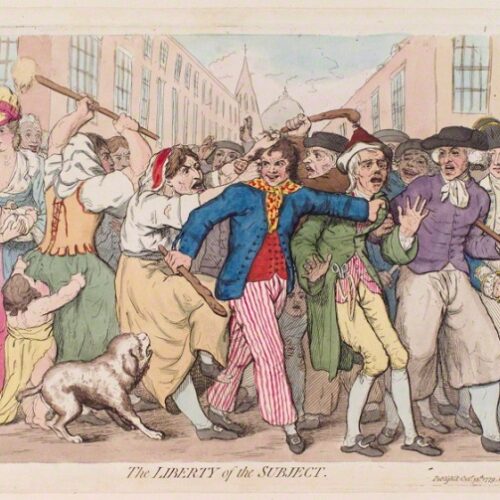
The Revolution began in 1789 with the storming of the Bastille, Paris’s notorious prison where those who were seen as a threat to the state were kept, often in terrible conditions and without trial.
This was the first time that the leaders of a movement had been able to mobilise the urban working class to rise against the establishment of church and state. The motto of the Revolution was Liberty, Equality, Brotherhood, and it stood for ideas such as social justice, personal freedoms, and the idea that there were inalienable human rights, which defied class, wealth or gender. Wordsworth supported many of the ideals of the French Revolution and to do so could be dangerous. To speak or write in support was a criminal offence.
In the summer of 1797, while living in Somerset, Wordsworth and his friend and fellow poet Coleridge, were suspected of being French spies, but a government agent sent to investigate concluded that they were merely a mischievous gang of disaffected Englishmen.
Some key poems

In the main outline, such it might be said
Was my condition, till with open war
Britain opposed the liberties of France.
This threw me first out of the pale of love;
Soured and corrupted, upwards to the source,
My sentiments; was not, as hitherto,
A swallowing up of lesser things in great,
But change of them into their contraries;
And thus a way was opened for mistakes
And false conclusions, in degree as gross,
In kind more dangerous. What had been a pride,
Was now a shame; my likings and my loves
Ran in new channels, leaving old ones dry;
And hence a blow that, in maturer age,
Would but have touched the judgment, struck more deep
Into sensations near the heart: meantime,
As from the first, wild theories were afloat,
To whose pretensions, sedulously urged,
I had but lent a careless ear, assured
That time was ready to set all things right,
And that the multitude, so long oppressed,
Would be oppressed no more.
But when events
Brought less encouragement, and unto these
The immediate proof of principles no more
Could be entrusted, while the events themselves,
Worn out in greatness, stripped of novelty,
Less occupied the mind, and sentiments
Could through my understanding’s natural growth
No longer keep their ground, by faith maintained
Of inward consciousness, and hope that laid
Her hand upon her object–evidence
Safer, of universal application, such
As could not be impeached, was sought elsewhere.
Was my condition, till with open war
Britain opposed the liberties of France.
This threw me first out of the pale of love;
Soured and corrupted, upwards to the source,
My sentiments; was not, as hitherto,
A swallowing up of lesser things in great,
But change of them into their contraries;
And thus a way was opened for mistakes
And false conclusions, in degree as gross,
In kind more dangerous. What had been a pride,
Was now a shame; my likings and my loves
Ran in new channels, leaving old ones dry;
And hence a blow that, in maturer age,
Would but have touched the judgment, struck more deep
Into sensations near the heart: meantime,
As from the first, wild theories were afloat,
To whose pretensions, sedulously urged,
I had but lent a careless ear, assured
That time was ready to set all things right,
And that the multitude, so long oppressed,
Would be oppressed no more.
But when events
Brought less encouragement, and unto these
The immediate proof of principles no more
Could be entrusted, while the events themselves,
Worn out in greatness, stripped of novelty,
Less occupied the mind, and sentiments
Could through my understanding’s natural growth
No longer keep their ground, by faith maintained
Of inward consciousness, and hope that laid
Her hand upon her object–evidence
Safer, of universal application, such
As could not be impeached, was sought elsewhere.
But now, become oppressors in their turn,
Frenchmen had changed a war of self-defence
For one of conquest, losing sight of all
Which they had struggled for: up mounted now,
Openly in the eye of earth and heaven,
The scale of liberty. I read her doom,
With anger vexed, with disappointment sore,
But not dismayed, nor taking to the shame
Of a false prophet. While resentment rose
Striving to hide, what nought could heal, the wounds
Of mortified presumption, I adhered
More firmly to old tenets, and, to prove
Their temper, strained them more; and thus, in heat
Of contest, did opinions every day
Grow into consequence, till round my mind
They clung, as if they were its life, nay more,
The very being of the immortal soul.
Dreams, books, are each a world; and books, we know, Are a substantial world, both pure and good: Round these, with tendrils strong as flesh and blood, Our pastime and our happiness will grow.

Imagination
Imagination
Nature
Nature

Relationships
Relationships

Society
Society
The French Revolution
The French Revolution
What is Romanticism?
