

by Gareth Evans
The old English apprentice system could be said to have had trouble built into it. Taking fifteen-year-olds into a form of servitude for at least four years, where their conditions were primarily in the hands of each business owner, was often a recipe for disaster. Pleasures such as free days, visits to taverns and play-going were circumscribed, with medical apprentices expected to have even ‘greater confinement’ than this. It is no surprise that the failure rate for long-standing apprentices was significant as they became increasingly resentful of their lack of financial and personal independence as they progressed through adolescence.
[The apprentice] is never ready to come until breakfast or dinner be half over; whether he seems totally absorbed in himself, or whether he is too talkative, and given to putting in his oar with an unbecoming forwardness, and having something to say on every subject started as if he was one of the company.
William Chamberlaine. Tirocinium medicum, London, 1812.
The last remark, quoted from a colourful account by a contemporary practitioner, indicates how problematic an apprentice’s social position could be within the household he lodged. For an adolescent as ‘spirited and unsettled’ as John Keats was, this must have been particularly galling.
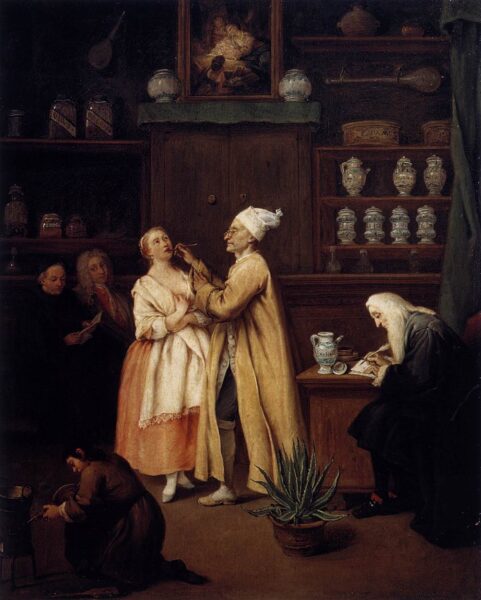
The Apothecary, Pietro Longhi (1752)
Keats was bound in an apothecary’s apprenticeship soon after he left school, aged just under fifteen. We don’t know many details of this period of his life but we do know that his apprenticeship was far from being an ideal one as his five-year term was cut short by mutual agreement. He had digs above the wood-panelled shop, or dispensary, on the property of his apprentice master, Thomas Hammond of Edmonton. Keats did, and always would have, a fiery side to his character, and whether related to his departure or not, as an adult he recalled an occasion when his hand ‘clench’d itself against Hammond’. This might have been a well-mannered way of saying that he shook his fist at Hammond. Read more literally, the clenched fist was the result of a sharp physical reflex made by an emotionally overwhelmed teenager. As the fist clenched itself, he was momentarily out of control. ‘Boy, that was a very big deal. It really was’ – may have been the reaction of a 20th-century fictional counterpart, the archetypal clever-but-troubled youth, Holden Caulfield, in JD Salinger’s The Catcher in the Rye (1951).
This is a time of personal development when we start to develop our own impressions and memories, some of which are gained from the act of reading. We should remember that this seemingly simple activity always had the potential to be a particularly intense experience for Keats.
As an adult poet it is natural that he drew on an adolescence that was stimulating in several ways, even if he probably didn’t think so at the time. But before we start investigating this, we need to explore some background.
The Backroom
Keats’s apprentice master was a surgeon-apothecary. This unwieldy title defined a hybrid practitioner that had evolved to fill a widening gap within the medical provision available to a burgeoning population. That Hammond was a member of the Corporation of Surgeons, rather than the Worshipful Society of Apothecaries, is perhaps an indication of how he saw his professional identity. It could be said that he aspired to the consulting room in preference to the shop. After his qualifying year at Guy’s Hospital, in 1815-6, Keats, like his fellow scalpel-wielding medical students, was also to be such an up-to-date practitioner. Indeed, the speed of change in pharmaceutical science was so rapid at that time that, by Keats’s death from tuberculosis in 1821, his knowledge would have needed a little updating. Nevertheless, and maybe as a result of the speed of change, much of the past still lingered, and was to linger, into the coming years. The late-historian Roy Porter memorably described the Regency materia medica (the substances used in the practice of medicine) as ‘a jumble of items and uses lacking unity, relegated to the apothecary’s backroom’. The apprentice Keats would have found that backroom an aromatic space, figuratively if not physically, as it was characterised by arcane inscriptions on old drug containers or within well-thumbed books.
Several publications could be our guide, including the contemporary pharmacopoeias which were published by physicians for the use of apothecaries. These were official documents listing, in cryptic Latin, approved medicinal substances and preparations. However, I have settled on the Edinburgh New Dispensatory as my source, which was published in both Edinburgh and London in 1789. The date may seem a little early for Keats, but the degree of correspondence with Keats’s texts is significant. A dispensatory was a hands-on book; ‘much more in practical use than the pharmacopoeia’. The Edinburgh Dispensatory was originally compiled by physician William Lewis, its first edition being in 1753. In the following one hundred years, it went to forty-one English language editions and twelve in various translations.
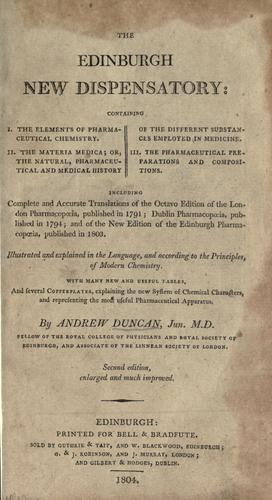
Where the pharmacopoeia is terse, the dispensatory is voluble, containing all that an apothecary may be called upon to make both officially and by custom, utilising commendations such as ‘elegant’, ‘agreeable’, ‘grateful’, ‘commodious’, ‘emollient’ and ‘beautiful’. The 1810 Encyclopaedia Britannica described it as ‘perhaps the most complete guide to the practical apothecary we have in any language’. It was not a high-minded textbook to be recommended to a hospital-based medical student but a valuable book for working apprentices, busy practitioners and, indeed, ourselves today.
‘The general virtues of unctuous substances’
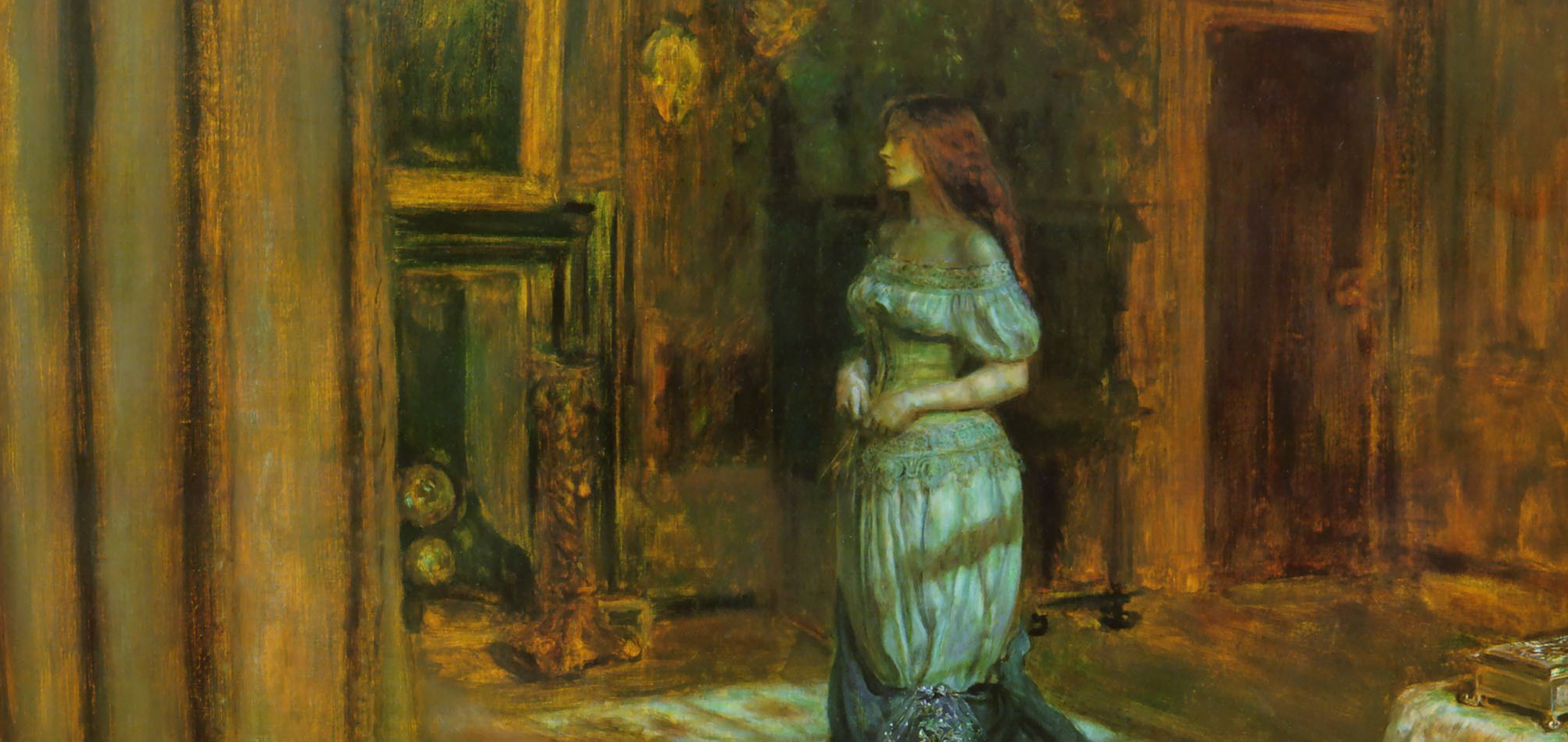
The Eve of St Agnes was written in 1819 when Keats was twenty-four. With its many references to the materia medica, stanza XXX of the poem has been long claimed as an apothecary-inspired creation, but perhaps not to its fullest extent.
 Here is a sequence of quotes from the Dispensatory which appears, unintentionally, to be a kind of heavy-handed ‘found poetry’ in the style of stanza XXX (each line is from a separate entry). It has associations of the aromatic, sensual, comforting and exotic. Think of it as a clumsy tribute act.
‘Syrup of quinces’ ‘Cydonia malus’ [quince apple]
‘The fresh root, candied … is said to be employed at Constantinople as a preservative against epidemic diseases’
‘Simple spirit of lavender’
‘… the plum and cherry … yield almost pure gummy exudations. From the ash is secreted the saline sweet substance manna’
‘[The gourd] possess the general virtues of unctuous substances’
‘It furnishes agreeable jelly with water, milk or broth, and is used in phthisical [tubercular] and convalescent cases.’
‘Where the complaint is more violent, this preparation [Alum curd] is the best external remedy.’
‘sweet pulpy [dates], the best are brought from Tunis.’
‘Where we wish to sweeten any mixture, at the same time add an agreeable aromatic, it [cinnamon syrup] is perhaps one of the best articles we can employ’.
If you are inclined to, do try the exercise yourself by following the link to an online version of the book at the end of this post. You may find antecedents of images from ‘La Belle Dame sans Merci’, ‘Isabella, or the Pot of Basil’, Endymion and the images of more contemporary pharmacy used in some of the 1819 Odes. You’ll find that reading the Dispensatory is a sensual experience, with unexpected associations: ‘The leaves have a more penetrating smell than any other mints, and a much warmer, pungent, glowing taste like pepper, sinking as it were into the tongue’. Haydon’s memoirs include a colourful anecdote of Keats covering his tongue with cayenne pepper, the better to feel the quenching coolness of a glass of claret. This is perhaps the bragging of a young man, but it has become a part of our perception of Keats.
‘In argosy transferred’
In the final stage of an international and colonial trade, exotic drugs characterised the long-established apothecaries’ retail business. When treating the poor, in the early 17th century, George Herbert advised against relying on expensive but familiar apothecary drugs, such as Chinese rhubarb and Armenian bole, in favour of simpler home-grown medicines.
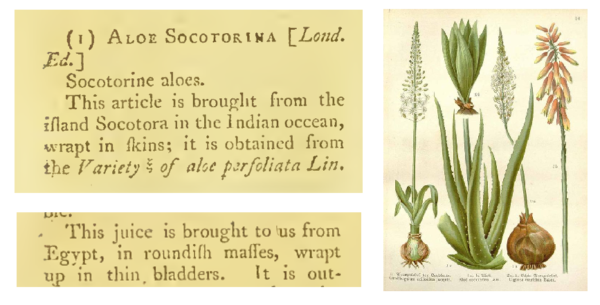 The lingua franca of this profession was the Apothecary’s Latin. In fact, despite recent reform, it was often a pseudo-Latin which could be improvised locally with names of very similar preparations sometimes differing from one pharmacopoeia to another (London, Edinburgh, Dublin etc.) At times, it is their names that Keats primarily drew on, giving easily gained, if loose, exotic colour. Folium Indium, or Foli Indi, (Indian leaf) from a cinnamon species that was anciently traded into Europe. If it had been finally committed to the backroom by Keats’s time this is of no concern for all he wanted were the words.
… pity these have not
Trac’d upon vellum or wild Indian leaf
The Fall of Hyperion – A Dream
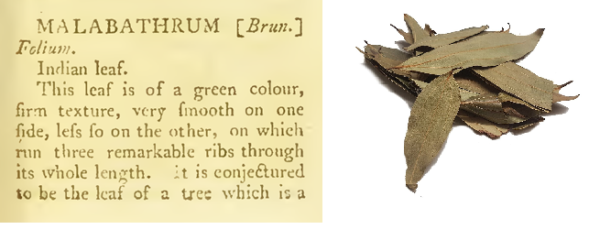 Keats’s derivations from apothecary’s Latin start to appear in his early works. Those, such as in Endymion and have been previously indicated in the scholarly literature.
Bay leaves were crackling in the fragrant pile,
And gummy frankincense was sparkling bright
Apothecary’s Latin utilised the ancient word olibanum for frankincense. A resinous exudation of a desert tree, the drug was in the form of hard droplets which were technically referred to as a gum (or gum-resin).
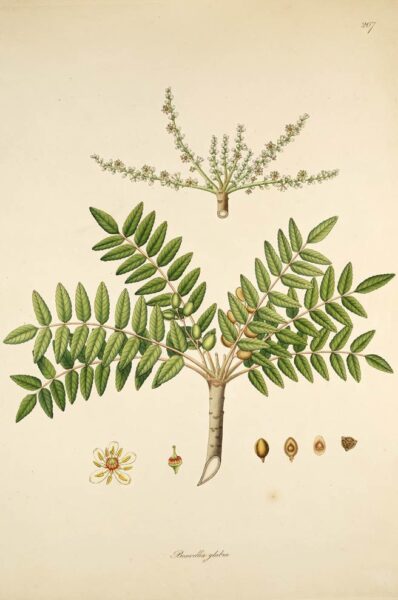 Keats translates half the apothecary’s binomial, gummi olibanum, playing with the generic term to increase the sensual load of the image, at the risk of some confusion about its consistency.
gummi olibanum → gummi frankincense → gummy frankincense
The medicinal, mythical and poetical all met in the apothecary’s dictamnus creticus, dittany of Crete, an ornate member of the oregano family (there is an unrelated European wildflower which at some point adopted its name). Endymion stumbles on it in an enchanted plot.
There blossom’d suddenly a magic bed
Of sacred ditamy, and poppies red:
The poet performs one of his creative spellings as he half recalls the Latin name – or does he? The presence of ‘ditamy’ here carries on the assonance of the sequence of ‘d’ and ‘m’ sounds in these two lines and in doing so prevents the second line sounding like a shopping list.
Dittany may have already been dropped from the London Pharmacopoeia, but not from the progressive medical botany books. These repeated the same passage from Virgil’s The Aeneid that the historical herbals had done before them.
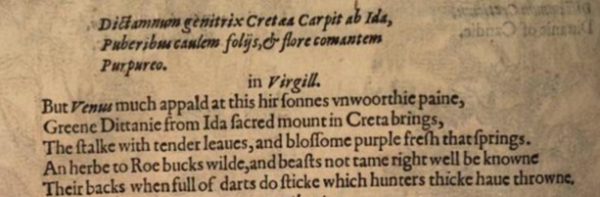 Virgil, Aeneid. Book. 12. Line 411-13 quoted in John Gerard, A Historie of Plants (1597)
Given his familiarity with the drug (dictamnum, in the original Latin of Virgil), it would appear that Keats knew exactly why he selected ‘ditamy’, so did not deserve the correction of some 19th-century editions of his work. In more modern editions it is sometimes footnoted as an ‘old usage’ but, for what it’s worth, I have been unable to locate one example of it.
dictamnus + dittany → ditamy
Famously, he performs several similar expressive extensions to the language. To coin ‘soother’, he applies a common grammatical transformation in an uncommon way.
smooth → smoother = soothe → soother
We can feel Keats’s hand passing a palate knife through the yielding words.
These new words, or neologisms, left him open to contemporary criticism, embarrassment from some more modern critics and a queasy feeling of indulgence in some modern-day readers. ‘Ditamy’ is a type of coinage that is called a blend neologism. This is somewhat fortuitous: blending was one of the techniques of the apothecary’s traditional practice. The Dispensatory details the often sensual but, nevertheless, exact nature of these procedures, ‘Blended with unctuous matter in the proportion of one to eight’.
These strange mutable words have been moulded by Keats into his poetical utterances, such that the concentration of their prototypes in the Dispensatory gives it the character of a young poet’s word book.
According to the Art
Why were such arcane items as dittany of Crete and Indian leaf so persistent in Western pharmacy over such a long period, surviving progressive drives to purge and modernise the materia medica? One suggestion connects them with the apothecaries’ active assertion of their particular professional skills. One way that this was realised was through the promulgation of elaborate ancient recipes with numerous and wide-ranging ingredients.
Throughout this post, I have included recipes for compounded medicines from the Dispensatory to highlight the fact that the profession of the apothecary historically was one of careful making.
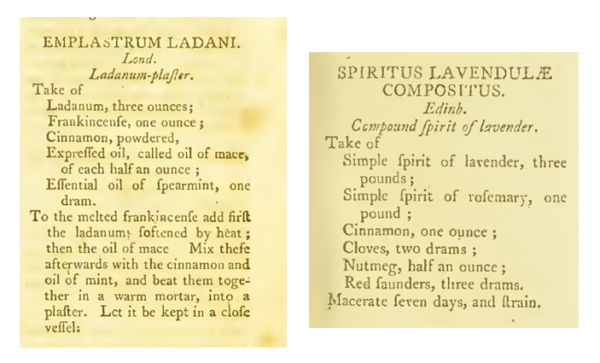 Among these many recipes, Mithridate and theriac were the archaic ugly sisters that ‘adorned the physician’s armamentarium for two millennia’. Their written origins went back to medicinal texts of the ancient Roman world, which in turn referred to earlier sources. These recipes, which were elaborated over time, were not dropped from the London Pharmacopoeia until 1788, although they had been vilified in some quarters well before this. Indian leaf and dittany of Crete (in addition to olibanum, or frankincense, and cinnamon) are some of the sixty-one ingredients that the Dispensatory lists in the entry for Mithridate, or the confection of Democrates.
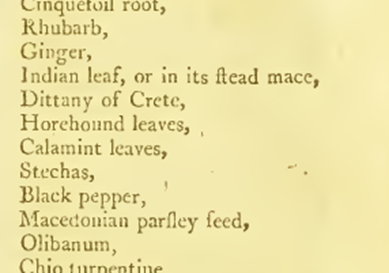 One has the feeling that the inclusion of such impossible recipes as Mithridate and theriac within a practical manual at this time was symbolic, in that it represented the potential complexity of the craft and its legendary origins. The recipes were totemic for the art of making. They had a name for this, secundem artum, ‘in accordance with the rules of the art’ (OED).
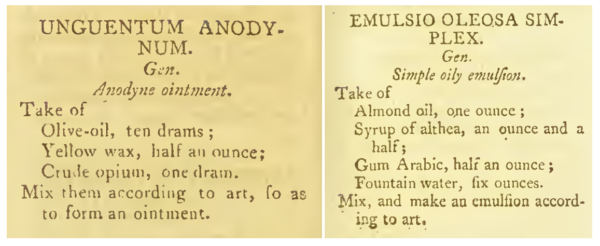 If my fabricated equations above may remind you of the contemporary chemistry of Lavoisier and Dalton, I may have misled you. If there is an analogy to be made here it is not the spontaneity of reacting materials but of the elements of a managed process, involving sequencing, manipulation, composition etc.
In this context, I am struck by Robert Gittings’s observation on the character and context of the poem’s creation.
The Eve of St Agnes is a poem where all this massive interplay of vowel and consonant finds a free unhampered narrative movement. It did not come easily, as his scored manuscript showed; this was not evidence of weakness in composition, but of the higher standards he was now applying to his poetry. …
The Eve of St Agnes is the first and perhaps greatest fruit of his determination not to produce any more slipshod work for the critics; it is the most striking result of the application of his ‘own domestic criticism’.
Robert Gittings, John Keats (1968)
If, indeed, the fine crafting of The Eve of St Agnes was Keats’s response to what he felt was legitimate criticism, then the disciplined art of the medicine maker, which had occupied his receptive teenage mind, was an accessible source of poetical raw materials, if not a frame of mind. However, the personal attacks within the same reviews were defiantly handled by their target, ‘pestleman Jack’. ‘A boy of pretty abilities’, Lockhart derided Keats, ‘who practises poetry and pharmacy’. And that’s just what Keats went on to do in creating this highly polished composition, albeit one with a wild heart.

Manuscript of The Eve of St Agnes
‘With her wild dream he mingled’
‘Palate’ is a notable Keatsian term which appears frequently in the Dispensatory, emphasising that a finished preparation should be as agreeable to the customer as possible. If Porphyro’s heap-making appears at first sight as an unexpected plot device it draws on the poet’s personal experience and recollection. Madeline’s maid Angela fills a cupboard for Porphyro, but it is Keats who provides the catering. He reaches mentally for labels which in Angela’s and Porphryo’s hands are transformed into aromatics of substance.
There is an interesting letter written by Jane Austen. In the course of teasing her sister Cassandra, she describes a surgeon-apothecary she has been socialising with as being ‘without the least spice of an apothecary’. A suggestion, if only through a witticism, of how the smart up-to-date surgeon-apothecaries were perceived. However, there is also an implication that apothecaries customarily could not escape the clinging aromas of their trade, perhaps least of all the poor apprentice. The key to the chamber scene may well lie in the well-recognised insinuation of aroma into memory and psyche (we are told that olfactory memory lies deep in the brain next to the site of our emotional memory). Porphyro is not an apothecary’s apprentice but, as Madeline conjures up her love(s) into her dreams, Porphyro attempts to stimulate Madeline’s recall of him through the sense of smell. Keats gives Madeline agreeable associations for Porphryo; memories of feasting, pleasure and of scented soothing compositions such as syrups, jellies and curds. Just like when the distinctive aroma of a particular place recalls the memory of a date you used to meet there.

Madeline After Prayer, Daniel Maclise (1868), Metropolitan Museum of Art, New York
The strategy works and she dreams of an idealised Porphyro who, of course, is unaware of it. So, he begins to sing to his lute at which point it all then goes off-script as Madeline starts waking up and conversing with him. Their subsequent union was a difficult scene for Keats to complete. Eventually, he sulkily altered it under pressure from his publishers. ‘Into her dreams he melted, as the rose/Blendeth its odour with the violet’ – was judged more agreeable for contemporary consumption than the first draft – ‘With her wild dream he mingled as a rose/Marryeth its odour to a violet’. These combined aromas sound like yet another Keatsian posy, if one that is rather difficult to construct in practice. However, this composition is more easily achieved from the apothecary’s shelves, on which we can find the aperient syrupus rosatus solutivus, or syrupus rosarum solutivum (a sweetened solution of rose petals) and syrupus violæ (a syrup of violets). The Dispensatory’s formal definition of a solution has the potential to make a teenage apprentice snigger: ‘A solution is an intimate commixture of solid bodies into one seemingly homogeneous liquor.’
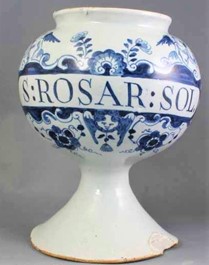 English Delftware Pharmacy Jar – Syrupus Rosarum Solutivum (Syrup of Rose Solution).
The lovers now come quickly to a mutual understanding; accordingly they creep past the ‘bloated wassaillers’, sleeping porters and duped bloodhounds to then flee into the stormy night.
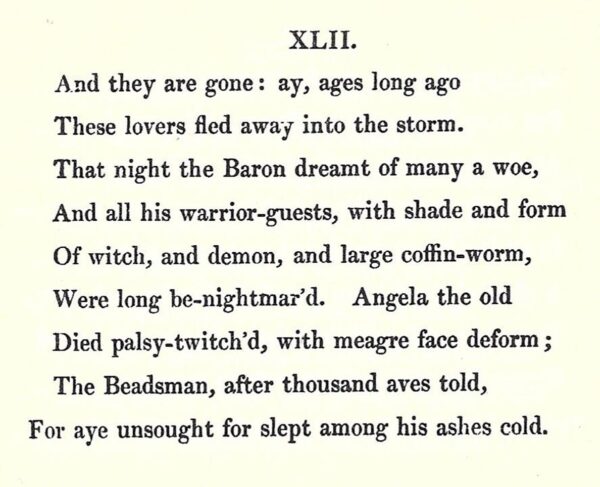 The couple’s exit drains all life out of the castle. This chilling ending has been much discussed, even before its publication. Angela’s unearned death may help to neatly tie up a loose plot end, but it does seem particularly harsh. From the point of view of the petty nihilism of youth, the future is theirs and old people die. In the mid-‘70s, none of the large mixed class of fifteen-year-olds of which I was a member expressed much remorse – Angela and the beadsman are dead. Keats makes the fate of the lovers the reverse of their close adolescent cousins, Romeo and Juliet, who die while their negligent elders live. The play is an acknowledged template for the poem, and Juliet a template for Madeline. In Keats’s discussion of Shakespeare’s female characters, it is the ‘conscious innocence’ and frankness of Juliet that would make Keats ‘follow her into Pandemonium’. He acknowledges that he should aspire to be a Romeo ‘to be worthy of her’, a role he can enact through the audacious and worshipping Porphyro.
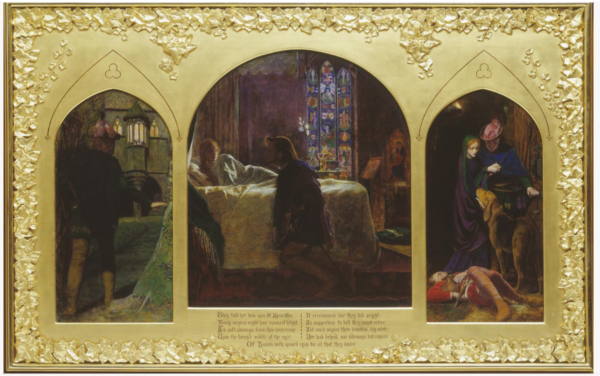
The Eve of St Agnes, Arthur Hughes (1856), Tate Britain
‘Young Porphyro with heart on fire’
Each in their own way, both Madeline and Porphyro act out two ardent teenage behaviours in an attempt to counteract ennui: wishing something – anything – to happen; and the converse, making something happen to the point of recklessness. The characteristic energy of this work derives from the hypersensitivity to stimuli that echoes the zealousness of the young leads. ‘Sensation seeker’ is a now-hackneyed term of mid 20th-century American psychology. It was characterised by the quest for intense experiences, and the willingness to take risks for their sake. Madeline’s ostensibly innocent scrying promises not just to conjure up the identity of her love(s) but a more intense experience – ‘They told her how, upon St. Agnes’ Eve,/Young virgins might have visions of delight,/soft adorings from their loves receive’. Porphyro’s intrusion into the hostile household is recklessly dangerous, taking risks beyond his initially avowed modest aims: ‘That he may gaze and worship all unseen’. He is fortunate to meet an ally in the form of Angela, whose decision to aid his quickly improvised strategy is central to its success. However, her characterisation is a cypher. She is there for what she can do, not who she is. Her portrayal might be summed up by one of Holden Caulfield’s throwaway lines; ‘some old lady about hundred years old [but] she was pretty nice’. If the young lovers had been challenged while fleeing the castle, they might have just shrugged, ‘Honest to God, we didn’t know it would turn out like this’. As it is, the adolescents flee without looking back.
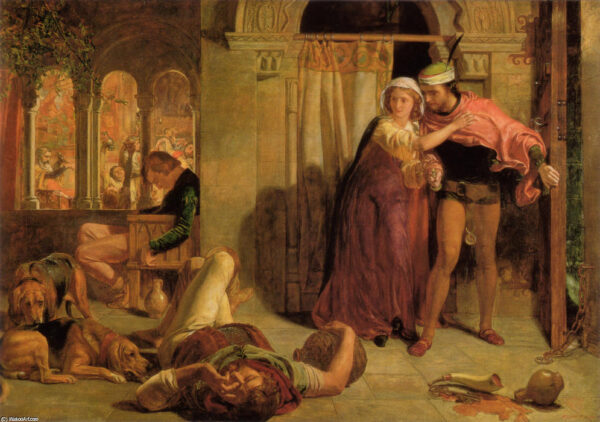
The Flight of Madeline and Porphyro during the Drunkenness attending the Revelry, William Holman Hunt (1848) Guildhall Gallery, London
The poem’s conclusion in youthful freedom and personal fulfilment is in marked contrast to Keats’s experience at the same age. I have always found the single image, ‘Filling the chilly room with perfume light’, striking and quite specific. Madeline’s chamber could easily have been lit by a cosy fire; flickering flames that project shadows in a warm romantic atmosphere. Of course, an apothecary’s workspace would have been barely heated, the better to store drugs. A fragrance in a cold environment gives a very different emotional response to the immediately gratifying experience felt in a warmer one; suggesting more than it delivers. It promises the genuine article, but not now – not yet.
If, as is often said, The Eve of St Agnes is an exercise in wish fulfilment, it is one within an adolescent’s world of heightened sensitivity and alienation where the conflict between personal freedom and responsibility is first wrestled with; a world that Keats as a young adult recalls and recreates.
David L. Cowen, Pharmacopoeias and Related Literature in Britain and America 1618-1847. Ashgate Publishing Ltd, Aldershot, Hampshire 2001.
Gareth Evans ‘Poison Flowers; John Keats and the Botanic Pharmacy’. Keats-Shelley Review, 16, 2002.
William Lewis, The Edinburgh New Dispensatory. Edinburgh and London 1789. (Link to an online version at Wellcome Collection).
RS White, Keats as a Reader of Shakespeare. The Athlone Press, London 1987.
Gareth Evans writes articles on the history and culture of plants (published work on garethhevans.com). He worked in, and with, botanic gardens for 16 years, specialising in the history of plants and medicine. Highlights include ‘Poison Wine: John Keats and the Botanic Pharmacy’, Keats-Shelley Review (2002) and the co-authored ‘Nothing but Flowers: John Keats’, The Lancet, (2011). Keats’s Flight from the Vegetable Monster was given at the Keats Foundation Conference (2017). He has written several posts for The Wordsworth Trust’s Romanticism Blog.


