by Gareth Evans
The satirical print grew in popularity as a profitable sideline for 18th-century London print shops. Generally, the plates were bought from an engraver or artist then printed up to be displayed in the shop window and sold for the printer’s profit. This ephemeral genre has a long history, depicting social, political and royal subjects. It had such notable exponents as Hogarth and, into the early 19th century, Rowlandson and Gillray. At their most popular, thousands of prints were published a year. Fewer were published as the 19th Century went on, nevertheless they continued focusing mostly on political subjects, but not to the exclusion of other subjects.
This 1831 satirical print is from a set of ten which are based on the existing poem The Devil’s Walk. It has undeniably disturbing images within it, but following this examination you may gain some insight into Keats’s last days and the later lives of two people in the wider Keats circle.

‘The Apothecary on a White Horse’ from The Devil’s Walk, ‘Ten Etchings, Illustrative of the Devil’s Walk, by Thomas Landseer’. (London, F. G. Harding) 1831 (British Museum)
Walk like the Devil
The Devil’s Walk is a humorous text of multiple versions and, what is more, multiple authors. The Devil’s Thoughts, as it was first called, was originally a bitingly satirical poem in ballad form associated first with Samuel Taylor Coleridge, and then Robert Southey.
Coleridge published it first in The Morning Post in 1799, and wickedly attributed it to a contemporary classical scholar Dr Richard Porson. Southey, with Coleridge, soon expanded it and in the process made it more explicit who the authors were. It was he who renamed it The Devil’s Walk.

(AI generated text-to-image of ‘Coleridge with horns’ &’ laughing Southey with book’. Perchance.)
The form of The Devil’s Walk is the unstoppable common meter of the ballad. With its stream of short, rhyming, rhythmical and punchy verses, this particular genre of satirical writing was found irresistible and imitated both by Byron (The Devil’s Drive, drafted 1813) and Shelley (The Devil’s Walk, published as a broadside in 1812).
Verses four & five, of the Coleridge/Shelley text give a flavour of the whole. The first establishes the devil’s appearance as someone of status examining his estate, the Earth. In the next, the satires of professions get underway with law then goes on to include politics and medicine.
And how then was the Devil drest?
Oh! he was in his Sunday’s best:
His jacket was red and his breeches were blue,
And there was a hole where the tail came through.
He saw a Lawyer killing a Viper
On a dunghill hard by his own stable;
And the Devil smiled, for it put him in mind
Of Cain and his brother, Abel.
The Devil’s Walk: A poem. Ed. HW Montagu. 1830

The Devil’s Walk: A poem. Ed. HW Montagu, 1830
This illustration is from an 1830 reprint. But, why 1830 when the original poem was published in 1799? An answer may be found in current events.
Reform and Satire
The desire for social change at the beginning of the 19th century would eventually lead to the 1832 Reform Act. The government had struggled with the question of a fairer representation in parliament, prompted by social unrest around the country. This was then a ripe time for satire. Within this context, the Coleridge/Southey anti-establishment The Devil’s Walk was republished conceivably as publishers’ speculation on the country’s general mood.
Before illustrated newspapers, satirical prints gave likenesses to senior figures and others. If a caricature didn’t look like the figure in question then, at the very least, it could look like existing caricatures of the person. In the last resort, labelling could be used, as it is subtly done here on the carriage door.

King and Carriage. Henry Heath. Detail. 1831, British Museum
The Devil’s Work
The sixth verse tilts its shaft at the medical profession.
He saw an Apothecary on a white horse
Ride by on his vocations,
And the Devil thought of his old Friend
Death in the Revelations.
We have to remember that this was written before the Apothecaries Act 1815, which aimed to improve the education of young practitioners, including the young John Keats. The apothecary was the general practitioner of its times and the sight of one doing his rounds on his horse would have been familiar, a reminder of the frailty of human existence. The home visit was not necessarily a reassuring experience.

The Devil’s Walk: A poem. Ed. HW Montagu. 1830
The 1830 edition of The Devil’s Walk (ed. HW Montagu) has sixteen etchings whose design is credited to (Isaac) Robert Cruikshank (1789 –1856), not to be confused with his brother George (1792–1878) who famously illustrated Charles Dickens’ work. The work fervently maintains the fake attribution to Dr Porson, and dismisses in passing the claim of Coleridge and Southey.
The general humour of the etchings is within that of the text; that is, they are nearer to the genre of book illustrations. This is in contrast to the more imaginative satirical prints produced the following year by the artist, engraver and etcher Thomas Landseer (1795-1880). Not to be confused with his brother Edwin (1802-1873), the famed painter of animal subjects, whose popularity was been credited to Thomas’s successful mass-produced prints of his brother’s paintings. It is estimated that he worked on more than hundred and twenty-five of Edwin’s animal paintings, each print of which sold between three and ten guineas.

The Other Landseer
Thomas was the eldest of fourteen children, seven of whom survived to reach adolescence. Four entered the art world: Thomas, Edwin, Charles and Jessica,. Their mother, Jane Landseer (née Potts), had once been a model for Joshua Reynolds. Their engraver father John engaged Benjamin Haydon to teach painting to Thomas and Charles. Edwin was too young to attend, but it was agreed he was the most promising.

Satirical print of Haydon’s Studio, 1818
Keats’s friendship with Haydon was during the period of the Landseers’ pupillage. The two sets of siblings, the Keats brothers and the Landseers were of the same generation, so evidently formed a social group: these pounced on me … all the Landseers … [they] enquired after you particularly. (Letter, John Keats to George Keats, 23 January 1818). John Landseer was present at Haydon’s infamously rowdy ‘Immortal Dinner’ in December 1817. Guests included Keats, Wordsworth and a very drunk Charles Lamb. John Landseer had trouble keeping up with the banter due to his hearing loss; ‘With his hand to his ear and eye was trying to catch the meaning of the gestures he saw.’
The intimidating attack by John Gibson Lockhart on poet Leigh Hunt in the Blackwood’s magazine of May 1818 could include Leigh Hunt, Haydon, John Landseer and youthful Keats in the same roar of contempt.
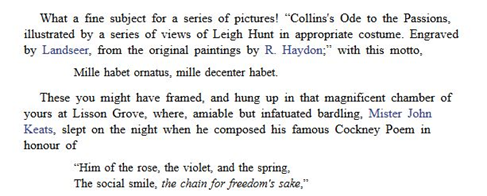
‘A Letter from Z to Mr Leigh Hunt, The King of the Cockneys.’ Blackwood’s Edinburgh Magazine, May 1818
The social circle of Thomas and his wife, Belinda, included Charles Dickens and Thomas Hood. It is said that Belinda furnished Dickens with the idea for Nicholas Nickleby. Through his working relationship with his brother, Thomas performed print work for Victoria and Albert; birthday presents etc. Edwin was favoured by the royal couple both professionally and socially.
Like his father, Thomas was hard of hearing; ‘very deaf and shy’. ‘[He] was a most amiable and happy man … He always wore a beaming smile.’ (Sir Edwin Landseer, Manson. 1902.) ‘He was so deaf that every word one desired to say to him had to be shouted into his ear through a long tin trumpet unless his pretty and garrulous wife chanced to be present to transact his business for him.’ (Glances Though Seventy Years. Vizetelly. 1893.) It should be said that Thomas was notoriously disorganised and the indications are that his wife Belinda made the business work.
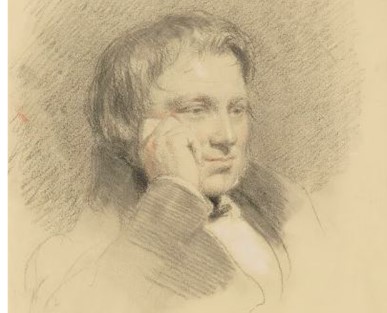
Thomas Landseer by Charles Landseer, NPG London
The Devil’s Walk, 1831
Thomas Landseer’s 1831 set of prints The Devil’s Walk selects ten of the Coleridge/Southey seventeen verses and elaborates on them using various styles and print techniques. Many prints add a contemporary interpretation to the original text using recognisable caricatures of people then in the public eye, an aspect that seemingly has not yet been recognised up to now.
One print adds the name ‘Gascoyne’ in place of a blank in the original text. General Isaac Gascoyne (1763-1841) was, at this time, the reactionary Tory MP for Liverpool who, out of principle, helped bring his own government down, inadvertently initiating events that would eventually lead to the Reform Act 1832.
General Gascoyne’s burning face
He saw with consternation
So he hied for his lake, for he thought by mistake
‘Twas the general conflagration

In the fifth illustration, the lawyer is, no doubt, the extraordinarily charismatic and successful Sir John Scarlett (1769-1844). Unhappily, Thomas Landseer would have had a recent experience of him at the King’s Bench (see ‘Landseer and Wife vs Robinson’. The Times. 14 May 1831.) where he acted against him and his wife in a bizarre case. A third party claimed Belinda had had an affair with him, and that the couple’s latest child was his. The Landseer family sent her away, but Thomas ultimately stood by his wife and they both went to court. At the end of the trial, the jury found for Thomas and Belinda, a rare defeat in the courts for Scarlett. (This is in contradiction to Thomas’ entry in the Oxford Dictionary of National Biography which passes on contemporary pre-trial loose talk in describing Belinda as an adulteress who Thomas took back with her child.) Is the desolate couple in the background Thomas and Belinda themselves?

‘Death in the Revelations’
Verse six has a biblical allusion to the Book of Revelations; And I looked, and behold a pale horse, and his name that sat on him was Death. Rev. vi. 8.
He saw an Apothecary on a white horse
Ride by on his vocations,
And the Devil thought of his old Friend
Death in the Revelations.
Before talking about the content of Thomas’ print for this text, let’s compare it with a print of his clever brother, Edwin. His print (left below) is in several collections, where it has been dated, at the widest, from the 1820s to 1860s. It shows an unlikely holiday for the short-lived lowly chimney boys, taking the reins from their master and excitedly leaving town with the hope that the rain will wash them clean. Thomas’ hack (right) seems a cartoon copy of Edwin’s horse complete with the dog who is now not leading the way but now coughing in the gutter behind. But more of that later.

British Museum
Thomas Landseer’s print caught the attention of Dr Ruth Richardson who wrote a description of it in The Lancet in 2001 (Ruth Richardson. ‘Landseer’s apothecary’, The Lancet. Feb 24, 2001.):
The lank apothecary sits high on his horse, inhaling snuff deeply from a pill box and looking utterly disreputable. … His horse is a hack, starved, weak, and sickly, pitted with sores, barely able to carry its master. Half-concealed behind him on the saddle is a dead baby (a reference to back-street abortion?) doubtless destined for dissection, and a copy of The Lancet, whose title reinforces this idea. … A moribund dog convulses in the gutter. In the background a body is borne away on a stretcher; men muffle their faces from the pestilential atmosphere; a coffin-bearer follows. In the midst of this desolation, a quizzical face smirks over the nag’s mane: the Devil, sniffing rosemary, approving all he sees. The apothecary holds a paper that reads ‘Accoucheur to the Queen: a reference to Princess Charlotte, whose shocking death in childbirth in 1817 had been followed by the suicide of her doctor…
Dr Richardson’s unflinching eye must have studied an original print. The reference to ‘Accoucheur to the Queen’ leads her to the case of Queen Charlotte and her accoucheur Sir Robert Croft, who, after she died in childbirth along with her baby, committed suicide. However, this occurred fourteen years earlier in 1817; maybe another more contemporary interpretation is available? A recent incident that was both distressing and macabre, was reported in the press.
Thomas Wakley and the Exhumation
The print surely represents an inquest held on 2nd October 1830 covered by The Lancet (Oct 3, 1830. p74) and The Observer (October 3, 1830. p3 ‘Extraordinary Inquest at Hampton’). The subject of the inquest was the death, two months earlier, of Frances Clark and her unborn child. Under scrutiny were the actions of her medical attendant Mr Bowen who was called in after the midwife could not resolve the mother’s great pain.
What concerns us here is not the tragic and disturbing details of the case themselves, but that they were recorded in scientific, but gruesome, detail in a four-page report in The Lancet; the pioneering medical periodical was only six years old. Indeed, its campaigning editor and founder Thomas Wakley not only attended but intervened in the proceedings. The mother and unborn child having been interred, the officials weren’t keen on exhumation after more than two months in the ground. Mr Wakley gently guided the coroner by reminding him that you cannot have an inquiry without a body. We shouldn’t jump to the conclusion that this was a case of a newspaperman making a story, (Wakley was to go on to become a reforming coroner, as well as a radical MP for Finchley).
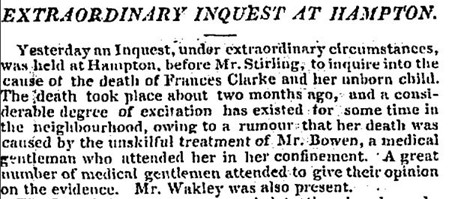 The Observer, 3rd Oct, 1830, p3.
This grim Lancet report is most likely what the group of men are crowding around to read in the right background of Thomas Landseer’s print.
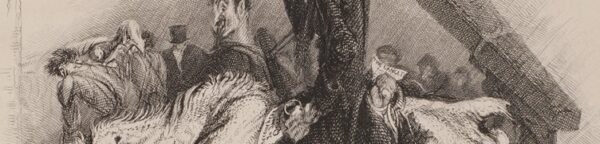
Although it may seem surprising today, it should be remembered that The Lancet started as an innovative weekly medical magazine originally aimed to include a readership beyond the specialised medical sector, which was a factor in its success. The visible title page hangs over the corpse of a baby with loose arms. To the left, indistinct images suggest a pestilential grouping of écorché, or flayed, figures and winding sheets which have intent medical men in top hats descending on them.
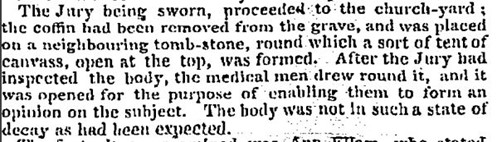
The Observer, 3rd October, 1830, p3.
The inquest’s verdict was that Frances Clark had ‘died by the visitation of God’ and there was no blame attached to Mr Bowen. This surprised some. The affair has many features, including the development of the professional standing of what we know today as obstetricians. However, it’s the extent of the subsequent debate that we are interested in here.
Wakley’s presence at the inquest was by invitation of the medical men who had come to support their colleague. But the combative Wakley was not a man to be taken for granted. The subsequent debate was first between some of the expert witnesses and The Lancet itself on the practice of obstetrics. The testimonies of the midwife and the friend of the mother were central to this debate (remember the unborn baby was dead).
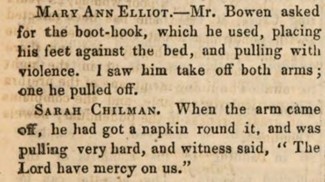 Seventeen indignant letters and editorial comments were published in The Lancet in three months following the inquest report. All of them, of course, from medical men concerned about their profession rather than the suffering of the patient:
 Too Many Clarks
Who then was the main figure in this print, and what was going on? As he is labelled ‘Accoucheur to the Queen’ then surely it represents Sir Charles Mansfield Clarke (1782-1857), the Queen is Adelaide the wife of William IV. Persuaded by his eminent brother John Clarke to specialise in obstetrics, Charles was already well-qualified medically. Starting his career, as others did, as an apothecary’s apprentice, by 1836 he was to be made a Fellow of the Royal College of Physicians. He was well-suited to the accoucheur role; educated, experienced and, crucially, good with people.
Regarding the professional standing of man-wives, the situation was still the same when Keats was a medical student back in 1816. At that time Guy’s Hospital made an optional midwifery course available to students but with no final examination. In 1826, Charles Clarke (sometimes spelt Clark) helped found the Obstetric Society and began a campaign targeting the existing medical corporations and the government to establish their professional standing through legally recognised examinations.
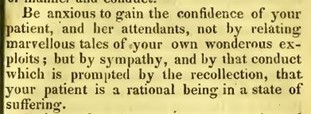 ‘The hospital pupil’s guide …’ by Aesculapius. 1818.
A message of Thomas Landseer’s print seems to be; why was this distinguished figure apparently indifferent to the notorious Hampton case where the practice of men-midwives was brought into the gaze of public attention? He couldn’t help knowing about the affair yet shows the worst of sins, haughty pride, or hubris. Only knighted in Sept. 1831, he wearing his new baronet’s hat. The devil approves.
It is striking how, in an age predating photography or illustrated periodicals, likenesses were important to satirical prints. As in Landseer’s print, there was labelling of characters but the accuracy of an image added veracity to the print and its supposed humour. So here is the problem, the main figure in the print is very distinctive but does not resemble Sir Charles Clarke at all.

Sir Charles Mansfield Clarke, (Wellcome Collection)
So, who might it be? There was another Dr Clark who could have been on Landseer’s mind. No. 2 in the identity parade has a strong jawline, angular profile and the lanky body depicted in the caricature.

Left, undated daguerreotype, Royal College of Surgeons.
Centre, Photographs of Eminent Medical Men, 1860.
‘Graceful reserve’
This is Dr James Clark (1788-1870) who was court physician to Prince Leopold, the widower of Princess Charlotte and uncle to Victoria. The Prince had become King of the Belgians earlier in 1831. The hauteur of the caricature, although meant to be Charles Clark’s, is James Clark’s (sometimes written Clarke). His demeanour was traced to his early career in the recuperative climates of the south of Europe. As Thomas Wakley wrote in James Clark’s death notice (The Lancet, 2 July 1870) ‘[In Rome], he acquired the courtly manners, the graceful reserve, the refined knowledge of the world [so] six years in the beau monde of the Eternal City were an admirable preparation for his practice in London’. From his experiences, he wrote his most original work, The Influence of Climate in the Prevention and Cure of Chronic Diseases (1829). One can perhaps see this referred to in the print as the figure takes snuff against the putrid air around him.
If Thomas did confuse the identities of the two doctors, he had a reason to do so. He would have first been aware of James Clark ten years earlier as one of his patients in Rome was the ailing John Keats. Opinions of his treatment of Keats’s tuberculosis may never be resolved; he was attentive but his lack of a correct diagnosis and his virtual starvation of the poet seems deleterious. His confiscation of Keats’s last resort, his bottle of opium, may uncharitably indicate that he had an eye for both his social audience in Rome and Keats’s attentive friends in London.
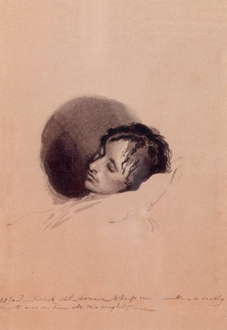
Joseph Severn’s sketch beside Keats’s deathbed.
Clark ensured that he was to manage Keats’s inevitable demise. Keats’s death at his own hand would have looked as if the doctor had failed somehow. If this view has any truth to it, the poet’s agonising slow, but dignified, last days were a wretched piece of medical theatre. Clark’s obituary can be seen to somewhat endorse this; ‘he endeared himself to the artistic denizens of the Eternal City by his tender care of the dying poet Keats’.
To reuse the words of the verdict at inquest of poor Frances Clark, Keats died of ‘a visitation of God’, indicating that it was out of the doctor’s hands. As with Mr. Bowen, there was no blame to be attached to the medical attendants, their reputations were intact.
‘Coming Events’
‘COMING EVENTS CAST THEIR SHADOWS BEFORE THEM,
Sir James Clark is in daily attendance at the Palace. We suppose that he is looking out for a new berth under Government.’
Punch. No. 191 p177.
James Clark’s progress as a court physician in the future Queen Victoria’s family glided up to its highest point when the then queen made him Physician-in-Ordinary and a baronet, in his own right this time, in 1838. But it was far from smooth sailing.
Thomas Landseer’s error strangely presages James Clark’s involvement in a court affair involving the death of Lady Flora Hastings, Lady of the Bedchamber to the Duchess of Kent, Queen Victoria’s mother, in 1839. It was thought by some that his courtly behaviour meant that a cancerous tumour was put down, through court intrigue, to a scandalous pregnancy. Her death set Clark’s practice and general reputation back, and virulent satires were published about the affair. Nevertheless, he crucially maintained the support of the queen and, eventually, The Lancet. In 1853, as then accoucheur to a relieved queen, he oversaw the first administration of chloroform, by John Snow, to a reigning monarch.
Along with other members of the press, Punch kept an occasional eye on his career. James Clark had become; ‘intimately associated, not only in his professional, but in a semi-political character, with the life in the Court … he became a “power in the state”’ (The Graphic, 23 July 1870). It was noted that his attachment to the court, and its functions, had inhibited his career financially. So, it was perhaps as compensation that he was granted use of Bagshot Hall on retirement for his use for the remainder of his life.
Back in 1839 an assault on James Clark’s reputation entitled Lady Flora Hastings. The court doctor dissected, went through five editions in its first year.
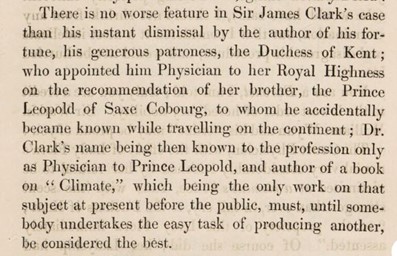 Lady Flora Hastings. The court doctor dissected. John Fisher Murray, 1839.
This quote highlights James Clark’s relative lack of qualification, and standing in the medical world, to be a court physician. In the same publication are examples of how James Clark’s and Charles Clark’s names could be juxtapositioned.
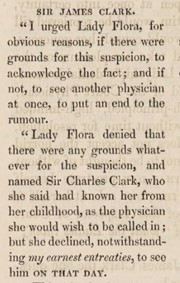 The hatchet job was unyielding: ‘Read … Sir James Clark’s statement and tell me if there was ever a more impudent, unfeeling, cold-blooded sentence penned by man?’
Taking Flight
Finally, I will add one more label to the print. It is to the coughing dog in the right-hand corner. In Edwin Landseer’s chimneysweep print, perhaps the figurative template of our print, the dog happily leads the way.
 In Thomas’ print, it has been replaced by a stone on the right and a sketchy dog is now moved into Clark’s wake; ‘a moribund dog convulsing in the gutter’. I am going to label the dog Keats. Might it be a private witticism of Landseer to depict his dead companion left behind by an oblivious and uncaring Clark? Probably not, but it does lend itself to a thought-provoking but unsubstantiated reading of the print.
Charles Clark’s devil-approved haughty pride, as erroneously depicted as James Clark, is then enhanced by the inclusion of James’s past deed, or misdeed. Despite the Keats circle’s approval of James Clark at the time of Keats’s death, Thomas’ opinion of the doctor may have become more cynical over time as Clark’s courtly career gradually developed.
Mr. T’s vocation
The reception of Thomas’ print collection was polarised. One was so effulgent in comparing Landseer to Hogarth that you suspect it was written by a friendly supporter. The editor of The Tatler (1 July 1831) was a certain Leigh Hunt. The tone of his criticism sounds patronising, but Hunt would have known of Thomas from the past. Indeed, Leigh and his brother John had published animal prints by Thomas, some ‘after Edwin’, in 1823.
While not mentioning any errors in his review, Hunt accentuated the positive. He was impressed by the execution: ‘This is surely Mr. T. Landseer’s vocation … No man can better engrave an animal than this artist and he should rather favour the world with some more of his brother’s beautiful designs which he can so capitally translate than disappoint them and himself with originalities of doubtful merit upon an exhausted subject.’
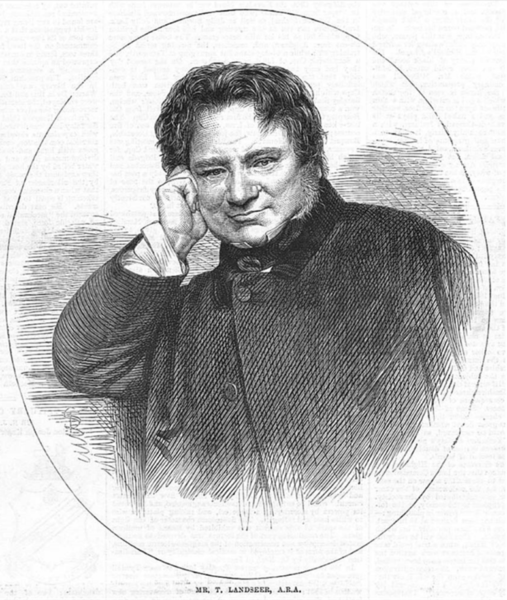
Indeed, this is what Thomas became noted for in his lifetime, he gained praise for his mixed technique; ‘so you did not miss the colour’ of his brother’s original paintings. In 1868 he was awarded Associate of the Royal Academy, London, like his father before him. This portrait (likely after a drawing by his sister Jessica) is part of a feature honouring his work in the London Illustrated News, founded in 1842, one of the new illustrated periodicals that, together with Punch, put paid to the satirical print forever.