


by Ian Reynolds
This is the third in a series of linked posts
My first and second posts looked at ‘Who was who’ in the life of John Keats, and considered his family, influencers and mentors. In this final post we look at further friends and acquaintances of John Keats. These biographical sketches of the people involved may help to give a broader view of John Keats’s short life—it should be noted, however, that whilst the factual information contained is hopefully accurate, some sketches may also include conjecture and the personal opinion of the author.
John Keats was born in London in 1795, the eldest of the four children of Thomas Keats and Frances Jennings. His father died from falling from a horse in 1804 and his mother succumbed to consumption, now known as pulmonary tuberculosis, in 1810. Alice Jennings, the children’s grandmother, aged seventy-three, appointed Richard Abbey and John Sandell as joint guardians of the four children. When Sandell died in 1816, Abbey became the sole guardian. In 1811, Keats left Clarke’s school in Enfield, and began an apprenticeship to become a surgeon and apothecary; brothers George and Tom worked as clerks in Abbey’s office. Alice Jennings died in 1814 and the youngest sibling Frances ‘Fanny’ Keats moved in with Abbey.
His newly married brother George emigrated to America in 1818, and his other brother Tom died of consumption aged nineteen later the same year. Keats’s own health broke down, and in September 1820 he travelled to Italy in the hope that a milder climate might help with his illness. He died of pulmonary consumption aged twenty-five on 23/24th February 1821, and is buried in the Non-Catholic Cemetery in Rome.
In his lifetime, he published three volumes of poetry: Poems (1817), Endymion: A Poetic Romance (1818), and finally Lamia, Isabella, The Eve of St Agnes and other poems (1820). During his brief career as a poet, it is thought that he sold no more than two hundred copies of his published works—fame and fortune had eluded him—but he retained a loyal band of friends who believed in his ability and unfulfilled potential as a poet, which was only fully recognized in the latter part of the nineteenth century.
The Friends and Acquaintances of John Keats
Benjamin Bailey (1791-1853)
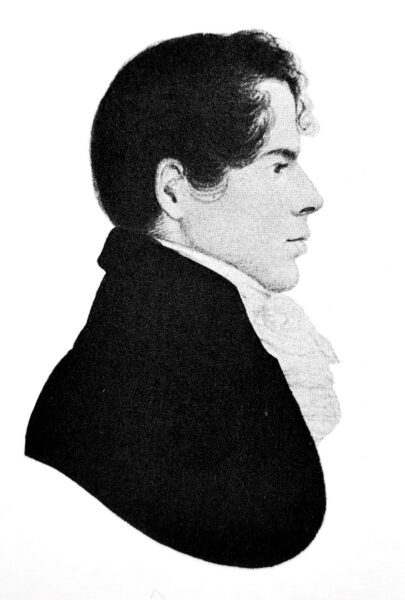 Bailey met Keats in the early summer of 1817 probably through his friendship with John Hamilton Reynolds and James Rice. A student of divinity at Oxford, Bailey hosted Keats for most of September 1817 at his college quarters, where he wrote book three of ‘Endymion’. Bailey is responsible for introducing Keats to aspects of philosophy and importantly to Dante’s Inferno, which was often the subject of discussion between the two of them. He also encouraged him to take a more structured approach to his reading regime, and possibly laid the seed of ‘Negative Capability’, given that this concept is akin to religious belief, where it is possible to believe in something, although doubts and uncertainties remain.
By the midsummer of 1818 the relationship had started to wane, mainly for two reasons; firstly, many in Keats’s circle thought that Bailey had behaved badly by ‘jilting’ Marianne Reynolds (sister of John Hamilton Reynolds) to become engaged to Hamilton Gleig, the sister of his Oxford roommate George Robert Gleig, and daughter of George Gleig, Bishop of Brechin and Primus of the Scottish Episcopal Church. Some people thought that Bailey was furthering his own ecclesiastical career by means of the engagement and subsequent marriage. Secondly, there was the issue of Blackwood’s magazine. George Robert Gleig worked on the staff at at the magazine and in July 1818, over dinner, Bailey was introduced to the critic and co-editor of Blackwood’s John Gibson Lockhart.
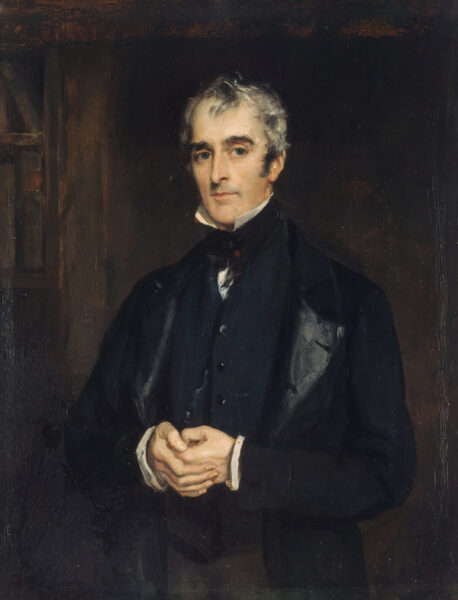
John Gibson Lockhart by Sir Francis Grant, National Galleries of Scotland c1854
When Keats’s name came up in conversation, Bailey tried to defend Keats’s 1817 Poems from the criticism it had attracted, but in doing so, he unwittingly disclosed additional personal information about Keats which was subsequently used against him, most notably in the August edition of Blackwood’s [see also my section on John Hamilton Reynolds]. Many in Keats’s circle thought that Bailey’s clumsy intervention only added fuel to the fire and led to the prolongation of the whole affair.
In early 1832 Bailey arrived in Sri Lanka with his wife to take up the position of Colonial Chaplain but she died shortly after their arrival. He was later elevated to Archdeacon of Colombo in 1846 and returned to England in 1852.
James Rice (1792- 1832)
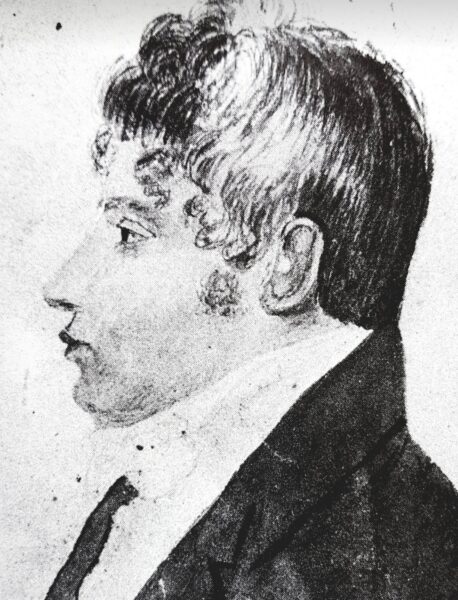
James Rice
Rice was a lawyer, and probably met Keats in the summer of 1817. Thereafter he John Hamilton Reynolds and Benjamin Bailey, made up Keats’s most fun-loving gang of friends. He is now one of the least known of Keats’s friends, but was renowned for his quick wit and wisdom; Keats described him as the ‘wisest’ of ‘three witty people’ who ‘makes you laugh and think’. He was always mentioned with admiration and great affection in correspondence.
Rice also generously funded John Hamilton Reynolds’s law apprenticeship fees of £110. Keats and Rice spent a month together in the Isle of Wight in the summer of 1819. Rice was unwell, as was Keats, and they both got on each other’s nerves, but this did not do permanent damage to the relationship, which always remained cordial. In 1821, Rice was one of five friends who contributed £10 to Keats’s executors to help settle the poet’s debts, and he received a one of his books as a keepsake, when the executors carried out Keats’s wish that his “chest of books” be “divide[d] among my friends”. Rice later assisted Fanny Keats obtain the release of the funds from Chancery related to the Jennings bequest and the estate of her deceased brothers.
William Haslam (c.1795-1851)
Haslam was also a lawyer. Described as ‘our oak friend’ by Severn, he was a reliable friend Keats and others could turn to in times of trouble—a ‘fixer’ and wise counsellor to the friends of Keats. Haslam considered Keats to be a genius and a rival to Shakespeare. Brown states that he was a school friend of Keats at Enfield, but Keats himself implies that he met Haslam via his brother George.
Haslam attended to Tom Keats during his final illness, when Keats was with Brown in Scotland 1818, and as Keats said, showed Tom ‘excessive kindness’. He also wrote to George in America to break the news of Tom’s death when Keats could not bring himself to do it. However, Haslam and George subsequently fell out badly, because Haslam believed George had shortchanged Keats when it came to the proceeds from Tom’s estate.
Haslam was principally responsible for planning Keats’s final journey to Italy, and pressed Severn to travel with Keats at short notice, possibly in return for Haslam dealing with arrangements in relation to Severn’s illegitimate child, Henry. He witnessed the assignment of Keats’s copyright before departure, and boarded the Maria Crowther with Taylor and Woodhouse on 17th September 1820 to see them off. After Keats died in February 1821 Brown asked Haslam to break the news of his death to Fanny Keats, and to Richard Abbey, her guardian.
Charles Wentworth Dilke (1789-1864)
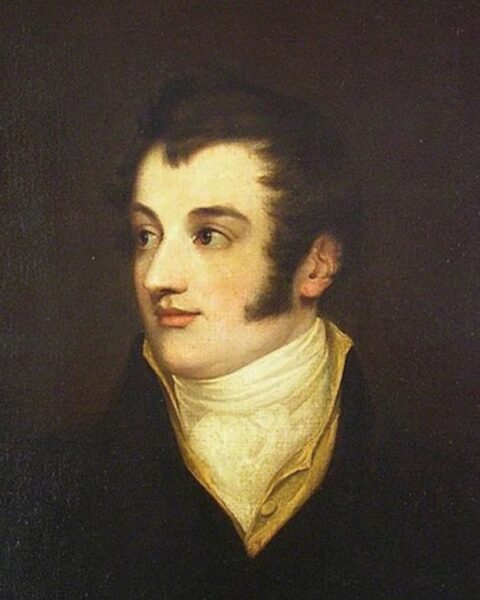
Charles Wentworth Dilke, Guildhall Art Gallery
Dilke probably met Keats in the winter of 1816/17, and introduced him to his school friend Charles Armitage Brown. Keats was friendly with all of the family including Dilke’s parents, staying with them in Chichester in early January 1819. Charles Dilke and his wife and family shared the other half of the Wentworth Place villa with Brown, but vacated it in April 1819 to move closer to their son’s school.
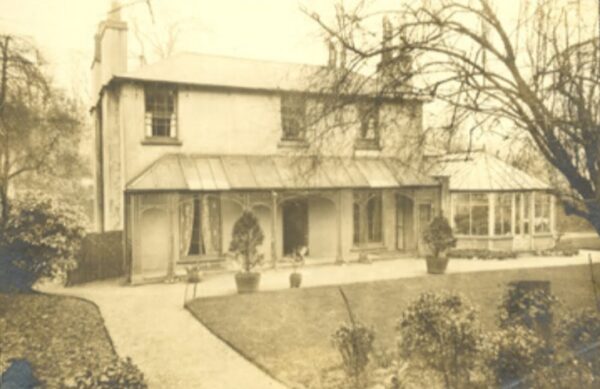
Wentworth Place around 1940. When the house was originally built in 1815/16 it was split into two separate dwellings –
Fanny Brawne and her family then moved into Wentworth Place, next door to Keats and Brown.
John Taylor (1781-1864)
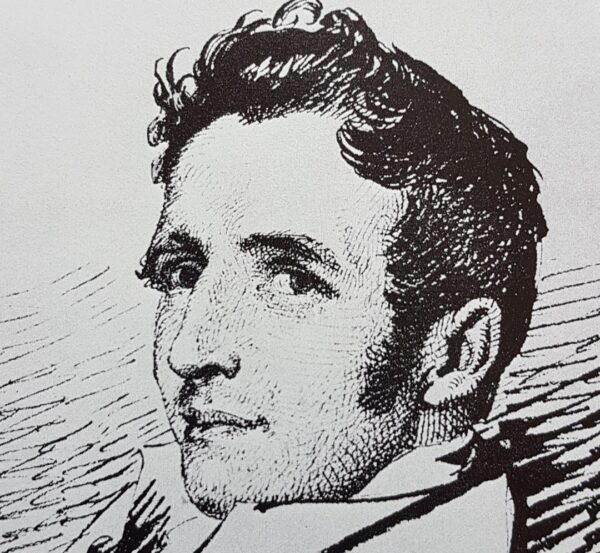
John Taylor as a young man
Taylor was a writer by trade, and established the booksellers Taylor & Hessey in 1806, with his close friend James Augustus Hessey. The company later expanded into publishing, issuing ‘The Naiad-A Tale and other poems’ by Keats’s friend John Hamilton Reynolds in 1816. They also published Keats’s Endymion: A Poetic Romance in 1818; and finally, Lamia, Isabella and The Eve of St Agnes and Other Poems in 1820. As Keats’s publisher, he had a tendency to offer suggestions and revisions, often much to the annoyance of Keats.
Taylor was also involved in a slightly mysterious episode in Keats’s life. He and Keats had a mutual lady friend called Isabella Jones. In February 1819 Keats was in London paying a visit to Taylor, and planned to pay a call on Isabella thereafter. However, a snow storm intervened and Keats ended up staying with Taylor for two nights. Isabella Jones was never mentioned again by Keats, although Taylor kept her up to date on news about Keats (see further comments below under Isabella Jones).
Taylor was co-executor of Keats’s estate with Charles Armitage Brown. Six months after Keats’s death in February 1821, Taylor wrote to Severn in Rome to give him some direction about the epitaph to be carved on Keats’s gravestone. Severn was dithering about the issue and would continue to procrastinate about the gravestone for a further two years. John Taylor told him ‘Neither name nor date is requisite. These will be given by his biographer. So, unless something else is determined on, let this line stand alone ‘Here lies one whose name was writ in water’.’

John Taylor in later life
Taylor had planned to write and publish the first biography of Keats, but didn’t get the help he expected from other friends of Keats, particularly Brown. Brown seems to have planned to write a biography himself, but never completed it, passing his Keats papers to Richard Monckton Milnes on the eve of his departure to New Zealand in 1841. Milnes’s Life, Letters and Literary Remains of John Keats was published in 1848. Taylor never married.
Richard Woodhouse (1788-1834)
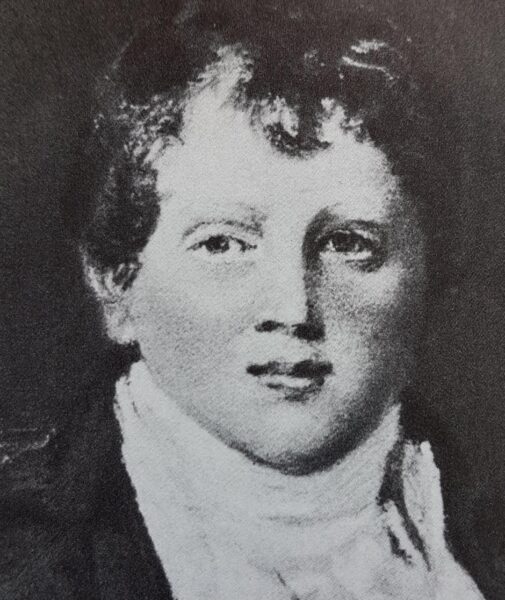
Richard Woodhouse
Woodhouse was a literary and legal advisor to Keats’s publisher Taylor and Hessey. He probably met Keats in 1817. He helped deal with Keats’s copyright transfers, and in conjunction with William Haslam, he sorted out the financial arrangements for Keats’s journey to Italy.
In addition to his role as an editor of Keats’s later poems, particularly Lamia, Isabella, The Eve of St Agnes and other poems, Keats scholars owe a debt of gratitude to Woodhouse for preserving many of the first drafts of the poems. Additionally, many of the transcripts of ‘lost’ Keats letters are in his hand. He had the foresight to keep the collection safe and in one place, the original intention being that John Taylor would use the material to write the first biography of Keats.
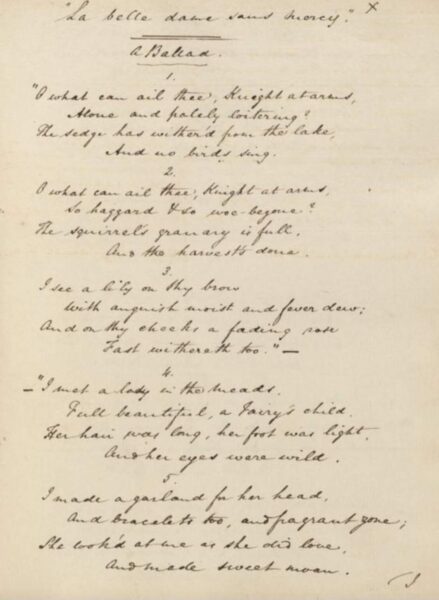
A copy of ‘La Belle Dame Sans Merci’ thought to be in Woodhouse’s hand
When Woodhouse died in 1834 he bequeathed all his Keats material to John Taylor. In his own words “all my Portraits, Sketches, Busts and Casts of Keats as well as all my manuscripts by or relating to him”. He added “in fact they belong to him but I have collected and kept them.”
Isabella Jones
Isabella Jones met Keats in St Leonard’s-on-Sea, near Hastings, in late May/early June 1817. She was a rather mysterious woman, well read, beautiful, and of independent means. Little is known about her background, or about her life after she dropped out of the Keats circle following his death, though we do know that she spent her time flitting between Tunbridge Wells and fashionable central London addresses. Early Keats biographers hardly mention her at all; some later biographers estimate her to have been about the same age as Keats, but others have her in her late thirties. She was also close to John Taylor, Keats’s publisher (see above).
It was Isabella Jones who first talked to Keats about the traditions associated with the feast of St Agnes, which clearly led eventually to his poem.
Isabella Jones was one of the first to be informed of Keats’s death in Rome and, like Rice, received one of Keats’s books as a keepsake when his will was executed. She also is famous for her blistering references to Joseph Severn in a letter to John Taylor on 14th April 1821: most of Keats’s circle considered Severn to have been a selfless and devoted friend of Keats, but when Isabella read a batch of the Severn letters from Rome, followings Keats’s death, she told Taylor ‘I never saw so much egotism and selfishness displayed under the mask of friendship’. Her incandescent rage echoes through the letter. Nothing much further is known about her.
William Hilton RA (1786-1839)

William Hilton, self-portrait, Usher Gallery
Hilton was a painter. He probably got to know Keats through his publishers, Taylor and Hessey, as Hilton illustrated some books for them. He also painted ‘The Mermaid of Galloway’, which was apparently inspired by Dumfries and Galloway folklore.
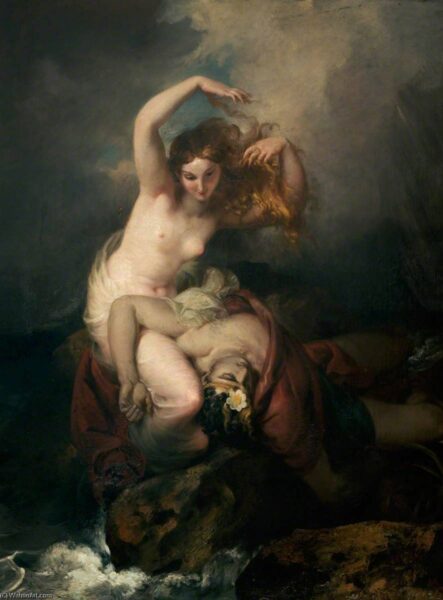
The Mermaid of Galloway by William Hilton, Tabley House Collection, Manchester University
Keats’s friend John Hamilton Reynolds also borrowed from the same legend and wrote a volume of poems including ‘The Naiad—A Tale’, published by Taylor and Hessey in 1816. Some scholars believe Keats may have been influenced by The Naiad/Mermaid of Galloway in relation to his 1819 poem ‘La Belle Dame Sans Merci’ as there are similarities in both poetic structure and theme.
It has also been suggested that Keats may have seen the actual Mermaid painting, because he mentions, in a letter to his brother George and sister-in-law, that he had visited Sir John Leicester’s Gallery in London and this visit had occurred just a few days before he included the ‘Belle Dame’ poem in the same letter. However, this assumption is incorrect: Sir John Leicester commissioned Hilton to produce the painting in 1818 but it was not completed until 1821, so it could not have been at the gallery when Keats visited; by 1821 Keats was either dead, or dying in Rome. Keats was, however, a frequent visitor to 10 Percy Street in London where Hilton shared the family home of artist colleague Peter De Wint and his wife Harriet (Hilton’s sister). It could therefore be argued that Keats could have seen the work in progress, or discussed the subject matter with Hilton. Hilton was one of five friends who contributed £10 each to a subscription to fund Keats’s final journey to Italy in 1820.
Dr James Clark (1788-1870)

Dr James Clark by James Andrews
Clark was Keats’s physician in Rome during his final illness. He had humble origins in Scotland but was eventually made a baronet, in recognition of his achievements in medicine. He qualified as a member of the Royal College of Surgeons of Edinburgh in 1809 and then joined the medical services of the Royal Navy, surviving two shipwrecks in 1811 and 1813. At the end of the Napoleonic wars Clark entered the University of Edinburgh where he graduated MD in 1817. His thesis was about the influence of climate on disease, an area that Clark retained an interest in for many years, particularly in relation to patients with consumption, later known as pulmonary tuberculosis.
Following graduation, he accompanied a consumptive patient to the south of France which inspired his first publication Medical Notes on Climate, Diseases, Hospitals, and Medical Schools in France, Italy and Switzerland in 1820; an extended version was published in 1829 which ran to a third edition in 1841. These studies were completely new at the time and gave Clark some standing in this field. He championed milder climates, fresh air, and wholesome food as a means of extending the life of consumptives, and by 1819 he was established as a practicing physician in Rome attending to the medical needs of visitors and expatriates. It was John Taylor, Keats’s publisher, who arranged for Dr Clark to attend to Keats in Rome before Keats had left London. When Keats and Severn arrived in November 1820 they presented themselves to the newly married Dr Clark at his residence in Piazza di Spagna, and Clark then set them up in lodgings at the other side of the piazza, just besides the Spanish Steps (now the Keats-Shelley House Museum).

According to Severn, Clark visited Keats four to five times a day and his kindness and attention was unfailing. Clark believed that Keats’s deteriorating condition had more to do with his digestive system and anxiety, rather than any issue with his lungs. He regularly bled Keats and put him on a starvation diet, but the situation was beyond hope. Much has been written about Joseph Severn’s attendance on Keats at the end, but there is no record of Dr Clark visiting in the hours leading up to Keats’s death, despite the close proximity to his residence, just across the piazza. On 25th February Clark performed an autopsy in the presence of two other doctors and found Keats’s lungs to be completely destroyed.
Clark and his family moved to London in 1826 and set up a medical practice. He later acted as physician to Prince Leopold of Saxe-Coburg-Saalfeld (King Leopold I of the Belgians from 1831), and through this connection he was appointed physician to Leopold’s sister the Duchess of Kent, the widow of King George III’s son, Prince Edward, Duke of Kent. The Duchess’s only child was Princess Victoria of Kent, heir to the British throne. After her accession in June 1837, Queen Victoria appointed Clark as her Physician-in-Ordinary and created him Baronet of St. George’s Hanover Square, London.
George Villiers, 4th Earl of Clarendon said he would not trust Clark to ‘attend a sick cat’. There were several instances of his medical incompetence, most notably the infamous Lady Flora Hastings affair of 1839. An abdominal tumour gave the unmarried Lady Hastings the appearance of pregnancy, and while Clarke prevaricated, deferring a full physical examination because he preferred to ‘wait and see’, rumours quickly circulated that she was indeed pregnant. She subsequently died a virgin aged thirty-three a few months later.
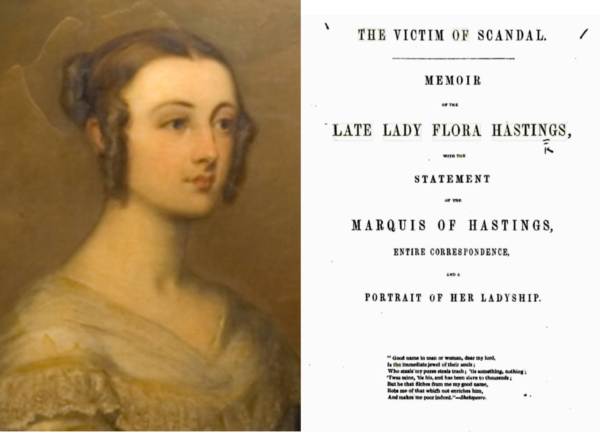 Clark was later also criticised for failing to diagnose Prince Albert’s fatal attack of typhoid in 1861. Throughout all this Queen Victoria steadfastly stood by Clark, and on his retirement, she lent him Bagshot Park, Surrey where he resided until his death (now the residence of HRH Prince Edward, Earl of Wessex and his family).
Bibliography & Source Material
The Keats Circle: Letters and Papers 1816-1878, ed. Hyder E. Rollins, 2 Vols. (Cambridge, MA, 1948; revised edition 1965)
Robert Gittings, John Keats (London: Heinemann: London, 1968)
Grant F. Scott, Joseph Severn: Letters and Memoirs (Aldershot/Burlington Vt: Ashgate, 2005)
Joanna Richardson, Keats and his Circle, (London: Cassell, 1980)
Grant F. Scott, Ed. Selected Letters of John Keats, (Cambridge: Harvard University Press, 2005)
Elizabeth T. McLaughlin, ‘”The Mermaid of Galloway’ and ‘La Belle Dame sans Merci,”’ Philological Quarterly 28, (1949), p471-476
Dongho Chun, ‘Patriotism on Display: Sir John Fleming Leicester’s patronage of British art’, The British Art Journal, Vol.4, No.2 (2003), p23-28
“The Mermaid of Galloway” by William Hilton R.A. University of Manchester, Tabley House Collection. Commissioned by Sir John Fleming Leicester in 1818 based on the Galloway poem and completed in 1821.
In relation to William Hilton’s painting of ‘The Mermaid of Galloway’ I would like to acknowledge my appreciation to Dr Peter Cannon-Brookes, Consultant Curator, The Tabley House Collection who directed me to his Paintings from Tabley: an exhibition of paintings from Tabley House at the Heim Gallery, October – November 1989, (London: Heim, 1989) which included Sir John Leicester’s ‘Mermaid’.
Ian Reynolds is a retired mechanical engineer who lives in Oxfordshire. He has a personal interest in those associated with the Keats-Shelley Circle, and poets of the Romantic period, especially John Keats. He is unaffiliated. Ian’s other interests include reading, listening to music, particularly rock and jazz, road cycling and wine.


