

The Time Lab: VOL I
A dispatch from the first few weeks of a new exhibition exploring memory and time in Wordsworth's The Prelude. By Guest Curator Stacey Joy Rossouw.
Walk into the Special Exhibition Gallery these days and you’ll find something unusual:
a working creative studio.
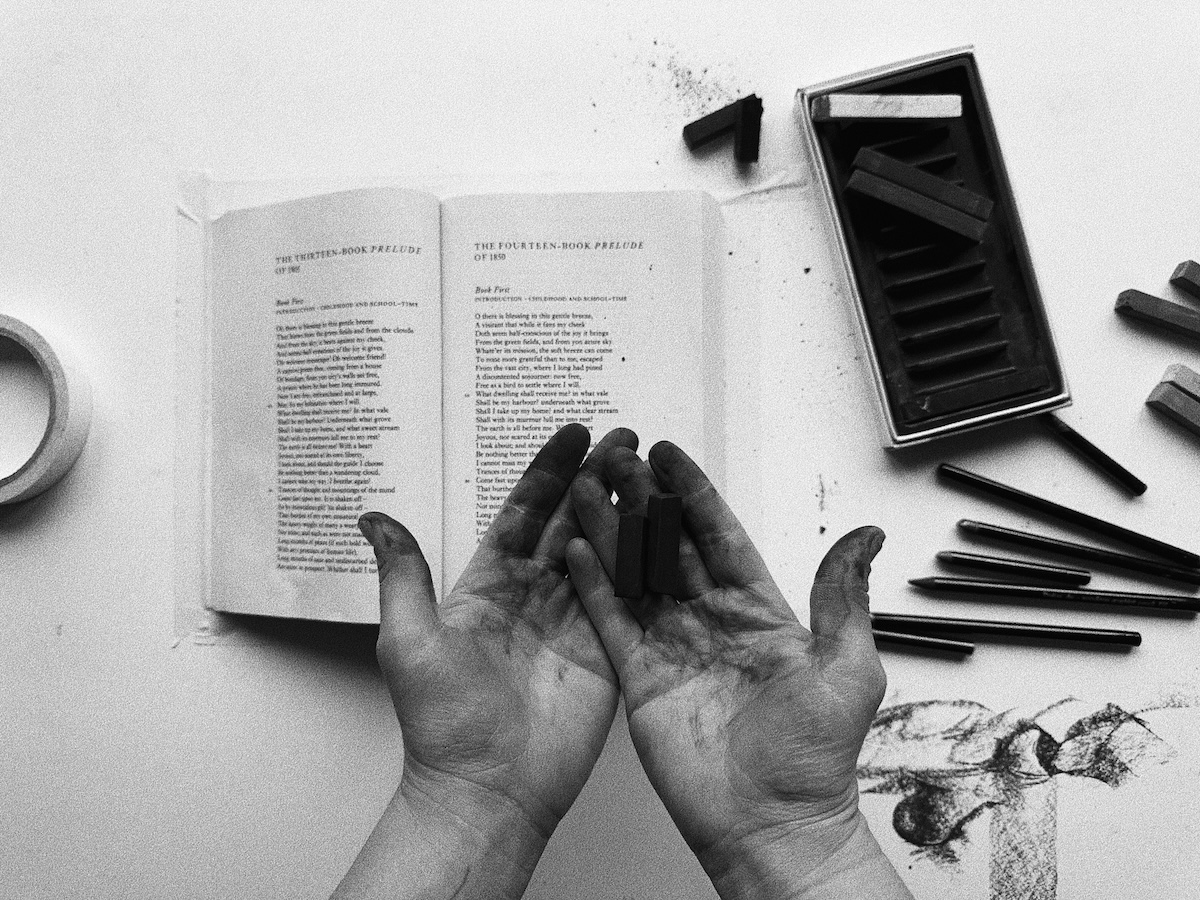
There’s charcoal dust on tables, and traces of fingerprints on door handles and jean pockets; music drifting from a bright red piano, and visitors bent over drawing stations, sketching their memories and turning sound into drawings. This is The Time Lab, my summer-long experiment in making time tangible.
For the past three years, I’ve been working with the Wordsworth Trust on a design-focused PhD project inspired by one simple question: How do we visualise time? That question has spiralled into a field of possibilities. Whose time? What time? Where time? Why time?
Einstein once said, “The only reason for time is so that everything doesn’t happen at once”. However, our experiences, our memories and histories, our sense of identity and connection to ourselves and to the more-than-human world… all seem bound to this great force increasingly influenced by the misuse of technology and the “datafication” of life itself. Storyteller Martin Shaw describes the sense of time in this age as “a reality where all sorts of centuries are crashing into each other”. This is an “every-time” marked by collapse and a disappearance of wilderness, both literal and metaphorical.
What if poetry and story can offer us something different? A way to remind us that time is something we make, in relationship to everything we are? Every day in the gallery, I’m drawing, composing music, and having conversations with visitors. I’m translating memories—yours and Wordsworth’s—into sounds and images that you can see evolving in the space. This is an experiment in gathering voices and making them live.
My approach is inspired by what writer Nora Bateson calls “Warm Data.” You might think of regular data as statistics, facts or numbers, and you’d be right. But there is a crackling sea surrounding this kind of data, vivid and vitally important. Warm Data is the living, breathing information in our stories and connections. It honours complexity and context. It asks not “What are you?” but “Who can I be when I am with you?”

Your Memory, Wordsworth’s Words
The Time Lab centres on Wordsworth’s epic poem, The Prelude, his lifelong exploration of “the growth of a poet’s mind.” Within it are his famous “spots of time”:
“There are in our existence spots of time,
That with distinct pre-eminence retain
A renovating virtue…”
These are moments that shimmer with feeling, where past breathes into present. I found the Wordsworthian idea of the “spot” to be a great portal into this epic work. The Prelude is a text thickened by a lifetime of editing by the poet, and having doorways into Wordsworth’s story has been incredibly fruitful for me as a researcher approaching the poem as an artist rather than a literature scholar. I have always considered these memories like poems themselves, shifting under attention, and holding a quality and depth that sets them apart.
Every day, visitors contribute memories on postcards, make drawings that capture sounds, and share stories that surprise us all. I aim to take these fragments, of which there are already a few hundred “seeded” in the gallery, and translate them alongside Wordsworth’s verses. Sometimes it’s a charcoal drawing that captures the rhythm of someone’s childhood memory. Sometimes it’s a musical phrase that bridges a visitor’s story with Wordsworth’s skating scene. The studio becomes a place where different times meet.
Five Volumes of Discovery
This journey is designed to unfold in five volumes through summer and autumn:
Volume I: Seeding (June—ongoing) is where we are now—and we’re already a month deep into this phase. The gallery has transformed into a workshop alive with creative energy, and the walls are beginning to tell stories. But the seeding never stops. Throughout the entire residency, I’ll be inviting new contributions, watching how each fresh memory changes the whole.
Stories Already Growing
A month in, the connections are already surprising us. An Australian teacher shared how she uses Wordsworth’s skating scene to discuss climate change with her students, and suddenly, 200-year-old words become contemporary. An engineer told me the space “softened the edges” of her logic, offering an expansion of her data-driven worldview.
The senses are powerful time machines here. Two women from Bolton, now living in Kendal for forty years, talked about how smell and sound take them straight back to their younger selves. One might not know the song playing, but just a single note can unlock everything. The smell of gorse is reminiscent of coconut, not the tropical islands, but rather the yellow flowers that bloom most of the year around the fells. I was warned never to kiss anyone whose gorse is not in flower.
Then there was the walker who shared a memory of encountering Arthur Wainwright by chance on a random hillock, not recognising the legendary fell-walker until years later when she bought his drawings at an art show. His dog had followed her through the bracken, creating a connection she only understood in retrospect—time folding back on itself in the way Wordsworth knew so well.


As these stories accumulate, they’re beginning to shape what comes next.
Volume II: Translating (July- August) sees your contributions start sprouting. I’m translating the feelings in your memories into drawings and music, finding where different stories connect and diverge.
Volume III: Composing (August) weaves individual translations into larger artworks—a rich tapestry of shared stories bringing The Prelude into our time.
Volumes IV & V: Showcase & Reflection (September-October) become a living exhibition that continues growing as new memories arrive. We’ll ask: What do we want to learn from Wordsworth now?
Ancient Wisdom for Modern Times
This work follows what I call an “anarchival” practice. Instead of preserving things in fixed states, I treat Wordsworth’s text and your memories as “carriers of potential”, ready to create new conversations in the present moment.
These ideas aren’t new. Indigenous artists, writers, and scholars worldwide have long understood time as local and embodied. Thinkers like Tyson Yunkaporta and Robin Wall Kimmerer, philosophers like Iain McGilchrist, artists like deep-listening composer Pauline Oliveros, all point toward this idea in time: we’re part of a relational world, and our ways of knowing and meeting must be as rich and interconnected as the world itself.
Wordsworth’s poetry offers a powerful antidote to modern rush and noise. He invites us to slow down, listen with our whole being, find the extraordinary in ordinary moments. The Time Lab extends that invitation. It’s a space to see poetry as a living partner in conversation about our own lives.
Learning to Be Responsive
The work of Warm Data is slow and often invisible. It can’t be quantified or used like a tool. It’s about training the senses, learning to be responsive to what emerges.
Every postcard, every drawing, every shared memory gets tended and woven into this evolving work. Plant a memory seed with us and let’s make time together.
Visit The Time Lab in the Special Exhibitions Gallery. Open daily during museum hours. Drawing materials and postcard stations available. The artist is typically in residence 10am-3pm, Tuesday-Friday.
Can’t get there in person? Take part wherever you are. Click on the link below to share your own spot of time.

More from The Time Lab
Check out Stacey’s updates as the exhibition evolves

The Time Lab: Showcase


Minecraft meets Wordsworth

The Time Lab
The Time Lab: Volume 1


