


by Pamela Davenport
William Blake was a favourite poet both for me and my father, Jack. Blake was a poet, painter and engraver, who used his artistic skills to condemn the institutions of government, army and the church, and the way the poor and vulnerable people were disenfranchised and marginalised. Some people view Blake as a complex character and an isolated mystic, seeing “a world in a grain of sand and heaven in a wild flower. Hold infinity in the palms of your hand and eternity in an hour”. However, to me Blake was a radical prophetic poet and a visionary. At school, I was introduced to Tyger Tyger , and I became fascinated with the brilliant optical illusion and imagination contained within the poem. “Tyger Tyger burning bright In the forests of the night”. The pounding rhythm of the poem was an earworm, with the words constantly repeating themselves in my head.
However, it was through my Dad, who loved reading but was denied the chance of higher education, that I came to see Jerusalem as a fascinating commentary on industrial society. Jerusalem was my Dad’s favourite poem. I have lovely memories of how he would laugh out loud when key ‘institutions’ used it as their anthem, given the anti-establishment views the poem expresses. I also remember how pleased he was to see it used in the Opening Ceremony for the Olympic Games in 2012.
Since Sir Hubert Parry set the poem to music in 1916, Jerusalem has gained in popularity. For some people the Last Night of The Proms would not be complete without the rousing renditions of this beautiful piece of work, and many it would be their preferred national anthem. But personally, I have never been entirely sure that Jerusalem fits comfortably with Land of Hope and Glory and Rule Britannia. As the poem gained in popularity, people have interpreted it as a view of an idealised England, but this distracts from the ideals and values which Blake hoped to express. The poem is open to many different interpretations, and some see it as an expression of nationalism. But to my Dad, Blake was far from a nationalist, and a much more complex religious and revolutionary character.
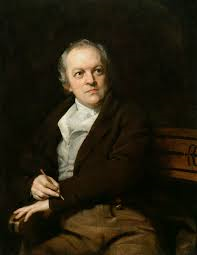
William Blake by Thomas Phillips, National Portrait Gallery, London
This is apparent at the beginning of the poem, where Blake wonders whether Jesus once visited England to establish a society of universal peace. “And did those feet in ancient time Walk upon England’s mountains green? And was the holy Lamb of God On England’s pleasant pastures seen?” The rest of the poem forms a series of questions, which are left for the reader to answer, from their own thoughts and imaginations.
The poem then moves quickly onto the clouded hills and the unforgettable image of the dark, satanic mills. Originating from Lancashire and from a family of mill workers, these words are tremendously powerful to me. Even in the twentieth century, life for mill workers was harsh, with long working days, excessive heat, air thick with cotton dust, and the deafening noise from the machinery. Health and well-being was not a major consideration. The success of the factory system came at a cost, a human cost.
Jerusalem contrasts the rural ideal of a harmonious and peaceful society with the crushing reality of an industrialised world: “And did the Countenance Divine Shine forth upon our clouded hills? And was Jerusalem builded here Among these dark Satanic Mills?” The poem then becomes a rallying call, and Blake demonstrates his determination to fight for justice and change. In this way, the dark satanic mills became my Dad’s and Blake’s reality, as the green and pleasant land was not.
When I hear Jerusalem I think of my Dad and the values he instilled in me: for me, the poem represents the struggle for human not national identity, whether that’s against the ‘dark satanic mills’, or other more contemporary problems. That’s why I believe that it resonates with those who have no faith, as well as those who do. Like all favourite poems, Jerusalem has meant different things at different times of my life. I saw the film Suffragette, which tells the story of women’s fight for votes, and a fairer and more equal society. It reminded me that the rights to the poem were owned for many years by the Suffragette Movement. The prison cells, the forced feeding, and the continued fight for equality became their own version of the ‘dark Satanic mills’. For women it would take many years for any form of Jerusalem to be ‘builded here’.
So whatever the interpretation of Jerusalem, one thing is certain: the poem has staying power and has ensured that William Blake is still remembered today. His words are as relevant now as they were in the early 19th century: “I will not cease from mental fight, Nor shall my sword sleep in my hand Till we have built Jerusalem In England’s green and pleasant land”. To my Dad and me, the poem became an expression for our shared desire for social change, and our hope for a better future. We sang it with pride at Dad’s funeral, a fitting tribute.
Pamela Davenport is an experienced Higher and Further Education teacher, who has substantial experience working with children and young people in social care, community and educational settings including the British Council’s Erasmus/Socrates Teacher Mobility Project. Writer on social Care Values in Practice, The Invisible Child, The Rights of Children and co-author for Teacher’s Handbook for HUGS Charity. She is a passionate lover of art and literature, in particular Shakespeare, the Romantics, and the work of the Pre-Raphaelite Brotherhood.


Pamela
A really insightful and thoughtful analysis of William Blake.
I had the good fortune to meet your dad but I did not know of his love for the poem Jerusalem. You have made your writing come to life by making it personal and a tribute to the memory of your dad.
Thanks for sharing your memories and experiences Pam. I think it would be a bit of a shame if Jerusalem ever became the English national anthem – Toby Perkins’ campaign is an interesting one though.
Thanks for this post; it’s great to read a strong analysis with heart, driven by personal memories and passion. I love Blake, and here’s a memory for you: when I was about fourteen my school English class was waiting in the classroom for the arrival of a new supply teacher, and preparing to give him the usual hard time that kids reserve for those brave souls. Suddenly the door was flung open and a burly young man burst into the room, reciting ‘Tyger Tyger’ at the top of his voice, with the most passionate intensity, and fixing each boy in turn with his own blazing eyes. I guess he figured that attack was the best form of defence, and he was right. Completely blew us away, and we didn’t give him any trouble for the few weeks he taught us. He was a good teacher, too.
Paul, thank you so much for the feedback and I love your story. I had an inspirational teacher, Mr Hamer, I wrote a blog about the way he opened my eyes to poetry. If you are interested check out what John keats and Bright start means to me.
I too will vouch for Mr Hamer as an English Literature teacher, he was wonderful. A great synopsis Pamela
Joy Hart
Hi Pamela, it is a lovely read. I have only ever thought of William Blake’s ‘Jerusalem’ as a political poem, how could it be read any other way? I liked the memory of your Father too, obviously a man who knew the values of life which, as you say ‘and the values that he instilled in me.’ We all should live by true, caring and justice for all, fighting when we are able for causes that we believe in.