


by Lucy Peltz
From America’s Declaration of Independence in 1776 to the end of the Napoleonic wars in 1815, Britain’s economic, social and political stability was in turmoil. Against this backdrop of revolution abroad, the relations between the sexes – and their proper roles — were increasingly challenged. While the figure of the respectable female writer of sentimental novels, poetry or didactic literature had become a cultural commonplace, there was a new backlash against the literary woman asserting her views in the more ‘masculine’ genres of history and politics. The tightening of gendered boundaries can be particularly identified in the reception and troubled reputation of a new generation of political voices, including the radical Mary Wollstonecraft.
In 1787, Mary Wollstonecraft was a relatively unknown writer who was running a school when she published Thoughts on the Education of Daughters. This was a ‘conduct book’, one of the few genres deemed acceptable for women writers. A year later Wollstonecraft wrote Mary, A Fiction, a semi-autobiographical novel in which she created an independent female protagonist whose ‘grandeur is derived from the operations of [her] own faculties, not subjugated to opinion’. It was also in 1788 that Wollstonecraft began to write for the Analytical Review. It was in this radical newspaper, that she first declared her admiration for the controversial republican thinker, Catherine Macaulay. This happened when Wollstonecraft was reviewing the older woman’s Letters on Education, where there was a clear overlap between Macaulay’s ideas and those Wollstonecraft had published in Letters on Education, especially around the importance of parental nurture and the coeducation of girls and boys. Wollstonecraft also empathised with Macaulay’s attack on the way girls were expected to ‘counterfeit . . . weakness in order to attract the notice of the male’. And while Wollstonecraft had formerly imagined herself the ‘first of a new genus’, in 1790 she was pleased to identify Macaulay as a female role model. Her enthusiastic sense of affinity with the ageing radical is evinced in the unsolicited and bold letter that Wollstonecraft wrote to Macaulay.
Madam,
Now I venture to send you < blank >, with a name utterly unknown to you in the title page, it is necessary to apologise for thus intruding on you – but instead of an apology shall I tell you the truth ? You are the only female writer who I consider in opinion with respecting the rank our sex ought to attain in the world. I respect Mrs Macaulay Graham because she contends for laurels whilst most of her sex only seek for flowers.
Whereas the final sentence of this letter captures the spirit of the two writers’ shared interest in promoting a new model of assertive womanhood, it is the first (now expurgated) sentence that indicates Wollstonecraft’s main excuse for writing to Macaulay without prior introduction. With this letter, we can deduce that Wollstonecraft had sent a copy of her recent publication the Vindication of the Rights of Men. This was her impassioned reply to Burke’s Reflections on the Revolution in France (1790) which had appeared a few months before — Observations on the Reflections of the Rt. Hon. Edmund Burke, on the Revolution in France (1790). Her letter to Macaulay thus attempted to reach out to a kindred political and intellectual woman whose own published attack on Burke’s Reflections had also just appeared. Both pamphlets reflect the feeling among radicals who had welcomed the French Revolution, in its first years. Wollstonecraft later summed up the mood when she stated that a ‘new spirit has gone forth, to organise the body-politic . . . Reason has, at last, shown her captivating face.’
The Vindication was Wollstonecraft’s first major success and it moved her into the masculine terrain of political discourse. It argued in favour of a more meritocratic society and scorned the privilege and property of the aristocratic hierarchy which Burke had defended. The first edition of the pamphlet made no mention of Wolstonecraft’s name and many critics assumed it was the work of a man. The Analytical Review knew better and their critic could not resist mocking Burke on this point: ‘How deeply must it wound the feelings of a chivalrous knight . . to perceive that two of the boldest of his adversaries are women!’ For conservatives in Britain desperate to maintain the status quo the deferential relationship expected between men and women took on an increasingly politicized charge at this time at this time. In this context, the image of the empowered woman – as identified particularly in the French mob — became deeply emotive. An example of this can be seen in the satire Don Dismallo running the Literary Gauntlet.
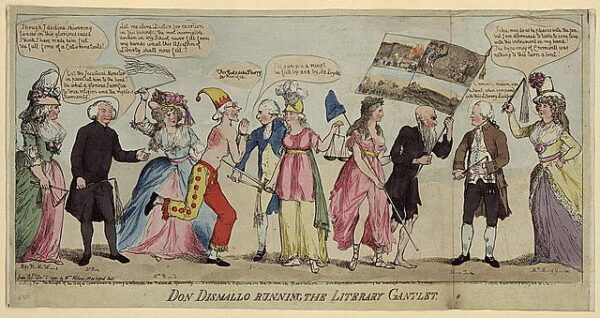
Don Dismallo Running the Literary Gantlet, published by William Holland, 1790
The people in this print are all linked by their support for the Revolution. The women were distinguished for refuting Burke in print, or so it seemed. Williams who was noted for her sympathetic, eyewitness Letters Written in France had just published a poem in praise of the storming of the Bastille. Catharine Macaulay’s forthcoming attack on Burke’s Reflections had been announced and Barbauld, who had first opposed Burke in March1790, was assumed to be writing another refutation of his Reflections.
While only a handful of the responses to Burke were by women, Don Dismallo indicates how the female political voice raised special anxieties. Horace Walpole, who shared Burke’s anti-revolutionary conservatism, dismissed them as cheap hacks who ‘spit their rage at eighteenth pence a head’. He vilified further, describing them as ‘Amazonian allies, headed by Kate Macaulay and the virago Barbaud, whom Mr Burke calls our poissardes’. By referring to Burke’s description of working-class women in the French mob — as fishwives, or the ‘furies of hell’ – Walpole’s comments reflect the conservative fear of female activism.
Wollstonecraft’s Vindication of the Rights of Men appeared just a few days before Don Dismallo which explains why she is not figured in the print. According to her biographer, the Vindication received ‘extraordinary notice’, especially once it was identified as the work of a woman.
At the same time, her name became associated with other leading revolutionaries who, like Tom Paine, had attacked Burke’s Reflections. She met Paine and many others through Joseph Johnson, the bookseller who was like a father figure to her. He gave weekly dinners which were a meeting place for London’s religious dissenters and political radicals. Among them were Henry Fuseli an extrovert but married artist for whom Wollstonecraft developed a desperate infatuation and eventually proposed a ménage à trois — and William Godwin – a shy and awkward philosopher who was initially irritated by the way she monopolized the conversation but would later become her husband. It was also through Johnson that Wollstonecraft met John Opie, the fashionable artist who became her life-long friend. This was his first portrait of Wollstonecraft painted in the period immediately following the Vindication. It is a sensitive and confident image of a female author, showing her distracted momentarily from her studies.
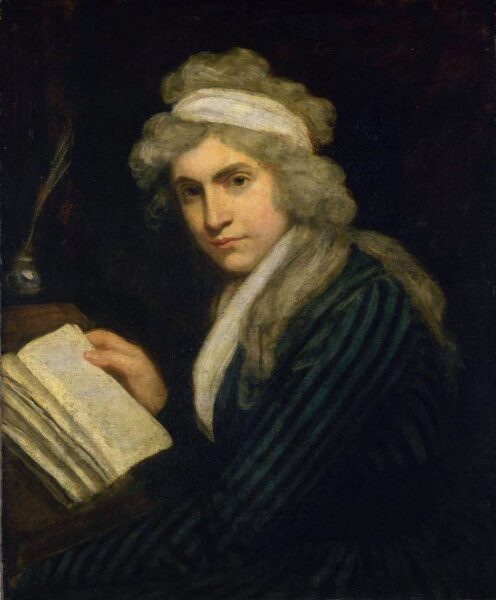
Mary Wollstonecraft by John Opie, c.1790–1, Tate London
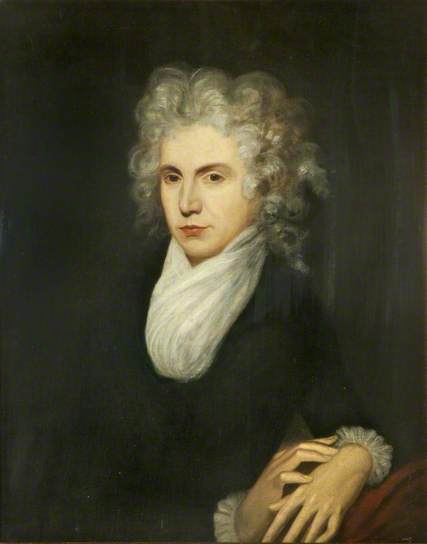
Mary Wollstonecraft, by John Williamson, 1791. Courtesy National Museums Liverpool, Walker Art Gallery
It would be an overstatement to call the Rights of Woman an autobiography. The work does however tackle issues of female education, identity and autonomy that had preoccupied and effected Wollstonecraft for most of her adult life. English women she argued had been forced into narrow roles within society, were denied access to education and were thereby trivialized as frivolous creatures whose purpose was only to please men. Moreover, women were complicit in their own cultural subordination through their love of sentimental novels, gossip and fashion. Advocating serious study to lift a woman from sensation to intellect, Wollstonecraft’s rallying cry was aimed at the radical reform of Britain as a whole. “It is time to effect a revolution in female manners – time to restore them their lost dignity – and make them, as part of the human species, labour by reforming themselves to reform the world.
Having renounced Christianity in 1790, Wollstonecraft’s proposals were rooted in her belief in ‘perfectibility’ – the doctrine that people can achieve perfection in their lifetime. The work was also based on a levelling principle which took its inspiration from the French Revolution. Both were contentious positions to adopt and yet the Rights of Woman was greeted with approval in 1792. That is because most reviews treated it as ‘an elaborate treatise on female education’. The Analytical Review, for one, managed to overlook the radical elements and conclude that ‘If the bulk of the great truths which this publication contains were reduced to practice the nation would be better, wiser and happier’. The only periodical to attack the Rights of Woman was the Critical Review. This Tory paper correctly identified the revolutionary ambitions and implications of Wollstonecraft’s proposals. It envisaged a world in which Wollstonecraft’s proposals were put into action and decried the social impact if women, once educated to the level of men, refused to continue their allotted duties of child care and nursing the sick. Ironically the French Revolutionary government concurred. Although Wollstonecraft had dedicated the book to the French diplomat Talleyrand, his report on education to the National Assembly in France expressed the view that women were indeed the weaker sex and should follow the ‘will of nature’ in pursuing gentler, domestic occupations.
Despite its initial success, the Rights of Woman and its author would become synonymous with libertarian immorality and would soon be shunned. The reasons for this fall from grace were manifold including the reception of Wollstonecraft’s subsequent writings, the details of her private life and the increasingly repressive social and political situation. The personal details were revealed by her widower William Godwin whose Memoirs of the Author of A Vindication of the Rights of Woman was rushed into press four months after Wollstonecraft’s gruesome death in childbirth in 1797.

William Godwin, by James Northcote, oil on canvas (1802). National Portrait Gallery, 1236.
True to his philosophical ideal that perfection could be achieved by reason alone, Godwin made no attempt to hide the scandals of her life. He shocked readers with details of how Wollstonecraft had lived out of wedlock and had a child with another man, had twice attempted suicide, had become pregnant before her marriage to Godwin and, finally, had refused religious rites on her deathbed. In focussing on her personal life and distress, Godwin aimed to present his dead wife as a ‘female Werther’ – the doomed character in Goethe’s influential novel The Sorrows of Young Werther (1774). But in the end, Godwin’s writing is in fact more an exploration of his own feelings and the culture of sensibility than the Wollstonecraft’s political philosophy.
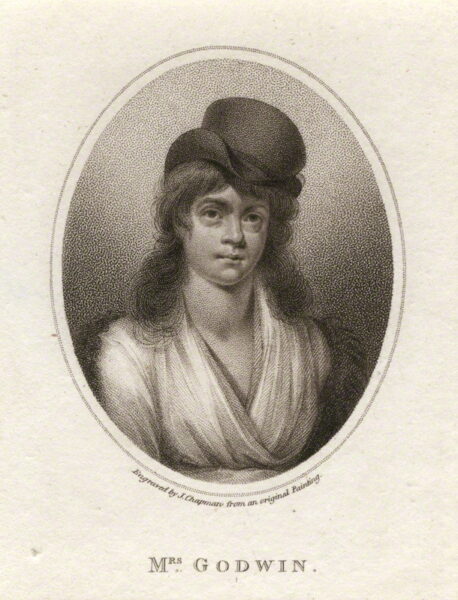
Mary Wollstonecraft, stipple engraving, by John Chapman, possibly after an anonymous painting (1798) National Portrait Gallery, D7842.

Mary Wollstonecraft by John Opie, oil on canvas, circa 1797
See Wollstonecraft, whom no decorum checks,
Arise, the intrepid champion of her sex;
O’er humbled man assert the sovereign claim,
And Slight the timid blush of virgin fame.
Besides Wollstonecraft, Polwhele named eight other ‘unsex’d’ women: Mary Hays, Helen Maria Williams, Catharine Macaulay, Anna Letitia Barbauld, and Charlotte Smith. This may have been was a disparate group, but on close inspection what the ‘unsex’d’ women have in common is their temerity in claiming literary independence but worse still, their support for progressive politics and their criticisms of Britain’s political, social and religious institutions.
All this was manna to Wollstonecraft’s opponents in the increasingly repressive climate that followed the Treason Trials, the Naval mutinies, and the Irish Rebellion in the late 1790s. Thus Wollstonecraft’s life was turned into an emblem of revolutionary, immorality in action. The European Magazine declared her a ‘philosophical wanton’ and the government-sponsored Anti-Jacobin Review led an intense scurrilous attack to defame her and her beliefs. In the index for 1798, under the heading ‘Prostitution’ was printed simply: ‘see Mary Wollstonecraft’.
Lucy Peltz is Head of Collection Displays (Tudor to Regency) and Senior Curator, 18th Century Collections, at the National Portrait Gallery. She is a Wordsworth Trust trustee. Her book Facing the Text: Extra-illustration, Print Culture and Society in Britain, ca. 1769-1840 is about to be published. Other recent publications are Thomas Lawrence: Regency Power and Brilliance, with A. Cassandra Albinson and Peter Funnell, Yale University Press, 2010; Brilliant Women: 18th Century Bluestockings, with Elizabeth Eger, National Portrait Gallery, 2008 and the guide book to Beningbrough Hall, with Roger Carr-Whitworth, National Trust, 2006.


I found this article fascinating because it shows how bold Mary Wollstonecraft was in stepping into political debates that were rarely open to women at the time. It made me appreciate how her writing and even her public image challenged traditional expectations of women. Her call for a “revolution in female manners” really highlights how radical and forward-thinking her ideas were for that era.