


by Gareth Evans
Once, while reading in a library that I used to haunt, I had an unexpected feeling of familiarity. I had been searching for something completely different in a bound volume of The Gentleman’s Magazine when I had stumbled on poem that side-tracked me.
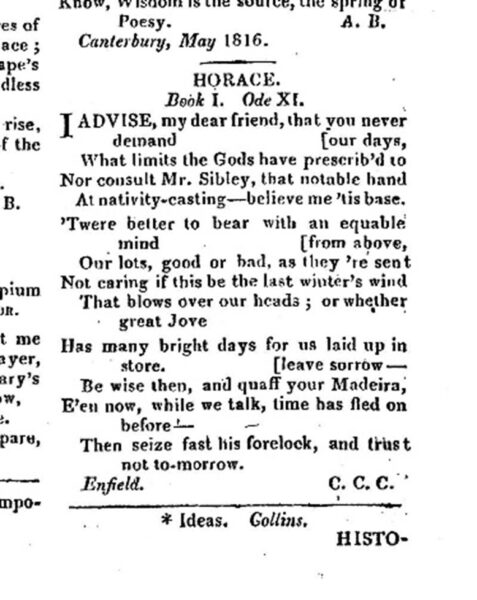
The Gentleman’s Magazine (1816. Vol. 119 Part 1. p616.)
With unusual foresight, and after some duplicate form-filling, I had the page photocopied; nowadays, of course, it’s available online. It was a translation of the Horace ode (Book 1, Ode 11) that is credited with popularising both the phrase, and genre, carpe diem – seize the day. Its sequence can be summarised like this (I’ll leave you to choose a sequence of emojis, if you wish):
- Don’t be like that.
- Instead do this, as time is short.
- a spirited finale.
This discovery brought to my mind how this invariably jolly form seems paralleled in the ‘Ode to Melancholy’, perhaps on the face of it the most unlikely. This association was reinforced by the poem’s attribution; ‘Enfield / C.C.C.’. While the popular Horace ode is something that Keats might have easily met with at school at Enfield, there appears here to be a personal connection with his earliest mentor. The headmaster’s son, Charles Cowden Clark personally encouraged the schoolboy Keats’s interest in literature, lending him books and eventually becoming the pathway to Leigh Hunt.

Charles Cowden Clarke
The poem appears in Cowden Clark’s commonplace book dated 1814, however, the dates of the book’s contents are recognised as not being those of composition but their entry into it. That Keats was more likely to have access to the book than not, rests on such evidence as Cowden Clarke’s open-handedness with it and Keats’s knowledge of some of its contents. Later in his life, in 1858, on the back of his success as a public lecturer, Charles Cowden Clark published a collection of poetry that dated back to 1805 humbly entitled Carmina Minima. It makes interesting reading as, in addition to a version of the Horace translation, there are several suggestions of images found later in Keats’s 1819 odes. (John Barnard, ‘Charles Cowden Clarke’s “Cockney” commonplace book’ in Nicholas Roe, Keats and History, 2012.)
The passing mention of divination at the opening of original Horace ode, Babylonios temptaris numeros, has been translated variously as ‘Babylonian numbers’, ‘Babylonian horoscopes’ or ‘Babylonian seers’. This was maintained by Cowden Clark in the 1816 version by modernising it to ‘Mr Sibley’. This is no doubt the contemporary astrological author and publisher Ebenezer Sibly (1751-1799).
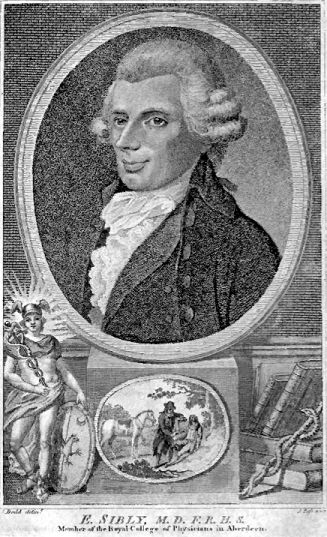
Ebenezer Sibley
Ebenezer was in a line of ‘respectable’ soothsayers that are a part of British cultural and publishing history. An astrologer, magician, and medical practitioner of sorts, his Celestial Art of Astrology (1784) was a ‘steady seller’ reflecting the ongoing popular market in superstition. Today he would be a maverick ‘M.D.’ and anti-vaxxer working all the social media sites.
Much work has been done on Keats’s careful reading of Robert Burton’s The Anatomy of Melancholy (1621). Burton’s immense book is a world in itself, and also of its world. His ‘melancholia’ covers several modern states of mind including depression. With a distinctive and engaging style, it is an exercise in literary reference from Antiquity onwards. If an early self-help book, one aim was to help himself. Burton’s strategy was for it to occupy his mind and so manage his tendency to depression.
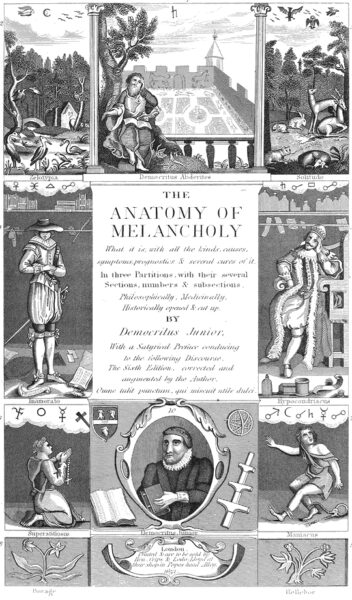 Having worked with the poet’s annotated copies at Keats House, Hampstead, RS White describes Keats as a ‘connoisseur of melancholy in all its manifestations and reinventions’. In his book Keats’s Anatomy of Melancholy, White details how this temperament informs the content and structure of Keats’s canon, also intriguingly outlining a legacy to 20th-century psychiatry. Keats’s personal accounts of his experiences are vividly integrated images of mind and body. In May 1818 he wrote to Benjamin Bailey apologising for troubling him with ‘the moods of my own Mind or rather body – for mind there is none. I am in that temper that if I were under Water I would scarcely kick to come to the top’.
Given that Keats had the carpe diem form in his mind when writing ‘Ode to Melancholy’, unlike the Horace original (or Cowden Clark’s modernisation) Keats does not conjure up images of divination but superstition in general. The younger Keats had covered this ground in ‘Written in Disgust of Vulgar Superstition’ (1816), thought to be the product of one of the 15-minute sonnet-composing contests in which Leigh Hunt produced On the Degrading Notions of Deity. Keats’s sonnet begins:
The church bells toll a melancholy round,
Calling the people to some other prayers,
Some other gloominess, more dreadful cares,
More harkening to the sermon’s horrid sound.
Surely the mind of man is closely bound
In some black spell; seeing that each one tears
Himself from fireside joys, and Lydian airs,
To Burton, a fervent 17th-century Protestant cleric, superstition included the beliefs and rituals of the Roman church (the Gunpowder Plot had been only sixteen years before the book’s publication). In the ode, Keats’s diffuses the focus to what he saw as all empty religious ritual by creating a botanical eucharist parody. Behind these are the flickering flames of Burton’s rants on fake cures that included witchcraft; ‘you shall find many vain and frivolous superstitions forms of exorcism among them, not to be tolerated, or endured’. This is bracketed with the rites of the Roman church at the beginning of the second part of Burton’s Anatomy (‘The Cure of Melancholy’) a section Keats may well have thumbed through first, as only the second and third parts were available to him, at least, originally. Do not be ‘seduced and deluded’ by ‘holy waters, relics, crosses, exorcisms, amulets, images, consecrated beads etc.’
In the ‘Ode to Melancholy’, the apothecary Keats creates a symbolic imitation of communion wine from the extremely toxic aconite root (wolfsbane, Aconitum napellus). Perhaps it came into Keats’s mind as a drastic ‘remedy’ for small-mindedness, as in ‘I cannot brook the wolfsbane of fashion and foppery and tattle’ (to Fanny Brawne, May 1820). The ritualistic imagery can be seen to be sustained with the ‘nightshade, ruby grape of Proserpine’ as the forehead is ‘kissed’ as in the bowing of a communicant’s head towards the offered host. The woody nightshade (Solanum dulcamara) draws our attention with its equally popular, and co-incidentally fitting name, bittersweet (see Evans, ‘Poison Wine — John Keats and the Botanic Pharmacy’, Keats Shelley Review, 16. 2002). For some reason it was an everyday wildflower in the past compared its current scarcity, with a legacy of literary references to its use as a rural charm against witchcraft.
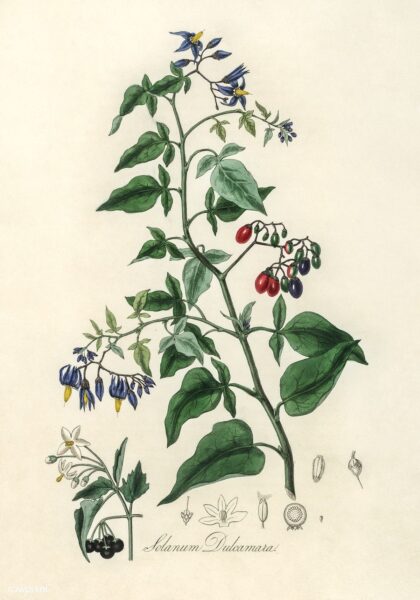 Keats’s multi-layered references include its red berries, hung in bunches, as a visual simile both for red grapes and, importantly, the individual crimson seeds within Proserpine’s real fruit, the pomegranate. After Proserpine’s abduction by Pluto, her accidental consumption of the fruit of the underworld was to forever prevent her unconditional return from the underworld to Earth.
‘Make not your rosary of yew-berries’ brings the ritualistic allusions to full-light. Comparison of the natural shape of the berry (technically, an aril) to a pieced bead matches the particularly colourful melodrama of the original first stanza that Keats was to discard. In fact, the fleshy part of the yew berry was known in Keats’s time to be the only part of the tree that was not potentially poisonous. The list of natural history images continues with the ‘death-moth’ and, the retrospectively alluded-to, death-watch beetle. Superstitions abound on the fatal consequence of hearing the buzzing sound that both can produce. An allusion to Psyche follows referencing the belief that one’s soul emerged from the mouth on death as a butterfly or moth. (Among the publications of Thomas Martyn (1735-1825), naturalist and erstwhile Professor of Botany at Cambridge University, is one meant for the popular market of ‘rare moths and butterflies’ that is simply headed Psyche.)
What does this laboured, but richly written, stanza mean? Returning to the opening we see that the first line has set the scene; ‘No, no go not to Lethe …’, the classical river of forgetfulness. Although drunk from by the dead to gain complete obliviousness of their earthly existence, it is not the Styx, the river crossed to enter the underworld. The mind filled with the superstition of this stanza would have the goal of oblivious forgetfulness. So, the first stanza has prepared the ground. Do not attempt to numb the ‘wakeful anguish of the soul’ and in doing so risk distancing yourself from the intensity of feeling needed for the remainder of the ode.
It could be said that Burton’s Anatomy is so all-encompassing that you can find just about anything between the covers if one tries hard enough. The starting point of Keats’s second stanza appears to be some advice that is quoted by Burton – ‘beauty alone a sovereign remedy against fear, grief, and all melancholy fits’ (Pt2 Sec2 Mem6 Sub4). However, the eponymous exhortation of the carpe diem reminds us of the passage of time, and indeed the short-lived nature of Keats’s instances of beauty (rainbows and blooms) implies its presence. However, it is the tolling line ‘She dwells with Beauty – Beauty that must die’ that reminds us most starkly of the inevitability of time. Keats then smartly subverts this into something very different; the act of timing, the control of the moment, which has been present throughout in the very nature of the ode’s subject. Many accounts testify to the sudden and unexpected onset of depression, concisely conjured up by Keats (via Burton) in the phrase; ‘when the melancholy fit shall fall’. Melancholy is indeed mighty as its victims are powerless, whether in their lack of knowledge of what hour it will fall or the number of the days it is visited on one.
In the last stanza Proserpine, appropriately, makes a re-appearance. ‘Joy’s grape’ through ‘Ruby grape’ connects to Proserpine’s fateful pomegranate that she had picked in the Elysium Fields to enjoy. Keats here identifies with her consequent binary state, that of her ‘posthumous’ life instigated by two innocent and unlooked-for events; her abduction by Pluto and her unwitting consumption of the underworld’s fruit means she has no choice but to divide her life between earth and Hades. For Keats, her forced abduction and translation are simple parallels for the instant of melancholy’s descent. In many ways, this carpe diem is an extraordinary inversion of the form. The narrator is a negative photographic image of the traditional avuncular imbiber. The advice is not how to avoid some form of melancholy, but comes from a voice ‘on the other side’, a habitué of the underworld of melancholy. And despite the symbols of death alluded to, the subject is the dread of the unpredictable abduction by melancholy and its consequences.
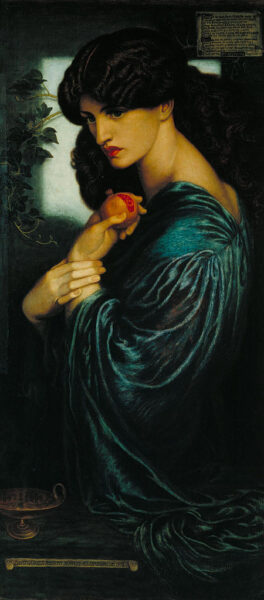
Proserpine, by Dante Gabriel Rossetti, 1874, Tate Britain
Nicholas Roe (John Keats, A New Life. 2012) has pointed out that the original Bethlem Hospital (so-called Bedlam Hospital) stood opposite the Swan and Hoop Tavern where Keats was born and spent his early childhood. Cibber’s Portland stone statue ‘Melancholy Madness’ was paired with ‘Raging Madness’ on Bedlam’s façade (they now guard the entrance to the Bethlem Museum of the Mind).
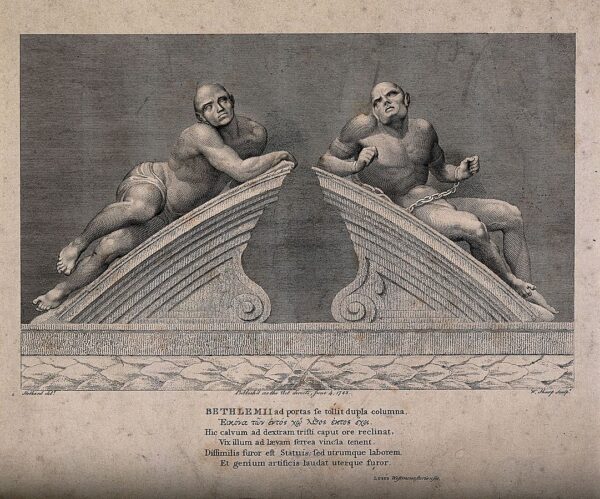 It was a representation of a historical condition; ‘flaccid and apathetic, Melancholy Madness is purposeless and disengaged from the world’. Hrileena Ghosh (John Keats’ Medical Notebook, 2020) discusses the embodiment of emotion in Keats’s poetry, a technique that could create vivid physical manifestations of feeling. Where the tongue is usually seen as the instrument and symbol of communication, Keats uses the descriptive possibility of its physiology. ‘Palsied’ is a pathological sign in Endymion as the grief-stricken Niobe’s tongue is like a ‘lost thing’. In The Fall of Hyperion (1818) the emotional state of stunned dejection is conveyed by the muscular tongue’s lack of tone and consequent muteness.
I had no words to answer, for my tongue,
Useless, could find about its roofed home
No syllable …
The ‘strenuous tongue’ of the ode’s last stanza has been seen as an unanticipated and startling image. In the context of Keats’s physiology of emotions, it is a development of previous images in his poetry. In the ode, the tongue’s muscles are not straining to counter an overly resistant pericarp but their own pathological paralysis. If we hear some note of triumph at the ode’s expressive close it is not only in the engagement with melancholy but how that goal is achieved. Straining an enervated tongue is an act of volition against the odds. His portrayal of the voluntary seizure of the life-changing fruit of Proserpine is a gesture of defiance in this case against the particular tyranny of melancholy.
Gareth Evans writes articles on the history and culture of plants and their use (garethhevans.com). He worked in, and with, botanic gardens for 16 years, specialising in the history of plants and medicine. Highlights include ‘Poison Wine: John Keats and the Botanic Pharmacy’, Keats-Shelley Review (2002) and the co-authored ‘Nothing but Flowers: John Keats’, The Lancet, (2011). Keats’s Flight from the Vegetable Monster was given at the Keats Foundation Conference (2017). He is currently working on The Four Humours project for Cadw at Strata Florida Abbey.


K’s Ode, to me, is rather ON than TO Melancholy, given it’s rationalistic and intellectualistic habitus; like many english romantics who feature rather than suffer the elements of “that” malady, their cortex seems too formed to let experience sink in (or out).
Otherwise in every sense a marvel of a blog. What enjoyment.