Guest blog
The Legacy of William and Dorothy Wordsworth in The Other Bennet Sister
by Molly Watson
The life and works of Jane Austen have never ceased to beguile and entertain. From the countless adaptations of Pride and Prejudice (1813) to Gill Hornby’s exploration of Austen’s family in Miss Austen (2020), Godmersham Park (2022) and The Elopement (2025), audiences continue to be drawn in by the Regency author’s witty charm. The BBC’s 2026 miniseries, The Other Bennet Sister, based on Janice Hadlow’s 2020 novel of the same name, reworks Austen’s most famous novel. It is told from the perspective of Lizzie Bennet’s overlooked sister Mary (Ella Bruccoleri), who slowly but surely grows in confidence as she is introduced to London society and two potential suitors, Mr Tom Hayward (Dónal Finn) and Mr William Ryder (Laurie Davidson). Key to Mary’s path to independence and romantic love is the poetry of William Wordsworth and the journals of his sister Dorothy.
William Wordsworth’s Poetry
Throughout The Other Bennet Sister, Mary struggles to understand and accept her emotions. Episode 1 ends with Mary’s humiliation after performing a song at the Meryton ball. In the next episode she reflects that:
“In the weeks that followed the disastrous Meryton Assembly, I buried myself in my books, hoping to stave off the pangs of shame and humiliation. It was all part of my plan for a new Mary. I needed a clear mind, unclouded by strong emotion. I was working on gravitas. From now on, I would be a steady, informed and rational woman. Books would be my guide. I would think more and feel less.”
Mary’s struggle between “gravitas” and “strong emotion” defines her journey in The Other Bennet Sister. As in Pride and Prejudice, Mary is bookish; her particular favourites include James Fordyce’s 1766 Sermons to Young Women and Catherine Macauley’s novels. After the sudden death of Mr Bennet (played by Richard E. Grant), Mary is sent to act as governess in the household of her uncle and aunt, Mr Gardiner (Richard Coyle) and Mrs Gardiner (Indira Varma). It is there that she meets Tom Hayward, a young barrister with a “passion for poetry”. One day Tom appears with a copy of Lyrical Ballads for the Gardiners; Mary admits that, although she has tried to enjoy the poetry of William Cowper, John Dryden, and Lord Byron, she much prefers “histories and geologies”. Tom declares that his mission from then on will be to encourage Mary’s appreciation of poetry. Gesturing to the copy of Lyrical Ballads, he hopes that “this is the book that will open the heart of Miss Mary Bennet!” – and so it does. William Wordsworth’s declaration in Lyrical Ballads that “all good poetry is the spontaneous overflow of powerful feelings” gains additional poignancy in The Other Bennet Sister, in which Mary becomes attuned to her own emotions.
Committed to ensuring that Mary grows to respect poetry, in episode 4 Tom performs ‘Composed upon Westminster Bridge’ (1802) to her and the Gardiners. So affected is Mary by Tom’s performance that she is brought to tears. William Wordsworth wrote the sonnet on his way to France with Dorothy. In her journal entry of that day, Dorothy notes:
“It was a beautiful morning. The City, St Paul’s, with the River and a multitude of little Boats, made a most beautiful sight as we crossed Westminster Bridge. The houses were not overhung by their cloud of smoke and they were spread out endlessly, yet the sun shone so brightly with such a pure light that there was even something like the purity of one of nature’s own grand spectacles.”
Here Dorothy evokes a sense of tranquility and calm. Such is apparent in the sonnet itself:
Earth has not any thing to show more fair:
Dull would he be of soul who could pass by
A sight so touching in its majesty:
This City now doth, like a garment, wear
The beauty of the morning; silent, bare,
Ships, towers, domes, theatres, and temples lie
Open unto the fields, and to the sky;
All bright and glittering in the smokeless air.
Never did sun more beautifully steep
In his first splendour, valley, rock, or hill;
Ne’er saw I, never felt, a calm so deep!
The river glideth at his own sweet will:
Dear God! the very houses seem asleep;
And all that mighty heart is lying still!
In The Other Bennet Sister, Tom is describing not only London but also Mary. Throughout the series Mary and Tom struggle to express their feelings for each other (whether due to social awkwardness or interruptions from Mr Ryder). Nevertheless, it is clear to the audience that they love one another. The “mighty heart…lying still” is at once a metaphor for a tranquil London and the complex emotions bubbling underneath Mary’s surface. For though Mary strives to be “unclouded by strong emotion”, her affection for Tom remains constant.
Dorothy Wordsworth’s Scafell Hike
There are numerous references to Dorothy Wordsworth in The Other Bennet Sister, especially during Mary’s visit to the Lake District with the Gardiners. Mary and Tom are keen to reach the summit of Scafell Pike, just as Dorothy did with her friend Mary Baker in 1818. (Note: The Scafell scenes were actually filmed in the Brecon Beacons). Though Scafell is popular amongst tourists these days, in the early nineteenth century it was rare to attempt such a climb.
Dorothy’s journal highlights the natural beauty of Scafell. She and Mary Baker are awestruck by “the majesty of the mountains below”. Nevertheless, the climb did not come without risk. A storm threatened to interrupt their journey: “the air changed to cold, and we saw that tiny vapour swelled into mighty masses of cloud which came boiling over the mountains”. The climb up Scafell in The Other Bennet Sister is similarly jeopardized by a storm. Yet it is not only the weather that brings drama. As the group climb up Scafell, Tom seems almost about to propose to Mary but is interrupted by William Ryder, who informs Tom that he has inherited a large sum of money and hopes to propose to Mary also. Disheartened, Tom emotionally distances himself from the group.
It is at this point that their guide informs them of a brewing storm. Tom heeds this warning but, hurt by his sudden coldness, Mary remains on the summit with William and Caroline Bingley. In a scene reminiscent of the ending of Sense and Sensibility (1811) (in which Marianne Dashwood is caught in a storm), Mary suffers a hypothermic collapse and is confined to her bed for days. When she wakes up, Tom has vanished: as she comments at the end of episode 9, “a trip that had promised so much, had delivered very little”.
For both Dorothy Wordsworth and Mary in The Other Bennet Sister, the climb up Scafell proves emotionally transformational. In keeping with Romanticism’s focus on the sublime, Dorothy’s descriptions of the landscape hone in on Scafell’s terrific beauty: “No gems or flowers can surpass in colouring the beauty of some of these masses of stone, which no human eye beholds”. In The Other Bennet Sister, Scafell becomes a symbol of Mary’s emotional turmoil. Who will she choose: Tom or William? Will she recognise her wants and desires? And is it worth keeping her feelings hidden? As the storm threatens to disrupt Mary’s climb up Scafell, so too does it threaten her chances with Tom.
While The Other Bennet Sister is at its heart a retelling of Pride and Prejudice, it is not solely concerned with Austen. Rather, it appropriates the Romantic period’s focus on emotional sensitivity. The verse of William Wordsworth unfolds Mary’s heart, while the trip up Scafell endangers her path to love.
By Molly Watson
Molly Watson has recently completed a PhD on Motherhood, Children, and Loss in the Works of Sara Coleridge and Mary Shelley (1820-52) at the University of Nottingham. She is interested in archives and letters, period dramas, and historical fiction.
All episodes of The Other Bennet Sister are now available on BBC iPlayer, with international release on BritBox scheduled for 6 May 2026.
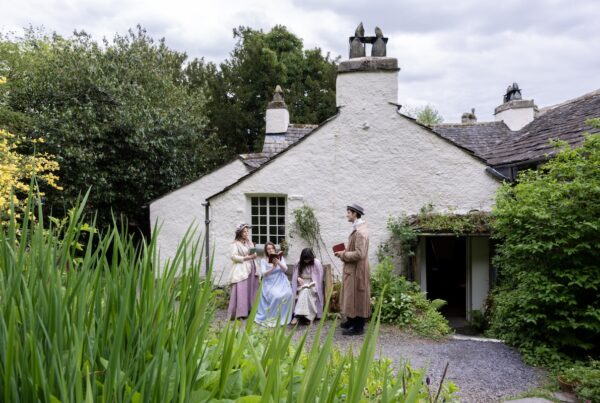
Visitors to Wordsworth Grasmere will find a unique copy of Lyrical Ballads in its original board covers – just as Mary herself would have had – on display as well as a rare first edition of Poems, in Two Volumes featuring ‘Composed upon Westminster Bridge’. The book is currently open to one of Wordsworth’s most popular poems ‘I wandered lonely as a Cloud’. Visitors to the attraction can also explore Dove Cottage, the historic residence of William and Dorothy Wordsworth.
Images used with thanks to BBC / Bad Wolf / James Pardon