


by Sinead Fitzgibbon
On the right bank of the Seine, just a stone’s throw away from the Palais Royal, the Paris Opéra and the Musée de Louvre in the French capital’s second arrondissement, lies a blink-and-you’ll-miss-it passageway. Despite being so close to these popular Parisian tourist attractions, the Passage des Petits-Pères boasts little to attract the attention of even the most intrepid of travellers.
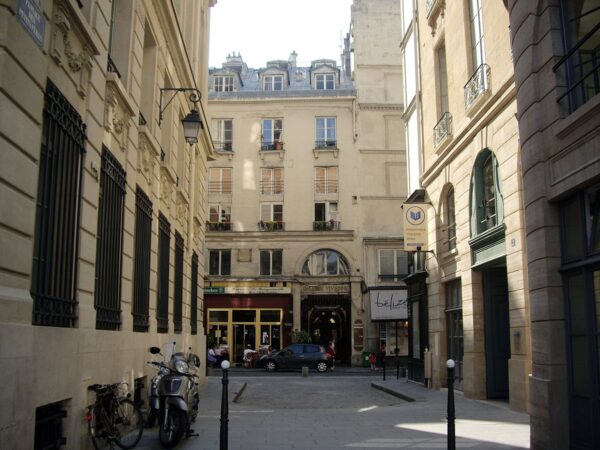
Passage des Petits-Pères
The first recorded meeting of this Society (which was later, somewhat misleadingly, called the British Club) took place at the Hôtel d’Angleterre, also known as White’s Hotel, on 18 November 1792, a Sunday. This ‘meeting’ was in fact a banquet to celebrate the establishment of the first French Republic and the advancement, as they saw it, of the Romantic ideals of democracy, human rights, and equality. In attendance were about one hundred British and American intellectuals including such progressive thinkers as Thomas Paine, author of the seminal Rights of Man; radical publisher, John Hurford Stone; the Welsh philosopher and polemicist David Williams; the poet and novelist, Helen Maria Williams; and the Irish aristocrat and revolutionary, Lord Edward Fitzgerald.
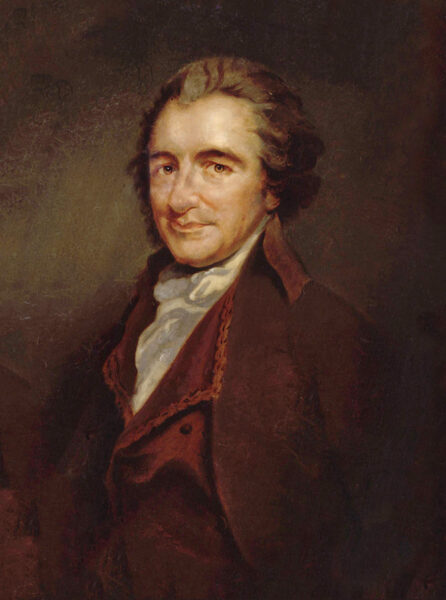
Thomas Paine, copy by Auguste Millière, after George Romney, NPG London
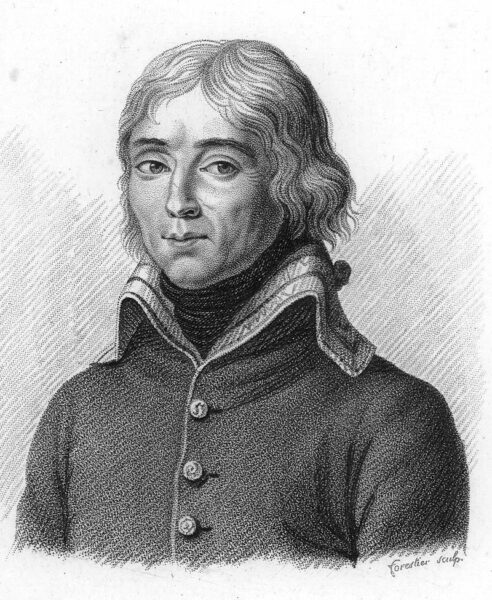
Michel de Beaupuy
Landing in Dieppe, the young traveller first made his way to Paris, where he stayed for some five days. During this time he did the rounds of the usual tourist sites, visiting Montmartre, Notre Dame, the Pantéon, and the fallen Bastille where he “sat in the open sun / And from the rubbish gathered up a stone / And pocketed the relic, in the guise / Of an enthusiast”. He also met with compatriot Robert Watt who introduced him both to the Jacobin Club, of which Watt was a member, and the National Assembly. Although he later declared that “In both her clamorous halls / The National Synod and the Jacobins / I saw the Revolutionary Power / Toss like a ship at anchor”, it is unlikely that Wordsworth would have been able to follow proceedings very closely given his then-limited grasp of the French language.
Leaving Paris, the young man then made a fateful journey south to Orléans. It was here, presumably not very long after his arrival on December 6 1791, that Wordsworth met Marie Anne Vallon. Whether the poet’s relationship with Marie Anne (known as Annette) was really the grand passion it has often been claimed to have been is debatable. Certainly, Annette’s surviving letters prove that she was quite infatuated with him, initially at least, but we can’t say for certain that this intensity of feeling was reciprocated by Wordsworth (perhaps tellingly, there is no direct reference to her in The Prelude). Nevertheless, one fact remains immutable; barely two months after their initial meeting, Annette was carrying Wordsworth’s child.
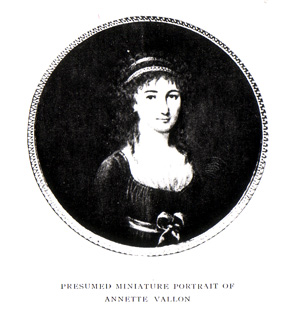
Annette Vallon
Revolutionary politics and the abstract predicament of the rural poor were not, however, Wordsworth’s only concerns at this time. With Annette’s pregnancy rapidly coming to term, the indolent traveller was forced to confront his own impoverished circumstances. The prospect of having to support two dependents was weighing heavily on him, and he was left with little choice but to make his way back to England in order, finally, to pick up some gainful employment. And so, with Annette safely back in Orléans, Wordsworth made his way back to England via Paris.
At almost six weeks, his second stay in Paris – which coincided with the meeting at White’s Hotel – was significantly longer than the first. This time, though, he encountered a very different atmosphere. The Bourbon monarchy had fallen in August, amid a violent attack on the Tuileries Palace while the September Massacres – an ominous presentiment of the atrocities to come – had thrown the National Convention into turmoil. But while these ugly eruptions of violence, which sullied the high-flown Romantic ideals of many of the Revolution’s foreign supporters, worried and sometimes frightened Wordsworth, they did little to dampen his enthusiasm for the republican movement.
Once in England however, with the outbreak of war between Britain and France making it impossible to return to, or even communicate with, Annette and his new-born daughter Caroline, Wordsworth began to waver. Initially, he found himself at odds with the public mood in his home country – his political affiliations and emotional loyalty were still very much with France. Indeed, in his Letter to the Bishop of Llandaff, written in early 1793, he is as defiant in his defence of the Revolution as ever. But the advent of Robespierre’s reign of terror in the autumn of 1793 horrified him, and as the utopian ideals of liberté, egalité et fraternité drowned in a sea of blood, Wordsworth, like many of his contemporaries, became profoundly disillusioned. He saw in Robespierre the destruction of the Revolution, but still, when the bloodthirsty Jacobin was himself shaved by Madame Guillotine, Wordsworth still hoped “for golden times”.
But golden times were not forthcoming. The advent of the Napoleonic era precipitated a radical change in Wordsworth’s political views, as he became increasingly conservative in his outlook. At the beginning of his French adventures, Wordsworth declared “Bliss was it in that dawn to be alive!” By 1794, he was saying in a letter to a friend “I am of that odious class of men called democrats” while in another he baldly stated “I recoil from the bare idea of a revolution…” By 1811, in View From the Top of the Black Comb, he was likening Napoleon to Milton’s Satan. Not content simply to distance himself from his early beliefs, Wordsworth in later life actively renounced them. In an echo of his doomed relationship with Annette, whom he met just twice more in 1803 and 1820, William Wordsworth had fallen out of love with France and all that she represented. It was a remarkable turnaround, by anyone’s standards.
As is often the case with such things, it can be argued that two competing narratives have grown up around the events in France at the end of the 18th century – there is the myth and there is the reality. The second generation of Romantic poets, including Byron and Shelley, were greatly inspired by the utopian ideals of the early Revolution, without giving sufficient weight to the destruction and horror which followed. It was easy for them to embrace a selective, almost mythical, version of events twenty years after the fact. Not so for Wordsworth; for him, the French Revolution was reality, and a painful reality at that. In renouncing all the beliefs he had once held dear, he was perhaps the most honest of them all.
(All quotes from The Prelude 1805 unless otherwise stated.)
Sinéad Fitzgibbon is the author of five titles for the popular History In An Hour series, including Shakespeare, Titantic, and JFK. She has also embarked on a series of city histories – A Short History of London is out now, while A Short History of Dublin is due in April.


Awesome article !
However, several years after, Mary Godwin Shelley rejected the bloody horrors of the French Revolution, although she remained being essentially revolutionary.
I got a doctorate with the study of the British Romantics and the French Revolution in 2002, and published a book of the same contents in 2003. It was entitled “British Romantics and the French Revolution: Blake, Wordsworth, Coleridge and the Revolution Controversy in the 1790s,” but unluckily it is in Japanese language and unavailable now except for myself.
I recall that the extract including “Bliss was it in that dawn to be alive!” made delightful reading. It would have been nice to have had it in full.