

“no children were ever more delighted”
What do you buy a 256-year-old poet for his birthday?
The 7th of April is upon us already, marking William Wordsworth’s 256th birthday. We were touched by all the enthusiastic comments and messages we received recently in response to the news that the Wordsworth Trust has been able to acquire Rydal Mount with the generous support of The Julia Rausing Trust and the Charlotte Aitken Trust. One particular contributor remarked that the acquisition was just in time for Wordsworth’s birthday and that got us thinking… so we had a little dig into the archives…
In our collection, two objects in particular offer glimpses into Wordsworth’s later birthdays: a cuckoo clock and a handmade rug.
The cuckoo clock was a 70th birthday present to Wordsworth from his friend Isabella Fenwick (1783-1856). She gave it to him before leaving Ambleside to go to Bath in February 1840.
The Wordsworths thanked Isabella in advance for the present, which obviously appealed to Wordsworth’s imagination even before he received it for ‘he has already heard it in fancy, and hopes to be present when you and little William first hear it together.’
All the Wordsworths loved the gift. William’s wife Mary (1770-1859) wrote to Isabella Fenwick that ’no children were ever more delighted with a new toy than we are’ with the cuckoo clock and how ‘Dear Miss Wordsworth [Dorothy] was seated before it upon the top of the stairs the other day – and when the bird had performed its office, and the little door flopped to, I thought she would have dropped from her chair, she laughed so heartily at the sudden exit of the little Mimic.’
Tradition holds that Wordsworth liked the clock so much he would wind it round to twelve o’clock in order to entertain his friends. Perhaps not surprisingly his wife complained that this led to it not keeping good time.
Wordsworth even wrote a poem about the cuckoo clock, originally titled ‘Stanzas Hint to a simple-minded Lover of Nature and of Art’, later titled simply ‘The Cuckoo-Clock.’
“The double note, as is with living power,
Will teach thee to be blithe as bird in bower.”
Wordsworth felt that the poem adequately recorded his feelings about the clock, for ‘Of this clock I have nothing further to say than what the Poem expresses’.
A few years later, for his 73rd birthday, Wordsworth received another deeply personal gift: a handmade rug, said to have been made by his daughter-in-law Fanny Wordsworth. Crafted from wool gathered from hedgerows that was spun, dyed, knitted, and embroidered by hand, the multi-coloured rug is made up of knitted squares each with the same embroidered cross-stitch motif.
The following year, in a letter to Henry Reed date 5th July 1844, Wordsworth describes quite the birthday celebration:
“In your last letter you speak so feelingly of the manner in which my birthday has been noticed, both privately in your country, and somewhat publicly in my own neighbourhood that I cannot forbear saying a word or two upon the subject. It would have delighted you to see the assemblage in front of our House, some dancing upon the gravel platform, old and young, as described in Goldsmiths travels, and others, children I mean, chacing each other upon the little plot of Lawn to which you descend by steps from the platform. The Tables were tastefully arranged in the open air, oranges and gingerbread in piles decorated with evergreens and spring flowers and all partook of tea, the young in the open air and the old within doors.”
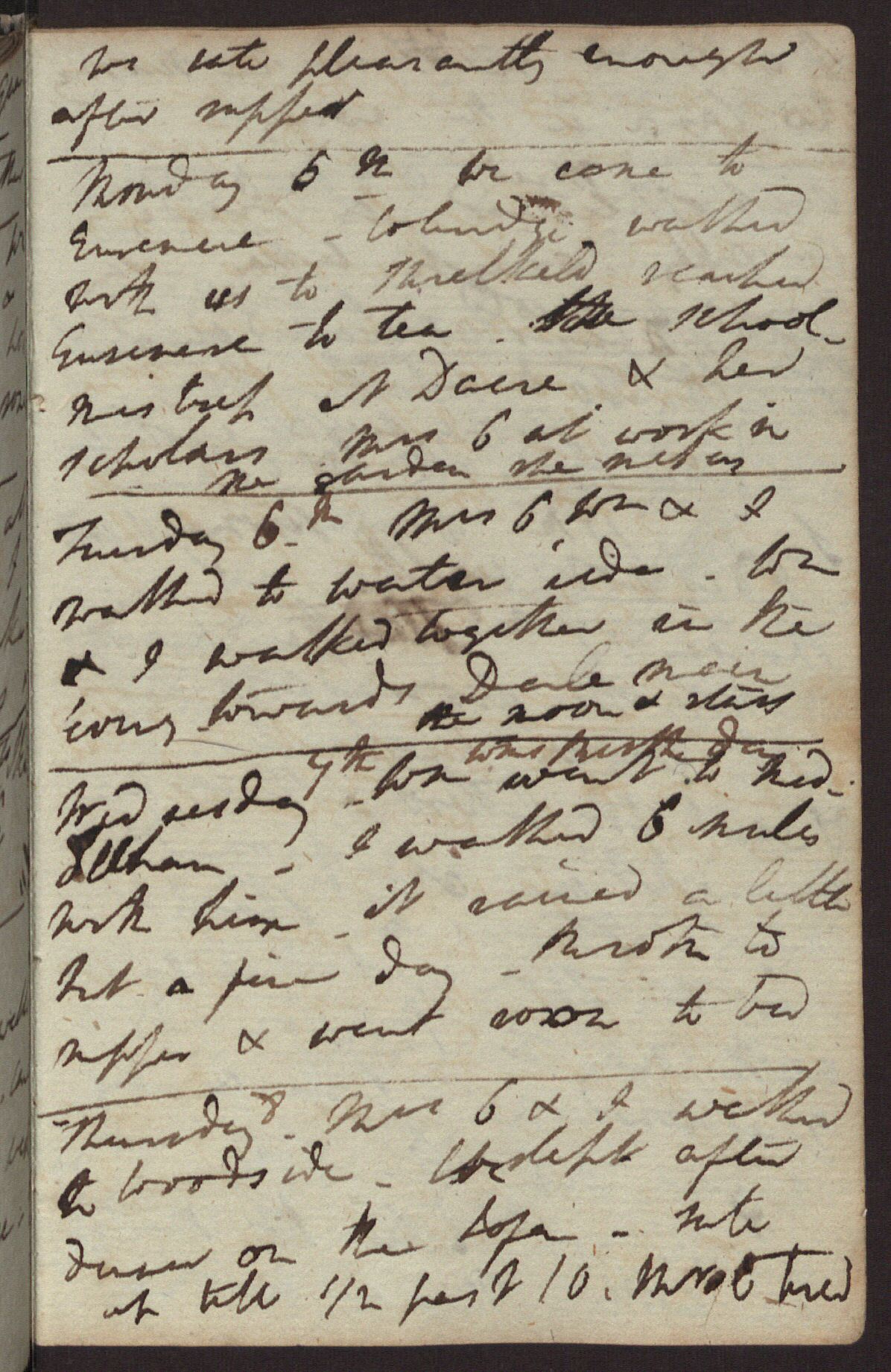
Not all of Wordsworth’s birthdays were marked so elaborately. Dorothy Wordsworth’s Grasmere journal records his birthday in 1802 with characteristic simplicity:
‘Wms Birthday. Wm went to Middleham—I walked 6 miles with him—it rained a little but a fine day. Broth to supper & went soon to bed.’ (Dorothy Wordsworth’s Grasmere journal, Wednesday 7 April 1802).
At first glance, it seems an unremarkable day. But that walk to Middleham brought Wordsworth to meet Mary Hutchinson, where the two would make their final decision about a date for their marriage. Even more charmingly, the manuscript shows that ‘Wms Birthday’ was added later, in a different ink – perhaps Dorothy forgot at first.
Together, these fragments – an enthusiastic household gathered around a cuckoo clock, a carefully crafted rug, a grand celebration and a rainy walk – remind us that Wordsworth’s life was not only shaped by grand ideas and poetic vision, but by friendship, family, and the memories of ordinary days.


It’s wonderful to learn about the personal touches behind Wordsworth’s celebrations, like the cuckoo clock from Isabella Fenwick — it really brings his later years to life. These small, thoughtful gifts remind us how deeply connected he was to his circle, and how much joy even simple gestures could bring. The acquisition of Rydal Mount feels like a fitting tribute to that legacy.