

by Jeanne Rae
Coleorton is an unremarkable village in North West Leicestershire, where the landscape was defined for almost 500 years by a coal industry that’s long since gone. The old colliery site has been planted over by the National Forest and Coleorton Hall, a Grade II listed building that once hosted a buzzing hive of Coal Board offices, is now an apartment complex. Rewind a couple of centuries, however, and Coleorton had a very different story to tell.

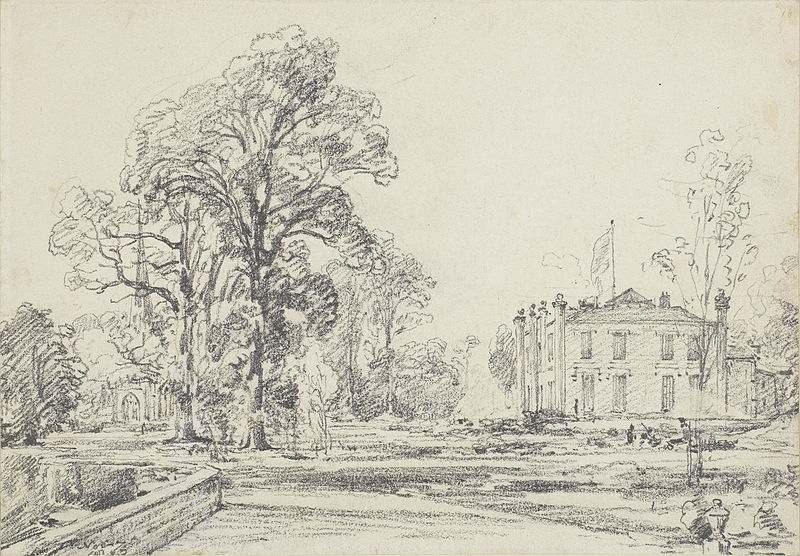
Coleorton Hall by John Constable, c 1823

Sir George Beaumont by Thomas Lawrence
Wordsworth’s brother John, a ship’s captain, had recently drowned after his ship ran aground and sank off Weymouth Sands, and the family was still deeply affected by his loss. On Christmas Eve, Samuel Taylor Coleridge joined them in Coleorton, bringing with him his own demons, most of them caused by his addiction to opium.
Writer and Director of Mantle Arts, Matthew Pegg, was drawn to this fascinating period in Leicestershire history.
What interested me was the relationship between Wordsworth and Coleridge, who were friends for much of their lives but in many ways very dissimilar characters. Wordsworth led a very domestic life, supported by family: his wife, her sister, his children and Dorothy. Coleridge had an unhappy marriage, from which he tried to escape, and was prone to addiction, relying heavily on drink and opium. My radio play focussed on the two men, their friendship, and the tensions between them. Coleridge envied Wordsworth’s family and fell in love with Wordsworth’s sister-in-law, Sarah Hutchinson. Paul Conneally, a Leicestershire poet, told us a scurrilous story about a vision of Sarah that Coleridge had in a pub at Thringstone. That incident also found its way into the play. The other theme in the script was the way Wordsworth reacted to the death of his brother, and the idea that, in creating the winter garden at Coleorton, he was working through his grief. In the script he calls it ‘a place to walk in winter,’ and Coleridge says ‘A walk for melancholy times. Yet when we emerge, it will be spring.’ By the end of the play he is able to say goodbye to his brother, though the experience has changed his poetry forever. We were very lucky to get project funding from the Heritage Lottery Fund to make this forgotten piece of North West Leicestershire history more widely known.
Using Matthew’s script, Mantle Arts created a community audio drama with a cast drawn from Ashby-de-la-Zouch, the nearest town to Coleorton Hall, and the surrounding areas of Leicestershire. Ashby Museum supported the project offering access to books and material from their archives as well as donating crucial rehearsal space. The play was directed by East Midlands-based director Julian Hanby. After a public rehearsed reading at the Venture Theatre in Ashby, accompanied by an illustrated talk on the background to the play from local poet and Wordsworth expert, Paul Conneally, it was recorded over two weekends at Aspect Studios in Loughborough, with the recording process directed by Martin Berry. The final recording is available on CD from Ashby Museum and can be streamed or downloaded from http://www.red-lighthouse.org.uk/events-and-projects/wordsworth-in-leicestershire/

If you would like a copy of the CD please visit http://www.ashbymuseum.org.uk/shop. You can also read more about the play and listen to some clips here


