


by Christine Kenyon-Jones and Geoffrey Bond
‘Don’t look at him. He is dangerous to look at.’
Lady Liddell to her daughter, on seeing Byron in Rome, 1817.
Being ‘dangerous’ was part of Byron’s character as a celebrity writer from early on in his life, because his poetry raised strong emotions, invited people to identify the poet himself with his wild and glamorous protagonists, opened up contentious areas of moral, political and religious debate, and laughed at many serious matters. Personally, too, Byron’s reputation as a handsome and seductive libertine made him supposedly fatally attractive to both women and men.
All this encouraged a wide range of artists to create portraits of Byron during his lifetime and to memorialise him after his death in Greece. Both in the originals and in print, these images were, and still are, a major part of his allure, drawing viewers into a relationship with him and making him instantly recognisable even to those who have never read his work, letters or life story.
But while Byron’s ‘dangerous’ writing and personal life can be regarded as his own choice, the question of how far he was responsible for the powerful visual effect of his portraiture and what can be called his iconography is more complex. Any portrait includes the contribution of the artist as well as the sitter and, as Byron soon discovered, he was by no means fully in control of the way he was presented visually, even if he had chosen and commissioned the artists himself and sat face-to-face with them to produce an ad vivum or ‘from life’ portrait.
In terms of his personal style and the way he looked, Byron certainly made strenuous efforts to control the presentation of his own face and figure, carefully disguising the deformed foot which embarrassed him and darkened his life, and using rigorous dieting and exercise to try to control his weight.
As a result, he appeared distinctly fat at some stages in his life, as in this 1822 portrait by William Edward West,

and painfully thin at others, as in this drawing by Alfred d’Orsay sketched only one year later.

The way he dressed was important, too: in real life he employed fashion of the scrupulous, Beau Brummell, type (acknowledging a ‘tinge of Dandyism’ in his youth); and in his portraits chose to wear sailors’ and ‘Albanian’ dress and Scottish plaid, and commissioned elaborate Homeric helmets for his final voyage to Greece.

He also instructed artists not to portray him with the pens or books that belonged to a poet, preferring to be presented as a nobleman and man of action rather than a sedentary writer. But even in face-to-face portrayals he could not exert total control over the artists – and in portraits which were not from life, such as the thousands that circulated during his lifetime through copies, engravings and other prints and imagined representations, he as the subject had no control at all.
Commissioning, sitting for, checking, responding and reacting to portraits of himself was a significant part of Byron’s life, and many of his relationships, both personal and with his public, were conducted through this process and through his portraits. Byron enthusiastically endorsed the social customs concerned with the exchange of miniatures and private portraits, although he often expressed doubts about the value of public portraits (‘vanities’), frontispieces of the author’s face (‘a paltry exhibition’) and particularly busts (‘pretensions to permanency’).
Ironically, some of Byron’s favourite portraits of himself are no longer extant for us to see in the original. Both the 1812 miniature by George Sanders, and the 1815-16 portrait by James Holmes, which Byron called ‘the very best … one of me’, were badly damaged by the amateur alterations of Byron’s great-granddaughter Lady Wentworth in the twentieth century.

Sanders’ 1812 painting survives in a copy because it was purloined by Byron’s former lover, Lady Caroline Lamb, who had this replica painted by Emma Kendrick. The gold locket is inscribed with Byron’s family motto – but in the negative: ‘Ne crede Byron’ – ‘Do not believe [him]’.
The 1815-16 Holmes miniature is now only available in copies and engravings, and in this photograph taken by Sir Emery Walker in the 1890s.

On the other hand, many of the famous portraits of Byron that we are now familiar with were not actually available to the public during Byron’s own lifetime, and in that respect (as in many others) we now know more about Byron than his contemporaries did.
Notable examples include the famous Thomas Phillips ‘Albanian’ portrait which was shown at the Royal Academy Exhibition in 1814 but then shut up in a case by Byron’s hostile mother-in-law and not known, even through engraving, until nearly twenty years after Byron’s death.

In the meantime, however, the features of Byron’s own elaborate ‘Albanian’ costume were borrowed by one of the first illustrators of Byron’s work, Thomas Stothard, to clothe this representation of Byron’s Giaour – contributing to the widespread identification of Byron in the public mind with the ‘Byronic heroes’ of his imagination.

The original ‘Albanian’ portrait is now the British Ambassador’s residence in Athens, but this version, which is the most familiar today – because it hangs in the National Portrait Gallery in London – was actually not painted from life but is an artist’s copy, created by Phillips in 1835, more than ten years after Byron’s death.

Even the version of Phillips’ equally famous ‘cloak’ portrait (below) that is on show at Newstead Abbey (Byron’s ancestral home in Nottinghamshire) is not the original, but again an artist’s copy, created several years later.

In what does appear to be the original (below), which is owned by the Byron family, Byron looks thinner, less smooth and self-assured, and perhaps slightly less glamorous.

Another famous portrait, the George Sanders 1807-9 portrait of Byron and his servant Robert Rushton in sailors’ costumes, which was painted for Byron’s family and household at Newstead, was also in private hands during the poet’s lifetime. His mother described it as both ‘angelic’ and ‘very like’.

It was unknown to the public until 1830, six years after Byron’s death, in the engraved frontispiece to Thomas Moore’s biography of Byron, which offers only a clumsy shadow of the original.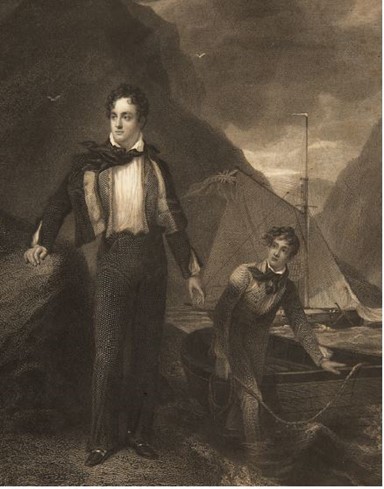 This beautiful 1815 drawing by George Harlow also remained unidentified as an original until the 1960s.

The prints of Harlow’s drawing made in 1815 and 1816 did became very familiar, but, by tipping the angle of his chin up slightly, gave Byron a supercilious expression not present in the original, becoming more and more exaggerated with each generation of copying.

Similarly, in sculpture, this fine original clay bust by Lorenzo Bartolini, created during numerous sittings with the poet in 1822, was unknown to the public until it was offered for sale in 2019.
Just how much an engraving or a copy can differ from the original artwork is demonstrated by the engraving of this bust made by Raphael Morghen, which gave rise to Byron’s mournful opinion that it ‘exactly resembles a superannuated Jesuit’.

Even in images taken from life, such as this silhouette traced directly from his shadow in 1806, there is huge variety among Byron’s portraits.

And (unlike in the cases of Keats, Blake, Wordsworth and Coleridge) no life- or death-masks from which to judge their accuracy, although Madame Tussaud did exhibit a waxwork figure of Byron.
And a modern version, wearing his original ‘Albanian’ costume, is on show at Bowood House in Wiltshire, where the costume was rediscovered in the 1960s.
Eventually, when his popularity as a poet began to wane, Byron began to resent what he now saw as the appropriation and unauthorised imaginative ‘creation’ of his image by the public. Using intensely visual metaphors to describe this process, he characterised women in particular as powerful artists who could make independent visual artefacts out of his face and body, himself and his works. Byron’s late epic poem Don Juan gives an ironically passive role to the legendary great seducer, and Byron presents Juan’s treatment by women in the same way that he saw himself, as the passive object of female visual fantasies:
with women he was what
They pleased to make or take him for; and their
Imagination’s quite enough for that;
So that the outline’s tolerably fair,
They fill the canvass up – and ‘verbum sat.’
If once their phantasies be brought to bear
Upon an object, whether sad or playful,
They can transfigure brighter than a Raphael.
Don Juan Canto 15, lines 122–8.
Two hundred years later, visual Byronism, Byromania and fandom are still flourishing, especially on screen, online and on social media, where images based on face-to-face sittings and those created from the artists’ fantasy or imagination circulate side-by-side as equally authentic ‘portraits of Byron’. One of the purposes of our book is to try to illustrate the ‘factual’ basis for these portraits as well as to show how, from early on in Byron’s lifetime, they have developed into a rich imaginative Byronic culture of many kinds, effectively rendering him immortal.
Geoffrey Bond and Christine Kenyon Jones are joint authors of  the new book, Dangerous to Show: Byron and his Portraits.
Geoffrey Bond is a former Chairman of the Byron Society and author of Lord Byron’s Best Friends. He lives in the Nottinghamshire manor house that was Byron’s home from 1803 to 1808.
Dr Christine Kenyon Jones is a Research Fellow in the Department of English at King’s College London. Her previous books include Kindred Brutes, and Byron: The Image of the Poet.


What an interesting piece of literary history. It reminds us that a person’s public image isn’t always created by the person themselves. Byron’s legacy was shaped as much by artists and public imagination as by his own poetry, and that’s a lesson that still feels relevant today.