by Fred Blick
It is only in the last 30 years or so that the pioneering contribution of Charlotte Turner Smith (1749-1806) to the Romantic movement has begun to be recognised. Wordsworth and Coleridge had been seen as pioneers of English Romanticism, most especially in their focus on the pleasures and pains of individuals, in the ‘one’ environment of Nature, but it is not always recognised that such concerns had also been reflected in William Cowper’s and Thomas Gray’s poetic appreciations of Nature, and subsequently in Charlotte Smith’s Elegiac Sonnets, which stirred the imaginations of Wordsworth and Coleridge. She was, in effect, a ‘mentor’ for them during much of her life.

Charlotte Turner Smith, by George Romney, 1792
Charlotte’s family, the Turners, were prosperous. She had a good education and a happy childhood, despite losing her mother at the age of four and being brought up by an aunt. She loved reading and wrote poems before she was eight. Later she became an acknowledged beauty, attracting the attention of the painter Romney.
Her troubles started when she was married off in 1765, at the age of fifteen, to a Benjamin Smith, who turned out to be irresponsible and financially reckless, and derived his money from slave plantations in Barbados. Charlotte Smith abhorred slavery (often comparing her own plight to that of a slave), but eventually she was forced to sell the slaves she inherited through her father-in-law’s will in order to support her six surviving children (five more children died either at birth or in infancy). Having shared a debtor’s prison with her husband in 1783, she finally left him in 1787. While her father-in-law’s will was being interminably disputed at great cost in the Chancery Court, she wrote ten novels to earn some extra cash, and was very successful. Sir Walter Scott later wrote admiring of her work. Between 1791 and 1793 Smith became involved with English radicals while living in Brighton, and Wordsworth visited Brighton on his way to revolutionary France in the autumn of 1791. He wrote in a letter to his brother Richard:
I was detained at Brighthelmstone till Saturday Evening which time must have past in a manner extremely disagreeable, if I had not bethought me of introducing myself to Mrs. Charlotte Smith, she received me in the politest manner, and shewed me every possible civility….
Smith showed her support for the French Revolution through the characters in her novels, just as Wordsworth later did in The Prelude, but like him, she became disillusioned by the excesses of the Reign of Terror.
Dorothy Wordsworth wrote of her in this journal entry, dated Christmas Eve, 1802:
It is a quiet keen frost …. my beloved William is turning over the leaves of Charlotte Smith’s sonnets, but he keeps his hand to his poor chest, pushing aside his breastplate.
It may be significant that Wordsworth began to concentrate on the sonnet form soon after this.
Smith’s Elegiac Sonnets was first published in 1784 and sold well. With additions, it went into eleven editions. Wordsworth gave a copy to his daughter Dora, and had his own copy (now at Grasmere) of the fifth edition of 1789, while he was a student at St, John’s, Cambridge.
 In it, he inscribed two more of Smith’s sonnets (later numbered
and LI in the sixth edition). These sonnets exhibit an autobiographical sensitivity to Nature in the tradition of the great sonneteers, Petrarch and Shakespeare, generally using the conventional Shakespearean rhyme scheme. Sonnet II is an excellent example:
Written at the Close of Spring:
The garlands fade that Spring so lately wove,
Each simple flow’r, which she had nurs’d in dew,
Anemones that spangled every grove,
The primrose wan, and harebell, mildly blue.
No more shall violets linger in the dell,
Or purple orchis variegate the plain,
Till Spring again shall call forth every bell,
And dress with humid hands her wreaths again.
Ah, poor Humanity! so frail, so fair,
Are the fond visions of thy early day,
Till tyrant Passion, and corrosive Care,
Bid all thy fairy colours fade away!
Another May new buds and flow’rs shall bring;
Ah! Why has Happiness—no second Spring?
By varying the Shakespearean form, Smith was a precursor for the Romantics’ experimentation in their own sonnets. Coleridge (who knew her personally) explicitly acknowledged her influence in his introduction to his 1796 Poems:
Petrarch, although not the inventor of the Sonnet, was the first who made it popular; and his countrymen have taken his poems as the model. Charlotte Smith and Bowles are they who first made the Sonnet popular among the present English….those Sonnets appear to me the most exquisite, in which moral Sentiments, Affections, or Feelings, are deduced from, and associated with, the scenery of Nature. Such compositions generate a habit of thought highly favourable to delicacy of character. They create a sweet and indissoluble union between the intellectual and the material world.
Smith’s use of the imagery of sight, flowers and particularly light may well have influenced both Wordsworth’s ‘Immortality Ode’ and Coleridge’s ‘This Lime-tree Bower my Prison’. This is her sonnet XXXIX:
I love thee, mournful sober-suited night,
When the faint moon, yet lingering in her wane,
And veil’d in clouds, with pale uncertain light,
Hangs o’er the waters of the restless main.
In deep depression sunk, the enfeebled mind
Will to the deaf, cold elements complain,
And tell the embosom’d grief, however vain,
To sullen surges and the viewless wind.
Tho’ no repose on thy dark breast I find,
I still enjoy thee — cheerless as thou art;
For in this quiet gloom, the exhausted heart
Is calm tho’ wretched; hopeless, yet resign’d,
While, to the winds and waves its sorrows giv’n,
May reach — tho’ lost on earth — the ear of Heav’n!
Likewise in XLVII:
To Fancy Thee, Queen of Shadows
Thee, Queen of Shadows! — shall I still invoke,
Still love the scenes thy sportive pencil drew,
When on mine eyes the early radiance broke
Which shew’d the beauteous, rather than the true.
Alas! long since those glowing tints are dead ….
Wordsworth and Coleridge loved to use ‘radiance’ to describe a special quality of light, as contrasted with its opposite, the ‘rayless’ dimming or extinguishing of that light, as Smith describes in Sonnet LVIII,
‘The Glow Worm’:
When, on some balmy-breathing night of spring,
The happy child, to whom the world is new,
Pursues the evening moth, of mealy wing,
Or from the heath-bell beats the sparkling dew;
He sees, before his inexperienc’d eyes,
The brilliant Glow Worm, like a meteor, shine
On the turf bank; — amaz’d and pleas’d he cries
Star of the dewy grass! — I make thee mine!
— Then, ere he sleep, collects the moisten’d flower,
And bids soft leaves his glittering prize enfold,
And dreams that fairy lamps illume his bow’r:
Yet with the morning, shudders to behold
His lucid treasure, rayless as the dust;
So turn the World’s bright joys, to cold and blank disgust.
In Wordsworth’s “Among all lovely things my love had been” (often called The Glow-worm”, the glow-worm symbolises possessive love, while Coleridge’s ‘Shurton Bars’, a love poem to his future wife, also invokes the glow-worm:
Nor travels my meandering eye
The starry wilderness on high;
Nor now with curious sight
I mark the glow-worm, as I pass,
Move with ‘‘green radiance’’ through the grass, ….
For Wordsworth, his sister Dorothy, and Coleridge, the glow-worm became a symbol of mutual love, as witness Dorothy’s journal for 24 April 1802:
We walked in the evening to Rydal. Coleridge and I lingered behind . . .We all stood to look at Glow-worm rock – a primrose that grew there, and just looked out on the road from its own sheltered bower.
Although the glow-worm already had a long literary history, stretching back at least as far as Shakespeare’s A Midsummer Night’s Dream, the fact that both Wordsworth and Coleridge used this image could well reflect their reading of Smith’s poems.
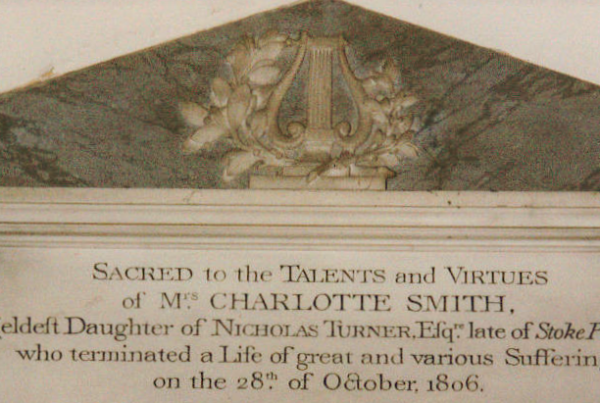
In her later years Smith suffered from rheumatism, which eventually left her immobile. She died on 28 October 1806, at Tilford, Sussex and was buried at St John’s, Stoke Church, near Guildford, where there is a memorial.

St. John’s churchyard, Stoke Park
Fred Blick is an independent scholar from a multi-disciplinary background. He has published a number of essays over the past twenty five years; not only ‘Wordsworth’s Dark Joke in ‘The Barberry-Tree’” in Romanticism journal in October 2014, but also innovative essays in peer-reviewed academic journals worldwide on the subjects of the sonnets of William Shakespeare and Edmund Spenser.