


by Fred Blick
The pioneer Romantic poet and novelist, Charlotte Smith (1749-1806) strongly influenced both Wordsworth and Coleridge. She died at Tilford, Surrey on 28th October 1806, and her marble memorial is eleven miles away at St. John’s Church, Stoke, Guildford.

Charlotte Turner Smith, by George Romney, 1792
There is every reason to believe that Smith chose to be buried at Stoke. She was born at King Street, London to Nicholas Turner and Anna, née Towers, on 4th May1749, but she was quickly moved with her family to Stoke Place, a prosperous estate which her father had inherited. Her baptism took place at St. John’s on 12th June 1749. Although the family soon moved again to rural Bignor Park on the Arun, Sussex, (another estate which her father had inherited), she must have felt that the roots of her earliest happiness were at Stoke, when her mother, who died before she was four, was still alive and where her poetically talented father at first cared for them very well. Although the exact location of her burial is not certain, it is probably with her mother Anna, “down a slope from Stoke Manor”, according to Judith Stanton, editor of her Letters. However, her black and white marble memorial can still be seen in St. John’s: .

It is curious that the memorial makes no direct reference to Smith’s outstanding and influential literary achievements, but merely to her “TALENTS and VIRTUES”. The only hint of her poetry is the carving of a lyre at the top. It is possible that the family had heeded Charlotte’s own words at the end of the Preface to the sixth edition of her Elegiac Sonnets , ‘I am well aware that for a woman – “The Post of Honor is a Private Station”’, i.e. “be obscurely good” ’(quoting Cato). However, the omission of any mention of her literary work is here unjust because the memorial to her eldest surviving son, William Towers Smith (1766 -1826), which stands adjacent and to the left of hers on the wall of the Church, refers to his achievements by recording that “AS A MAGISTRATE HE WAS KNOWN BY THE STRICT IMPARTIALITY OF HIS DECISIONS”. As a civil servant he had held the office of a Judge or Magistrate in India. However, in London he was a spendthrift and a losing gambler like his father.
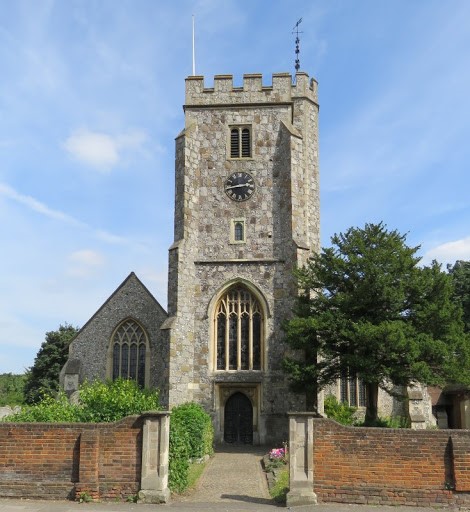
St John’s, Stoke, Guildford
Further, the memorial’s inscription below Charlotte’s, about two of her sons Charles and George Frederick, acknowledges their activities in “their Service of their Country”. Charles lost a leg in the war with France in 1793. He died from yellow fever in Bermuda when on family business in 1801. After his death George took over Charles’ Army Commission, but he died in 1806, six weeks before his mother, while on family business in Surinam, Guiana, also of yellow fever. The memorial makes no mention that Charlotte was the widow of Benjamin Smith, who died on 26th February, only eight months before her. This is understandable in view of their separation in 1787.
Most noticeably, the wording about Charlotte’s cause of death is curiously ambiguous: “Mrs Charlotte Smith …. who terminated a Life of great and various suffering”. Before the 1823 Burial of Suicide Act, interment in consecrated ground would have been forbidden by law if she had committed suicide and this had been referred to explicitly in the memorial. But it is difficult to ignore the fact that the verb “terminated” is used here transitively (OED 1.a). This implies, at the very least, a wilful giving up of life after “great and various Suffering”.
The ambiguity of the word “terminated” could have been avoided simply by using the words “died after”. But it is known from a letter of hers to a correspondent, Sarah Rose, dated 26 April 1806, that after ten years of pain and ill health, including the swelling caused by dropsy (which she treated herself with foxglove – digitalis), Smith was experienced stomach swelling and copious bleeding, indicative of uterine cancer, and that she did not expect to live much longer. She wrote to Sarah “ I hardly go even from my Sopha to the Window. I see nobody & hear nothing but the Wind”. In a letter dated 18th June 1806, she admitted to her patron and trustee, the Earl of Egremont, that she knew herself to be dying. In these circumstances her death from suicide is more than likely, especially as many of her letters suggest that the speaker “I” in her 1784 Elegiac Sonnets had suicidal tendencies at times of desperation. Charles Moore’s Full Inquiry into the Subject of Suicide of 1790 criticises Smith for appearing to encourage “the misplaced compassion excited by the death of “Werter” and to “furnish fresh palliatives in the cause of suicide” (2: 152). Moore is referring to the fact that Elegiac Sonnets includes sympathetic sonnets (XXI-XXV) about “Werter” who committed suicide in Goethe’s popular 1774 novel The Sorrows of Young Werther.
Even more significant is Smith’s autobiographical sonnet To Oblivion (written following the death of her favourite daughter Anna Augusta Smith de Foville in April 1795). This makes the urgent plea, “Oblivion! take me to thy quiet reign” (l. 6). If this plea is not simply poetic posturing (which would be inconsistent with her habit of sincerity), it is indicative of a desperate desire to give up life, even then:
Forgetfulness! I would thy hand could close
These eyes that turn reluctant from the day;
So might this painful consciousness decay,
And, with my memory, end my cureless woes.
Sister of Chaos and eternal Night!
Oblivion! take me to thy quiet reign,
Since robb’d of all that gave my soul delight,
I only ask exemption from the pain
Of knowing “such things were”—and are no more;
Of dwelling on the hours for ever fled,
And heartless, helpless, hopeless to deplore
“Pale misery living, joy and pleasure dead:”
While dragging thus unwish’d a length of days,
“Death seems prepared to strike, yet still delays.”
There are many other expressions of a desire for death or oblivion in Smith’s poems and novels. A chief motive of her life, which balanced her death wish, was to survive with courage by using her poetic ‘Lyre’ to help support her family. This is amply demonstrated by her letters. Perhaps her end came when she felt that she could no longer do this. She may have taken a final, very large dose of laudanum. She knew that one of her closest friends, Henrietta O’Neill, had terminated her own life in Portugal on 3rd September 1793 by a similar means. Henrietta had written a popular ‘Ode To The Poppy’ which Charlotte had published in 1792 in her novel Desmond. This concluded:
I’d …. conjure thee to impart,
The balsam for a broken heart;
And by thy soft Lethean power,
(Inestimable flower)
Burst these terrestrial bonds, and other regions try.
Almost exactly twelve months after Henrietta’s death, in September 1794, Charlotte wrote ‘Verses on the death of Henrietta O’Neil’, which ended with the wish that her own life should cease within twelve months of the passing of her “angel friend”. In all these circumstances it is reasonable to conclude that Smith’s memorial hints daringly at her suicide.
John Bacon Jnr.’s sculpture of the lyre at the top of the church memorial, though inconspicuous, is very appropriate. The lyre, as a symbol of poetry, goes back to the ancient Greek poets, particularly Sapho (c. 630 – c. 570 BC) who used it to accompany her poetry, and it is the source of the adjective ‘lyric’. The image of the lyre is all the more poignant in the light of Smith’s last poem, ‘To My Lyre’. This is an astonishing, satirical, eight-stanza poem of which her sister Catherine wrote, (it) “appears, from the feebleness of the handwriting, to have been composed a very short time before her death”. In it, Smith disdains the City’s fashion, its “Sons of Care”, its women, its commercial and legal jargon, and its expensive turtle meats and soups (“calepash and callipee”). She chooses instead “green fields …. leisure” and her “lyre”:
To My Lyre (stanzas 1, 5 and 8)
Such as thou art, my faithful Lyre,
For all the great and wise admire,
Believe me, I would not exchange thee,
Since e’en adversity could never
Thee from my anguish’d bosom sever,
Or time or sorrow e’er estrange thee. …
Long were thy gentle accents drown’d,
Till from the Bow-bells’ detested sound
I bore thee far, my darling treasure;
And unrepining left for thee
Both calepash and callipee,
And sought green fields, pure air, and leisure. ….
And as the time ere long must come
When I lie silent in the tomb,
Thou wilt preserve these mournful pages;
For gentle minds will love my verse,
And Pity shall my strains rehearse,
And tell my name to distant ages.
The sculptor of Smith’s St John’s memorial, John Bacon Jnr. (1777-1859), belonged to a family of established practitioners of monumental art. His work is to be seen at numerous sites, including St Paul’s, London, Worcester Cathedral, Bath Abbey (now in the V&A), Twickenham Church and St Peter’s in Thanet, Kent. The family’s commissioning of him is an indication of their sophisticated appreciation of such church art. Judging from his self-portrait below (sold at Christies on 16th March 2010) Bacon was also a skilled painter.

John Bacon Jnr
Although the underestimation of Smith’s influential achievements seems to have begun as early as the wording of her memorial stone, her valuable literary memorial, her poetic “Lyre”, is now secure. This is to be seen in full in The Poems of Charlotte Smith (Women Writers in English 1350-1850), edited by Stuart Curran (New York, Oxford, Oxford University Press, 1993).
Fred Blick is an independent scholar from a multi-disciplinary background. He has published a number of essays over the past twenty five years; not only “Wordsworth’s Dark Joke in ‘The Barberry-Tree’” in Romanticism journal in October 2014, but also innovative essays in peer-reviewed academic journals worldwide on the subjects of the sonnets of William Shakespeare and of Edmund Spenser.


