


A selection of poetry
by Adam Neikirk
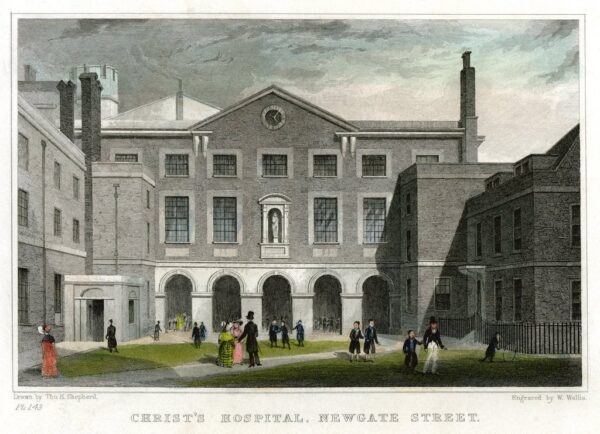
Lives there a Londoner who has not, at some stray hour or other, leant against the tall iron gates in Newgate Street, and felt his golden youth return, as he watched the gambols of the little bareheaded men in blue petticoats and yellow stockings? Can any man of thought, however hurried Citywards, but stop a moment to watch and see the ‘scrounge,’ the mad rush after the football, the dashing race to rescue prisoners at the bases? Summer or winter, the yellow-legged boys form a pleasant picture of perpetual youth; nor can one ever see the strapping young Grecian in the streets without feeling some veneration for the successor of Coleridge and Charles Lamb, Hazlitt and Leigh Hunt.
This passage from Old and New London: Volume 2, published in 1878, looks back nostalgically some one-hundred years to the days when Coleridge and Lamb dwelt together at Christ’s Hospital, a charity school located in Newgate Street, London (it has since been relocated to West Sussex, but still exists today).
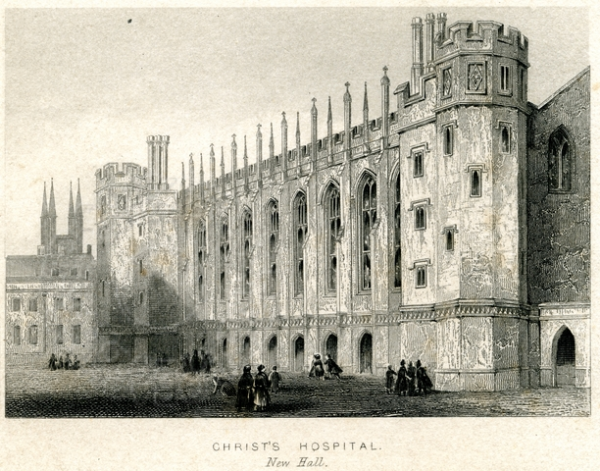
For the two future Romantic writers—Coleridge who would go on to compose poetry and philosophy; while Lamb, also a poet, tended to favour the essay and short story—it was the beginning of a lifelong friendship, though probably not one forged in the throes of “the mad rush after the football.” Coleridge and Lamb would both go on to write retrospectives of their days at Christ’s Hospital in Biographia Literaria (1817) and the Essays of Elia (1823) respectively.
 During my time as a PhD candidate at the University of Essex I have composed a number of verses relating the life of Coleridge (collected in a dissertation entitled Your Very Own Ecstasy: A Life in Verse of Samuel Taylor Coleridge). And it has been my pleasure to include ‘recollections’ of Charles Lamb in several of these, because he was Coleridge’s lifelong friend and the two shared not only biographical but temperamental likenesses (they both enjoyed smoking, drinking, and ‘disquisitioning’ at the Salutation and Cat tavern as adults). It is my belief that the friendship between Lamb and Coleridge deserves the same attention as that between Coleridge and Wordsworth, which was far more changeful.
Lamb frequently appears in Book I of my verse biography, which attempts to document the young “Sam” Coleridge’s time at Christ’s Hospital (among other things). Below I shall include several poetical excerpts from my biography which deal with Coleridge and Lamb together at Christ’s Hospital.
The poetry
Although Lamb is not named in these passages, he appears first in connection with the fearsome reputation of the Christ’s Hospital Headmaster, James Bowyer. Both Coleridge and Lamb recalled Bowyer’s sadism in later life. Coleridge here notices Lamb’s humorous nature.

Charles Lamb in 1798, by Robert Hancock, NPG London
From “X’s Hospital”
“I heard he eats your dreams at night.”
“I heard
He doesn’t eat at all, but subsists purely
On suffering, like a demon of the pit.”
“I heard that boys have died here,” said one more,
And Sam saw that it was a smaller child
Like him, only with curiously mismatch’d eyes;
He stood a bit away from the muddled group,
And went on speaking:
“And that there is, I heard,
A kind of warp that has form’d around this place,
Whereby the spirits of departed students
Are held inside, like snow in a glass globe,
And so this place is hopelessly haunted.”
This poetic remark, caus’d stirrings of disease,
But Sam, still peering at the elfin child,
Saw he was smiling, softly to himself
A party to disease he did not feel;
And all at once Sam realized it was a game,
A kind of contest, to see which wild remark
Could cut through to the listener, and check
The constraints of reason.
…
He paus’d to dab his brow, and his sharp eye
Fell again on Charles, who was rubbing the lump
Which following the blow he had receiv’d
Had form’d upon his face. “You, gentle boy!
In the freshness which pain entreats to thought,
I trust you now have some reply in mind
To the enquiry, which I beforehand made—”
Sam again saw mirthful laughter quietly
Dance thro’ the boy like two inhabited nuns
Sneaking together from the convent’s walls—
“Before… hand, sir?”
“I’ll beat you bloody, sirrah!”
In this excerpt Sam and Charles, together with some school-chums, are attempting to steal extra food out of the larder at night, breaking curfew in the process. Charles checks Sam’s exuberance, as he sometimes would as critic of Coleridge’s poetry later in life, so as to avoid detection.
From “X’s Hospital”
“Oh God!” Sam said aloud; “To eat a hare!”
Charles collar’d Sam, and fix’d him with a stare
Of blue and brown, of seriousness and mirth,
The icy glitter of pain and dirty truth,
And whisper’d, “Shut up! Or you’ll r-ruin us all!”
And then the nun: “O? Who can it be there?
Doth some poor sinner loiter in the hall?”
Not one of them answer’d; none return’d her call;
Until she, shrugging, tir’d, hungry too,
Took away her rabbit-skin, and the scent of stew
Gone after her like Piccadilly perfume.
When the door swung shut, it caus’d the scent to cease,
And Sam felt his heart relax, and Charles releas’d
His hold on him, and help’d to smooth the shirt
He had worn to bed, and check he had not hurt
His strange exuberant friend.

Coleridge in 1799, artist unknown
Below is an excerpt from a poem about an expedition taken by Coleridge, Lamb, and their friends Val and Bob LeGrice and Thomas Middleton to go swimming in the New River. This skulking led to Coleridge being placed in the infirmary with a fever, and may have prompted one of his first experiences with opium. Coleridge makes a speech to the others before jumping into the water fully-clothed.
From “New River Bathing Expedition”
They all lin’d up: Val, Charles, Sam, and Bob,
And Middleton inspected their bathing-garb:
Behind them, sunk within a concrete hollow,
A lion’s face spat out, and never swallow’d
The water, which logic would say, it drank;
With grim sad eyes set back in its green head,
And a mossy mane, both light, and dim, and dank,
The waterfall it made, flow’d to the bed
Of the New River, just outside the grounds
Of Christ’s Hospital. To their desultory wounds
The sounds it made, and the strings of purest light
That cut its waters, seem’d like a magic salve;
Soft sounds of chuckling, and of whispering,
As of a chum of theirs, who with inverted face
Retold some story of an Elfin race
“A grim procession by the bounds of night!
A thousand ghosts which thro’ the narrow road
Proceed or come from or pursue the grave;
They talk thro’ twisting and thro’ teetering of
Self-shuddering to release the heavy load
Of non-existence; ever & anon they go
From corner to corner, and from lamp to lamp,
To touch the furrow’d pole and make it dark,
Then leave it blindly with resuming spark.
Do they flee from us? Or do we from them?
Doth that one, up the graveyard’s hilly steep
Go running off, to find forever-sleep?
Or did I back—backpedal—to the place
Where I was born, and with inverted face
Retell some story of an Elfin race?”
The longer excerpt below contains part of a scene from ~1795, when Coleridge and Lamb are drinking together in the Salutation and Cat, and Coleridge is bemoaning his future marriage to Sarah Fricker.
From “Some moaning with a backdoor that ‘pops’”
O song of spring! Now lift up thy hand catch
The fragrant blossoms blowing overhead!
Even in London, where, ‘tis said, one cannot
Step on its grounds, and not step on a place
Where someone died or suffered, spring has come!
Oi! Do not swat me!
Coleridge and Lamb
Were sitting together in the tavern known
As the Salutation & Cat, smoking tobacco from pipes,
Drinking warm wine, and regaling themselves with tales
Of fictional motives and strange elves
Who went to school together many years
Ago. But oft would Coleridge interrupt,
Returning his friend, and all, to commiserate,
“O! Charles! But think of it! I am to marry!”
And he would throw his hands up, and let out
A deep and piteous moan, undoubtedly
The loudest thing in the room, emerging like
A hideous monster’s love-call from the back,
Except there was a back door on that place
That when it closed, would misfit of its frame,
And get stuck closed, so that someone who wanted
To enter discretely, or by the same route go,
Would have to force it open with a loud
But pleasantly unwavering POPPING sound.
…
Then someone PUSHED the door open. Charles sighed.
“It could be worse, Cole! You c-c-ould be on a ship to Ah-america.”
Coleridge let out a deep, unhappy sigh.
“I wanted to be on a ship. I wanted
To be there by now! Lovell, Southey and I,
And our three beautiful Fricker-sister brides!
Starting society anew! O think of it;
Just think of it, dear Charles! ‘Pantisocracy’!”
“‘Tis a beautiful coinage, Cole, b-but perhaps …”
Coleridge went on. “We really wanted such
A word, you know; instead of trodding upon
The dusty, hot & chalky road of Convention,
You slip in trustful wanderment across
The green & pathless field of Novelty.
Pantisocracy, from the Greek, Pantis, meaning—”
(Similes forever! Hurrah!)
“B-but really, Cole,” Lamb intervened, and his friend
Looked crestfallen that he could not finish his lesson.
“I understand the i-impulse, even if I
H-have a great l-l-love of London . . .
B-but still, you ought to m-meditate upon
Your o-own weak and sinful nature!
Just l-look at this snug room! These p-pipes, which,
Are of a d-decent cr-cr … a d-decent make …
Which w-we had ch-cheaply, I mean, r-really,
Y-you i-i-improvised—do you not rem-m-ember?”
Charles was laughing, and Coleridge raised his head,
Which had been lolling sadly o’er the table;
And seemed bestruck, almost by pang of conscience,
As if the memory revealed that while
It had been passing into the recent past,
He had been, through some hidden act of bombast,
Beguiling it; making it less than it was;—
The sense of himself—a player on a stage—
A sense which he had mildly built, from nothing,
Through letters, self-portraits, given in jubilant moments
(His cast of mind almost visibly rising
Over the page as scrawl led unto scrawl)
To that family which had loved him best, when he
Was but a kind of orphan, desultory,
A wanderer, outcast, and leave-day loner,
A sense of purpose, an inroad, and a notch
In the large unruly mosaic, that was London,
Had been prepared for him, it seemed, and he
Thought of it now with the achings of great loss,
Because he felt he had thrown it all away.
Charles still laughed, though his friend were Misery
In a hood of loose dark hair; and he lifted his glass,
And shifted like a feline, half-asleep
Beside the comfort of a heated room;
For he was drunk and happy, well-ensconced
In one of his favoured haunts; his mind did not
O’er range that place, did not like the Larch-tree
Shoot out its mental leafits from the now;—
“Oh, C-Coleridge, don’t be so miserable!
You have g-given your word, haven’t you?
You h-have your duty—you know, for s-some, ‘tis all
They need for happiness … b-but, by and by,
I think you are seeing the past, in a rosier h-hue,
Than e’er it was. If I m-might, m-might tell you s-something …”
Adam Neikirk is a PhD candidate in Creative Writing at the University of Essex and a Communications Officer in the Charles Lamb Society. His creative and critical writings have appeared in Creel, as well as the Coleridge Bulletin and Charles Lamb Bulletin. He lives in Colchester, Essex with his partner.


