


by Leslie Katz
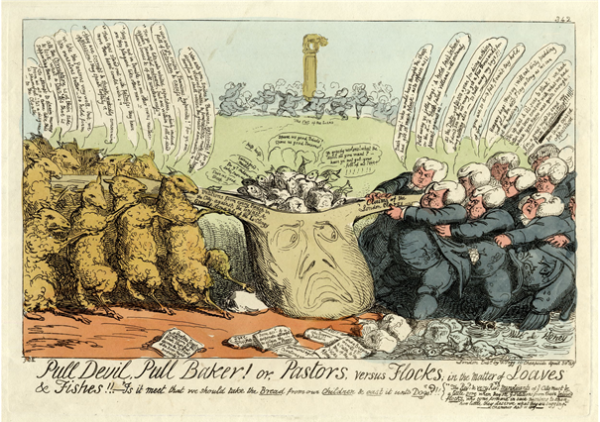
© Trustees of the British Museum
In the above print dated 30th April 1819, George Cruikshank satirised the greed of Church of England clergymen. The impetus for the print had been an attempt by a group of such clergymen to obtain by legislation an augmentation of their stipends.
Approximately two months earlier, on about 3rd or 4th March 1819, in the course of a journal-letter to his brother George and sister-in-law Georgiana that he wrote over a considerable period of time, John Keats had exhibited a satirical attitude to the greed of Church of England clergymen similar to that soon to be exhibited by Cruikshank. According to Keats,
[1]
Here is the parson at Hampstead quarreling [sic] with all the world, he is in the wrong by this same token; when the black Cloth was put up in the Church for the Queen’s mourning, he asked the workmen to hang it the wrong side outwards, that it might be better when taken down, it being his perquisite—
[2]
Parsons will always keep up their Character, but as it is said there are some animals, the Ancients knew, which we do not; let us hope our posterity will miss the black badger with tri-cornered hat; Who knows but some Reviser of Buffon or Pliny, may put an account of the parson in the Appendix; No one will then believe it any more than we beleive [sic] in the Phoenix. I think we may class the lawyer in the same natural history of Monsters; a green bag will hold as much as a lawn sleeve— The only difference is that the one is fustian, & the other flimsy….
For ease of discussion, I’ve divided into two numbered paragraphs the passage from Keats’s journal-letter that I’ve just quoted.
I’ll begin by elaborating on Keats’s discussion in my paragraph numbered [1] of the conduct of “the parson at Hampstead”. First, I’ll deal with some matters of identification. In referring to “the parson at Hampstead” Keats was referring to the Reverend Samuel White DD, who’d been the vicar of Hampstead since 1807 (and who was to remain in that position until his death in 1841). (Incidentally, according to the OED, the term “parson” is used “sometimes with pejorative connotation” and the context certainly suggests that Keats was using it in that way.) Further, in referring to “the Queen’s mourning”, Keats was referring to the mourning for Queen Charlotte, the late wife of King George III, who had died on 7th November 1818. Keats says that the vicar has been “quarreling with all the world”. The vicar may have been doing so, obviously about his asking to have the black cloth put up in the church inside out, but, assuming that he was, apart from Keats’s reference to the quarrel, I’ve unfortunately been unable to find any other reference to it.
The vicar’s concern about preserving the value of the black cloth put up in the church because it was his perquisite, was, in one sense at least, understandable. As Adam Smith had pointed out decades earlier in The Wealth Of Nations (1776), “A publick mourning raises the price of black cloth (with which the market is almost always under-stocked on such occasions) and augments the profits of the merchants who possess any considerable quantity of it”. Obviously, a similar happy result would ensue for the vicar if he was intending, as seems likely, to sell the black cloth after it had ceased to be required for the Queen’s mourning and had begun to be required for some other occasion. The vicar may even have been anticipating selling it on the death of the King, which death in fact occurred on 29th January 1820, less than a year after Keats’s discussion of the vicar’s conduct. (Although the vicar would presumably not have agreed with the entirety of Shelley’s description of the King in 1819 as “old, mad, blind, despised, and dying”, he might at least have agreed with the last part of it.) Would it be too much to imagine that the vicar sold the same cloth to the church authorities time after time as it was required, each time claiming it back as his perquisite when its use was no longer required?
If he had lived long enough, Keats would no doubt have derived some satisfaction from learning that there existed corroboration of his characterisation of the vicar as greedy. In 1832, the vicar successfully sued another clergyman, Wilcox by name, in the Consistory Court of London for officiating in the Downshire Hill Chapel, Hampstead without the vicar’s permission. An appeal by Wilcox to the Arches Court from the Consistory Court’s decision against him was afterwards dismissed. It may be that Wilcox further appealed from the decision of the Arches Court to the High Court of Delegates, but, apart from finding a reference to the existence of such an appeal, I’ve been able to discover nothing further about it. In a contemporaneous religious journal’s account of the Consistory Court proceedings, it was said,
The existing system of placing the veto in the hands of the incumbent affords an opening to practices which all must condemn, but which we shall not stop to explain. It may not however be irrelevant to observe, that when on a former occasion, Dr White consented to the licensing of a clergyman to this very chapel, he withheld that consent until the clergyman engaged under a penalty of two thousand pounds, not to visit any sick person; and it is expressly stated ‘That a poor gentleman being thrown out of his gig, and receiving a mortal wound, having desired the assistance of a clergyman; and Dr White and his curate being both out of the way, the then minister of Downshire Hill Chapel expressed his regret at being obliged to decline attending the bed of the dying man, for fear lest he should be compelled in consequence to forfeit the two thousand pounds!’
There was a footnote to the passage just quoted, which read, “There are certain other provisions in the said bond, which afford melancholy proof how actively the demon of covetousness operated in the minds of those by whom this most disgraceful[ ] document was drawn.” It appears plain that the vicar had been using his power to withhold consent to Wilcox’s licensing in order to further some moneymaking scheme of his (the vicar’s). (Perhaps the vicar had withheld his consent because Wilcox had refused to execute a bond in the same terms as those of the bond executed by an earlier licencee to the same chapel, including the egregious penalty clause.) That some moneymaking scheme on the vicar’s part was involved seems to be confirmed by a statement made by Sir John Nicholl in his reasons for judgment in the Arches Court:
Mr Wilcox had no permission to officiate in the chapel, which was an infraction of the rights of the perpetual curate, whether he had the cure of souls or not. If Dr White had the cure of souls, it was an infraction of his spiritual rights—if he had not the cure of souls, it was an infraction of his pecuniary rights….”
I turn now to my paragraph numbered [2] in the passage from Keats’s journal-letter that I’ve quoted above. In that paragraph, Keats moves on from dealing with one particular clergyman to dealing with clergymen more generally. There are a number of references in the paragraph to clerical apparel and it will be convenient to say what I have to say about those references first.
First, the clergyman of Keats’s day is described as “the black badger with tri-cornered hat”. White preaching bands worn by a clergyman together with a black cassock could be said to make the clergyman reminiscent of a badger, which has a black head with distinctive white markings. (One also finds a description of a clergyman as a black badger in Tobias Smollet’s The Adventures of Roderick Random (1748).) The reference to a “tri-cornered hat” was, I believe, a reference to what is more commonly referred to as a shovel hat.
Next, there’s the comparison of lawn sleeves, described as flimsy, to green bags made of fustian. The first reference is a clerical one; the second, a legal one. According to the OED, “lawn” is a “kind of fine linen”, used, among other purposes, “for the sleeves of a bishop”.

Charles Manners-Sutton, Archbishop of Canterbury 1805 to 1828, attributed to John Hoppner, Lambeth Palace, London
The above image shows the lawn sleeves that were part of the apparel of the Archbishop of Canterbury of Keats’s day. I should point out here that, contrary to the impression that one might gain from Keats, clergymen had to have episcopal status in order to sport lawn sleeves. A mere “parson” such as the vicar of Hampstead would not be doing so. As to the legal reference, according to the OED, “fustian” was “formerly, a kind of coarse cloth made of cotton and flax” (obviously not a flimsy material like lawn), while a “green bag” is a “bag made of green material such as was used formerly (the colour being now blue) by barristers and [other] lawyers for [storing] documents and papers”, as well as storing other things.
Moving now to the thrust of the paragraph, it can be broken down into four parts. Keats: (1) treated the greedy conduct of the vicar of Hampstead as characteristic of that of clergymen generally; (2) expressed the hope that the class constituted by clergymen would disappear from the world; (3) imagined that someone revising in the future either Buffon’s or Pliny’s Natural History might add to the relevant original author’s account of extinct creatures an account of clergymen; and (4) expressed the view that lawyers were as greedy as clergymen.
As to the fourth point, it’s apparent that, at least at the literal level, the comparison that Keats was making was between the respective abilities of clergymen’s lawn sleeves, on the one hand, and lawyers’ green bags, on the other, to store something, obviously currency. Keats, of course, didn’t have it in mind that clergymen and lawyers actually stored currency in their lawn sleeves and their green bags respectively. His referring to the ability of their sleeves or bags to store currency was just a metaphor for their greed. I should mention now that Keats’s strictures on clergymen that I’ve been discussing above were not the only ones to appear in the particular journal-letter that contained them. In a passage that appeared in the same journal-letter, but had been written a few weeks earlier, Keats had written, among other things, “I begin to hate parsons…. A parson … is a hypocrite to the Believer and a coward to the unbeliever—He must be either a knave or an idiot….”
Whence came this antipathy to clergymen? A persuasive explanation of the source was proffered by Robert Gittings. According to him:
All through the year, Keats’s feelings about the Church and the clergy had become wilder and less rational. … There was … an increasing and abnormal violence in Keats’s attitude. … [H]e repeated with relish a discreditable story about Samuel White, the Vicar of Hampstead…. … [I]t is from Tom’s death that his emotional fury against the clergy gets out of control. It seems likely that some cleric, perhaps the Vicar of Hampstead himself, had made unfortunate remarks. Keats’s own words, “I will not enter into any parsonic comments on death,” indicate that some had been made.
“Tom” here is Keats’s younger brother, who’d died of tuberculosis a few months earlier, on 1st December 1818. Thus, according to Gittings, it was Keats’s dealings with clergymen around the date of Tom’s death that appears to have led Keats, a few months later, to write to his brother and sister-in-law about clergymen as he did.
Leslie Katz is a retired judge. Having spent much of his working life writing for a living, he’s found it natural to continue writing in retirement. His writing is mainly of papers on topics that are either literary, legal or both. He posts his papers on ssrn.com.


