


by Julian S. Whitney
British Romantic poet Percy Bysshe Shelley (1792-1822) was not unlike the famed rock and roll electric guitarist Jimi Hendrix (1942-1970) when it came to his love of music, meditations on the woman muse, and hypnotic fascination with the sonic qualities of the guitar. Whereas Shelley used the poetic medium to examine how sound might facilitate transcendence, Hendrix was famous for using the electric guitar to experiment with new sounds that could mentally transport his listeners to another place. Both artists are similar in that they use the shared imagery of women in flight to illustrate how the powers of music and idealized feminine beauty work in tandem to elevate them beyond the physical realm. In this essay, I argue that Percy Shelley’s poem “To Jane: the keen stars were twinkling” interrogates the concept of feminine musical flight in a manner that aligns with Jimi Hendrix’s representation of the phenomenon, particularly within central songs about love and women such as “Little Wing” and “Night Bird Flying.”
Shelley became infatuated with Jane Williams (1798-1844) following Mary Shelley’s miscarriage in June 1822, seeing her as the musical muse who would elevate him beyond the physical realm.
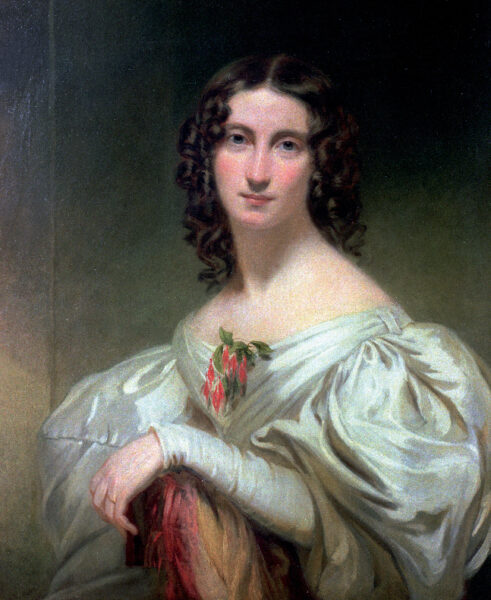
Jane Williams, by George Clint, c1822
Likewise, Hendrix interrogates a similar concept of idealized feminine beauty as he uses his music to address an ethereal woman-muse who represents a state of being in which love exists and thrives without limits. By invoking the woman-muse as a major source of male creative inspiration, Shelley and Hendrix exemplify a sort of romanticized creative originality that is rooted in a complicated rendering of the female subject as only having imaginative power within the paradigms of male fantasy.
Percy Shelley’s attraction to music and musical metaphors can be seen throughout his oeuvre with the trumpets of revolution in “Ode to the West Wind” (1819) or the immortalized music of Adonais (1821) in his poetic elegy to John Keats (1795-1821). He specifies the role of the Poet in musical analogies in A Defence of Poetry (1821), writing that the “Poet is a nightingale who sits in darkness, and sings to cheer its own solitude with sweet sounds.”[1] He analogizes the words of the Poet to “the melody of an unseen musician” who moves his listeners in ways they do not fully understand (516). Shelley describes human imagination as “the great instrument of moral good,” which has the power to discern right from wrong (517). However, the consistent invocation of musicality in the lyric reaches an even greater height with “To Jane: The keen stars were twinkling,” in which the muse possesses a musical voice of otherworldly flight that can transport Percy Shelley (his words and thoughts) beyond the physical limits of humanity.
In the poem, Shelley describes a romantic night with Williams before the “keen stars” and “fair moon,” an intimate locale in which an acoustic guitar is present for her to play (ll. 1-2).[2] Shelley famously gifted Jane with an Italian guitar (which remains at the Bodleian Library in Oxford) and wrote “With a Guitar, to Jane” which accompanied the gift.
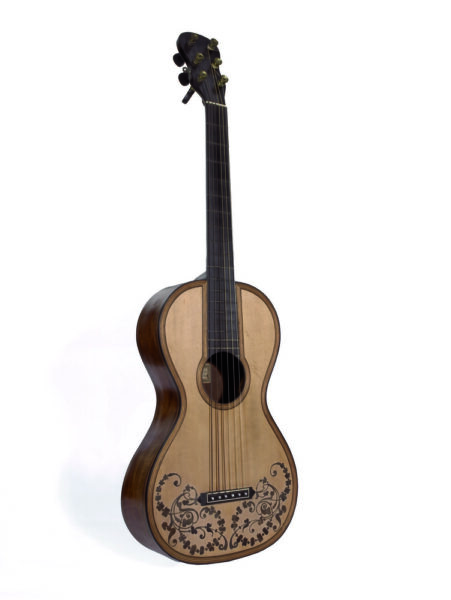
The guitar Shelley gave Jane, Bodleian Library, Oxford
When Shelley describes that Jane’s guitar “was tinkling / But the notes were not sweet ‘till you sung them / Again,” he intimates that the instrument is capable of power and emotion, but cannot be fully realized without her voice (ll. 3-4). Shelley reiterates his view later on saying, “So your voice most tender / To the strings without soul had then given / Its own” (ll. 10-12). He views the guitar itself as lifeless and “without soul” when devoid of Jane’s sweet voice and technical prowess. Yet, his rendering of Jane’s voice as an instrument of seduction problematizes her role in the poem. While she possesses the ability to synchronize the imagination with musical performance, Jane’s power only serves the purpose of elevating Shelley. Her voice is what ultimately imbues her instrument with a living “soul” but the music she composes is one rendered within Shelley’s aspiration for eternity.
In the second half of the poem, Shelley attributes even greater power to Jane’s voice when he describes its effect on the serenity of the natural world: “No leaf will be shaken / While the dews of your melody scatter / Delight” (ll. 16-18). The power of Jane’s performance quiets the world around her and creates a sense of uninterrupted peace. However, even more provocative is Shelley’s curious reuse of “scatter” (from “Ode to the West Wind”) alongside “Delight,” which specifically expresses enjoyment, pleasure, and self-fulfilment. In his ode Shelley addresses the Wind by demanding it to scatter his “words across mankind!” (l. 67).[3] He delivers a forceful proclamation about his immortal poetic legacy and the Wind’s power in preserving it through “mighty harmonies” (l. 59). But for Jane, her melodies “scatter Delight” across the world. In his provocative reversal of musical and literary agencies, Shelley defers the capacity for remembrance to Jane, but only through the expression of pleasure. He specifically states that Jane’s “sound overpowers” all and reveals a “tone of some world far from ours,” one that elevates them well beyond the limitations of poetics and text (ll. 19-22). In one sense, Shelley imbues Jane’s music with a power that transcends words, but the use of “Delight” renders her power as being less intellectual and more sexual. Her voice gives passage to another realm, where “music and moonlight and feeling / Are one” (ll. 23-24). But Jane’s musical agency only seems to occur at the expense of her eroticized identity.
Jimi Hendrix also experimented with the imaginative capacity of the woman-muse in his music with a specific emphasis on feminine flight and whether his Fender Stratocaster could facilitate such an ascent as well. In his rhythm-and-blues-inspired ballad, “Little Wing” (1967), Hendrix writes about an angelic, heavenly, quasi-mythological woman whose ability to walk the clouds inspires him to follow alongside:

Well, she’s walking, through the clouds,
With a circus mind that’s running wild
Butterflies and zebras, and moonbeams and fairy tales
That’s all she ever thinks about, riding the wind [4]
Like Shelley, Hendrix also attaches celestial movement to his woman-muse by depicting her as walking “through the clouds / With a circus mind that’s running wild.” She possesses the power of flight along with “a circus mind…running wild” with improvisational freedom that enables her to conjure up many images of “butterflies,” “zebras,” “moonbeams,” and “fairy tales.” However, the following line, “that’s all she ever thinks about,” complicates her articulations of improvisational freedom since Jimi Hendrix is also suggesting the triviality of her thoughts – that all she ever thinks about are fantastical images of make-believe. Like Shelley, Hendrix develops his woman-muse with a creative energy that exists within the confines of male fantasy – a metacommentary on the limits associated with rendering these women as entirely interdependent. At the same time, Hendrix’s song depicts a woman whose “unpremeditated art” (to borrow a phrase from Shelley’s “To a Skylark”) becomes the model for creativity.[5] In the song, the woman-muse embodies the poetic creation that Shelley himself aspired to in his poetry – a sort of spontaneous and improvisatory flow of ideas without the need for premeditated thought. Hendrix can be viewed the same way – his guitar-playing features a series of embellished legato phrases in order to simulate the experience of physically walking the clouds. However, what further complicates rendering the woman-muse as independently creative is Hendrix’s fantasy of her as someone who willingly offers herself up – “take anything you want from me” – to him when he experiences emotions of melancholy.
Hendrix expresses a similar sentiment in his rock song, “Night Bird Flying” (1970), which portrays an idealized woman as a bird who soars through the midnight sky. In this song, he awaits the arrival of a woman “for one precious night” of time together.[6] He depicts that “she’s flying down to me / But ‘til tomorrow got to set her free,” a scene which reflects Hendrix’s implicit desire to control an entity that resists imprisonment. In one sense, her flight capability can be understood as an expression of freedom given how Hendrix confesses openly that he cannot hold onto her forever. But when Hendrix remarks they only have one night together, which is reinforced further by “hold on ‘til the sun gets out of bed,” he acknowledges that his interest in the woman is purely sexual, calling into question the legitimacy of her agency. This issue becomes especially apparent when he asks his muse to invite him into her world, a request that carries both imaginative and sexual implications rooted in the action of male penetration:
Just wrap me up in your beautiful wing
Better hear what I say, yeah,
Oh, carry me home
Please take me through your dreams
Inside your world I want to be (ll. 12-16)
On one level, Hendrix’s representation of his woman-muse as a bird is problematic because he actually denies her the expression of intellectual autonomy. The way he describes her form is quite complicated given that she is simultaneously a bird who soars through the sky and a woman with “blues and shoes… and things / And rags down under the bed” (ll. 10-11). While Hendrix’s use of sexualized imagery and language is not surprising for his songs, it is quite peculiar how similar his image of a metaphysical and eroticized woman is to Shelley’s construction of a transcendent Jane Williams. When Hendrix asks her to be allowed “inside your world,” the sexualized overtones speak of male penetration. Sexual intimacy is being understood with his access to a transcendent plane of existence through a woman’s body. Just like “Little Wing,” the song dehumanizes the subject’s identity since her worth is being represented as dependent on her conformity to Hendrix’s erotic male fantasy. Like Shelley’s poem, which also renders Jane’s influence through the prism of erotic “Delight,” Hendrix constructs an imaginary woman whose power is highly sexual. In this way, Hendrix is not too dissimilar from male Romantic-era authors who use the complicated, and, at times, sexist imagery of male sexual gratification to explore ideas of artistic creativity. Nowhere is this more apparent than in the conclusion of “Night Bird Flying” in which there is an explosive four-part guitar coda (3:05-3:50) to exemplify Hendrix taking off with his ideal woman.
Shelley and Hendrix use their shared fascination with the guitar to explore larger questions about voice and creativity, but their creation of a woman-muse ultimately dehumanizes the female subject by giving her the power of sexual gratification above all else. While it is true that both artists render their women-muses with a set of creative properties for exploring the imagination, they seem to exist only to catalyze the artistic and sexual aspirations of their male counterparts. Shelley and Hendrix’s journey for a higher state of embodiment cannot escape the paradigms of male fantasy that govern the way they understand their paths to the artistic ether. The eroticized aspect of male fantasy becomes its own imaginary world.
[1] Shelley, Percy Bysshe. A Defence of Poetry. Shelley’s Poetry and Prose. Edited by Donald H. Reiman and Neil Fraistat. New York: W.W. Norton and Company, 2002, 516.
[2] P.B. Shelley, “To Jane: The keen stars were twinkling,” Shelley’s Poetry and Prose, 479.
[3] P.B. Shelley, “Ode to the West Wind,” Shelley’s Poetry and Prose, 301.
[4] Hendrix, Jimi. “Little Wing.”
[5] P.B. Shelley, “To a Skylark,” Shelley’s Poetry and Prose, 304.
[6] Hendrix, Jimi. “Night Bird Flying.” https://genius.com/Jimi-hendrix-night-bird-flying-lyrics
Julian S. Whitney is a Byron K. Trippet Assistant Professor of English at Wabash College in Crawfordsville, Indiana. His research specialties include British Romanticism, law and literature, and Gothic fiction. At Wabash, Julian teaches courses such as English Literature 1800-1900, Writing with Power and Grace, and The Global Gothic. He has an essay forthcoming in Studies in Romanticism – “A Black Manifesto: Ottobah Cugoano’s Radical Romanticism.” Special thanks to the Keats-Shelley Association of America for their invaluable and constructive feedback on the complicated gender politics associated with the woman-muse in Shelley’s poetry.


I’ve been fascinated by Fanny Imlay for years, and have written a 2000 word blog about her. May I send it to you?