


by Adam Neikirk
On the Rock of Names my own initials come
Just after William’s, to signify
His love for me and quietly confirm
A change in the settled order
(“Mary Hutchinson, At Gallow Hill” ln. 1-4, pp. 76)
Vital Stream is a sequence of 135 sonnets, and a new collection of poetry by Wordsworth and Coleridge scholar Lucy Newlyn, which was released by Carcanet Press in late 2019. This book focuses on the lives of William and Dorothy Wordsworth and Samuel Taylor Coleridge in 1802 – an important year for these famous poets. I’ve already reviewed the work for the Charles Lamb Bulletin, but this piece will focus in particular on the formal aspects of Newlyn’s verse, i.e. the activity described as prosody or versification.
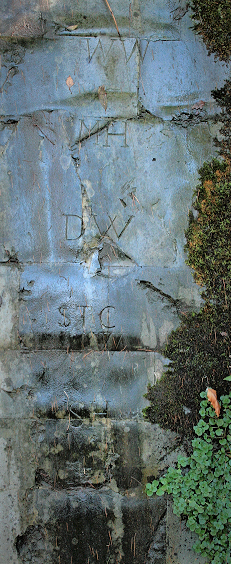
The Rock of Names
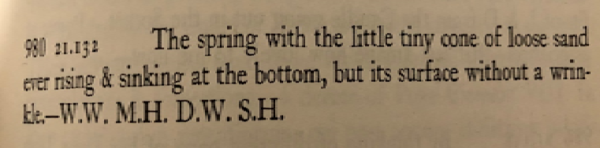
From Coleridge’s Collected Notebooks, Vol. I, 980 (September 1801)
Two images inform Newlyn’s work in dynamic counterpoint, and both are famous among scholars of Wordsworth and Coleridge. The first is the Rock of Names (shown above), in Cumbria; upon which five sets of initials, belonging to William Wordsworth, Mary Hutchinson, Dorothy Wordsworth, Samuel Taylor Coleridge, and Sara Hutchinson, respectively, were etched in the early nineteenth century. In some ways, in choosing to write sonnets, Newlyn has decided to embed her researches concerning this group of five Romantics (what John Worthen called ‘the Gang’ in his biography of the same name, and what they themselves called ‘the Concern’, and what Coleridge privately called enopentas—the ‘five in one’) in a kind of literary stone. While the sonnet form changes over time, like a rockface that has stood up to the wind and water of hundreds of years of authorship, it retains its basic shape while ever slightly yielding to repeated efforts to update or, perhaps, undo it. The second, an image from Coleridge’s notebook, entered shortly before the spring and summer months with which Vital Stream is chiefly concerned, is an image of water and motion that belies a rockiness, ‘its surface without a wrinkle’: the paradoxical nature of water currents, which can flow continuously at some unseen depth, while the surface remains unchanged. (Notice how Coleridge preserves the same order of initials as the Rock: WW, MH, DW, SH; only ‘STC’ is missing.)
Combine these images, I think, and we have a fairly natural way of talking about the formal powers of the sonnet sequence as its own, interlinked form. Whenever my father would ask me to paint something, usually while staying at an old seventeenth-century farmhouse in Casey County, Kentucky, which we were gradually repairing, he would mention that the way to get the clearest and best-looking paint was to paint something once, then do it again, and then again. In a way this is what Newlyn has done: only that the rock, as in ecological ‘deep time’ theory, begins to take on the dynamic features of water; the ‘dreamatis personae’ (as Coleridge once described the figures of his usually sinister dreams) of the Concern appear again and again as Newlyn paints one picture, then another, cleaving to the same formal elements while thematically we shift scenes and perspectives and move between outer- and inner-worlds. As the sequence progresses we encounter both the larger shifts that impact each person—William marries Mary; Coleridge pines for Asra; Dorothy mopes about the wedding; Mary (in the sonnet quoted above) attempts to fit into the Wordsworth household (‘For several years / Now he has lived alone with Dorothy; / It would be natural to have some fears’); William struggles to realize ‘A form of verse so like a drop of dew, / … it can imbue / Our thought with water’s clarity’—and the smaller, more personal ‘slice of life’ elements that make this a poetry also deeply concerned with what has in recent years been called life-writing. In that sense it is both poetical and biographical, and Newlyn draws on both her long research career and her own imagination to bring disparate texts and instances together into a vital and unified whole that is both pleasing and formally sophisticated.
Consider the collection’s 43rd sonnet, entitled ‘Coleridge, on Love and Friendship’:
‘W.W. M.H. D.W. S.H.’
Where has it gone, the feeling that was
Four loves mingled into one, a stream
Moving softly, whose perpetual flow
Was Life, not Change, so translucent
As not to be seen, its source always hidden
And murmuring of a shadowy world?
I am like a mother listening for the sound
Of a still-born child – or a blind Arab
Straining to hear steps in the wilderness.
Yet now a waterfall dances where a leaf
Is still attracted, still repelled, below.
My love for Asra is a spring, its tiny
Cone of loose sand ever rising and sinking
At the bottom, but without a wrinkle.
The poem’s first line fails to live up to any expectations we might have as readers about how the first line of a sonnet should sound. With the caesura created by the comma after ‘gone’, it is natural to read this as a tetrametric line. Yet, at this point, perhaps having read forty-two other sonnets previously, the reader will feel uncomfortable reading it as a caesural tetrameter line; yet the alternative is also disconcerting. As a pentameter line it is incomplete—like Coleridge’s notebook entry compared to the Rock of Names, which is missing its fifth set of initials, this line is missing its fifth foot. This is no accident. The next line is irregular as well: even allowing for a ‘headless’ line, what we experience is the ghost of a pentameter line rather than its realization. In fact the first six lines of the sonnet, being an inverted sestet (placed at the beginning of the poem rather than the end), struggle to recall the ‘flow’ of iambic, pentametric feel; the rhythm we have come to expect is gimped and displaced by commas, italics, and missing words. This is especially prevalent, I feel, in the sonnet’s sixth line, ‘And murmuring of a shadowy world’, where the words ‘murmuring’ and ‘shadowy’ scan as dactyls, and like what Coleridge called, in the ‘Dejection’ ode, ‘afflictions’ that ‘bow me down to earth’, are too ephemeral/unstressed (as both murmurs and shadows tend to be in reality) to prevent this line from collapsing too into an odd-feeling and unfulfilling tetrameter.
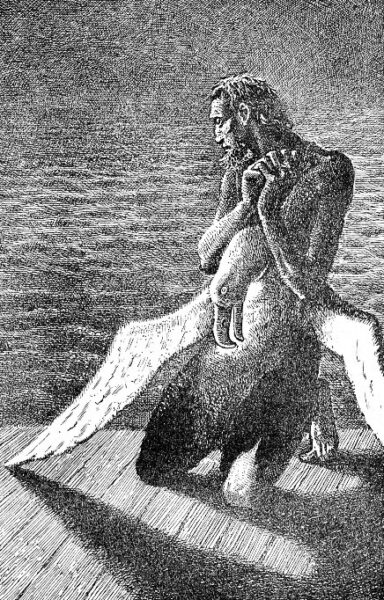
From Gustav Dore’s ‘Rime of the Ancient Mariner’ (1877)
In a sonnet that deals with loss, specifically Coleridge’s sense that he has lost his connection to WW, MH and the others, Newlyn’s conscious deviations from the sonnet’s expected pentameter serve as both a commentary on the subject matter, and as a kind of arbitrary—and yet not arbitrary—underpinning of the repeating form. Like water, there is always the possibility, one feels, that the meter will disappear, or go underground, and never return.
This sense of lost ‘power’, which is a power to return to what is ultimately abiding or vital, mirrors the concerns about Coleridge felt most of all by Dorothy Wordsworth, as in the later sonnet ‘Dorothy Dreams of Hardraw Scar’ (a poem that does not mention Coleridge, but which I believe represents his continued ‘life’ in Dorothy’s unconscious):
From the hard fells you carve your wayward course
And now in a single sudden chute you fall:
Noisy and fierce, a mighty thunderous force,
Releasing your pent power, your strength, your all
In this dark hollow where I stand confronted
By a huge cavernous and echoing wall
Scooped out around your form in sedimented
Layers of limestone, sandstone, shale.
No seedling could settle long enough here
To root itself, no climber find a stay
In the serrated sides which drop sheer
To the beck as it tumbles down the valley.
But I can walk beneath you, see you batter
The shining rocks below, or watch the way
You smash and in perpetual motion shatter
Your own reflection with dancing froth and spray.
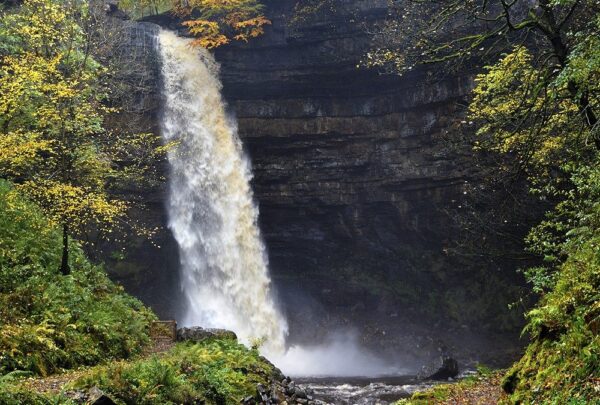
Hardraw Scar
Where a poem is more regular, the burden of readerly interpretation shifts to the side of what is far more comfortable: talking about (as Coleridge would say) what it means, what the language means rather than the versification. Of course, Newlyn’s handling of the form is such that the poem, like a mountain beck, bumps along into the feminine rhyme of ‘valley’ in line 12 with ‘stay’ in line 10 (a bump made more prominent by continuous one-syllable rhymes in ‘way’ and finally ‘spray’) before finally crashing into ‘reflection with’ in second position in the final line, where the meter rises up in a lively way to both cushion and augment the climactic image of the force crashing headlong into itself, as only moving bodies of water, some mythological beasts, and vulnerable narcissists can.
My ‘reading’ is that this is a sonnet about Coleridge in which he has been disguised as Hardraw Beck/Hardraw Force. This of course lends the sonnet overtones of a Freudian, repressed-forbidden-love element, which I would rather were not associated with the reading; but there is nothing to be done. As Alan Hankinson has pointed out in Coleridge Walks the Fells, Coleridge was the first, and the only man of his time, to ‘[walk] over and among the high fells, alone … for the sheer fun of it’ (18). He went walking through the highest places in the Lake District in August of 1802, writing long descriptive letters of his journey to Sara Hutchinson, who would have talked of them or shown them to Dorothy. As he tended to release his mental and spiritual force in dark hollows, in his private notebooks, or in his conversation with friends, Dorothy may have, in her gloomier moments, felt that her life with William, which was in some ways coming to an end, and which would soon exclude Coleridge (or from which he would exclude himself) had become a dark hollow, too. But in this sonnet she identifies that Coleridge’s interpersonal problems are largely self-caused: the tumbling force, coming down from on high, continually breaks apart its own reflection, lashing out to investigate, sometimes to undermine, an external world that is ultimately only a tributary of what Coleridge describes in ‘The Eolian Harp’ as the ‘one Life within us and abroad’.
There is so much more to be said about Vital Stream—so many poems I have not touched upon; and so many aspects of those I have, which are still lying in wait to be fully understood. It is my hope that this book will be widely read by people who are still to be fascinated by the inner-workings of formal poetry, as well as appreciated by students of this period and these writers. In revisiting this book I have only become yet more interested in exploring it, and in that sense it is like the best of the English landscapes that inspired its principal personae.
Works Cited
Coleridge, Samuel Taylor. Collected Notebooks of Samuel Taylor Coleridge, Vol. I (1794-1804).
Ed. Kathleen Coburn, Bollingen Foundation, 1957.
Hankinson, Alan. Coleridge Walks the Fells. Ellenbank Press, 1991.
Woods, Susanne. Natural Emphasis. The Huntington Library, 1985.
Adam Neikirk is a PhD Candidate in Creative Writing at the University of Essex. His creative dissertation comprises a long poem about the life and thought of Samuel Taylor Coleridge, written largely in blank verse. He has been published in the Coleridge Bulletin and the pedagogic journal Teaching Philosophy, and is the author of a collection of poems called Songs for the Dead (2016). Follow him on twitter @tweets4thedead.


