


by Andrew Wordsworth
“Of this be assured, that I shall never go from home for any time again, without a female companion”, wrote Wordsworth to his daughter Dora in 1837 – (he was in Florence at the time, while on a tour of Italy). Throughout his adult life Wordsworth relied heavily on the company and affection of women. He couldn’t manage without their helpful and reassuring presence, yet he had no clear place for them in the poetry he wrote, which projected an image of himself as a solitary person.
The women of the Wordsworth household remained discreetly in the background of the poems he wrote, yet the elaboration of the texts – the endless copying and revision of manuscripts, followed by the production of a final version for publication – was almost invariably carried out by those same women. Dorothy, William’s sister, was always present and ready to help; and once William married, his wife Mary also participated. Sara, Mary’s unmarried sister, came to live with the Wordsworths, and joined the team; and once William’s daughter Dora was of an age to lend a hand, she was included in the group.
The secretarial work was dealt with like the normal domestic tasks – cooking, cleaning, washing and so on – that made up the daily lives of these women. Wordsworth took no part in any of this – though he occasionally wielded a spade in the garden, or chopped wood. His sole responsibility was to compose poetry. But whether or not he was feeling inspired and productive, Wordsworth was invariably accompanied by one or more women who saw to it that his life was as pleasant and comfortable as possible.

A silhouette of Mary Wordsworth (left) and portrait of Dora Wordsworth (right); map of the area around Grasmere, from the 1950s. In the Poems on the Naming of Places (mostly written in 1800), Wordsworth ascribed different places in the local landscape to the people he was most fond of.
It had been so different when he was young! Wordsworth’s adolescence and university years were spent in an all-male environment. His mother had died of tuberculosis when he was just eight; and following her death Dorothy was sent to live with relatives in Halifax, while the following year William and his three brothers were sent to boarding school at Hawkshead. His early work shows that he missed the “harmony / Home-felt and home-created” of normal family life; and in his first long poem, An Evening Walk, written while still in his teens, he turned to the natural world for the images of ‘tender Cares and mild domestic Loves’ that were lacking in his own life at this time. So, for example, he watched admiringly the farmyard cock surrounded by his hens:
Sweetly ferocious round his native walks,
Gazed by his sister-wives, the monarch stalks.
One feels that the adolescent Wordsworth rather fancied the idea of being surrounded by females; at any rate in middle age he had organised himself so well in this respect that Coleridge spoke enviously of ‘Wordsworth’s harem’. But when one thinks of William’s relationship with his sister Dorothy, the term ‘sister-wives’ raises the possibility of other connotations. An Evening Walk was dedicated to her, and the closeness of their relationship soon became evident to all. In 1795 they decided to live together, and they maintained this arrangement continuously until William’s death in 1850. In 1799 they set up house in Grasmere, and lived in many respects as a couple until William’s marriage to Mary three years later. They shared everything, and their long daily walks together gave them the opportunity to develop a dialogue which was remarkably rich and intense, both at an emotional and intellectual level.
From a literary point of view this aspect of Wordsworth’s life has gained enormously from the existence of Dorothy’s Grasmere Journal – not only because of the insights that it offers into life at Dove Cottage, but because Dorothy’s prose writing offers a wonderful counterpoint to William’s poetry. The difference though is not only formal: Dorothy’s attention when she observes and writes moves continually outwards, engaging with the outside world on its own terms, while her brother instinctively interiorised all that he experienced. And thanks to her ability to empathise with others, Dorothy offers us a portrait of her beloved brother that no one else could have attempted. As Pamela Woof says in her introduction to the Oxford edition of the Journal,
There is simply nothing like it anywhere else. This Journal calls out to us directly across some two hundred years, and its writer and her world come alive.
Yet even though we get a vivid sense from the Journal of Dorothy’s character, many aspects of her personality – her dreams, her expectations and aspirations – remain undefined, as she constantly moved in the shadow of her brother. Indeed, the only physical images we have of her as a young woman are a silhouette, and a sketch of the top half of her head. Like Mary, William’s wife, Dorothy remained in the background, discreet, in some ways barely visible.
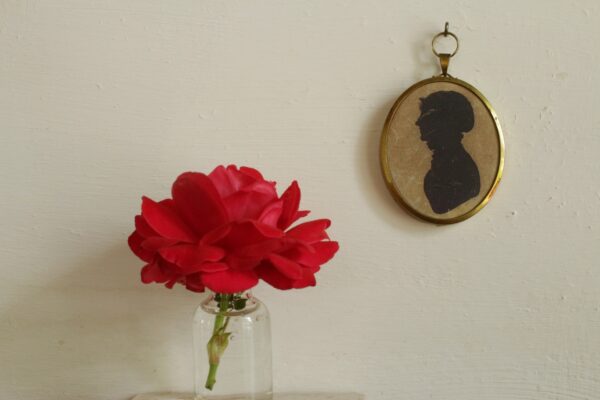
Silhouette portrait of Dorothy
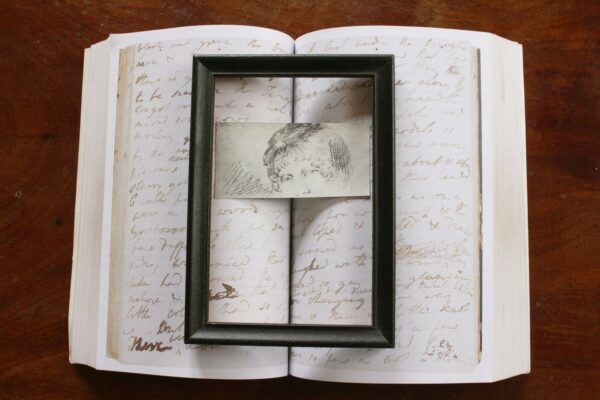
An unfinished sketch of Dorothy, and pages of her journal describing the daffodils on the shore of Ullswater
One of the stranger roles that Dorothy accepted was to be a kind of go-between in William’s relationship with Annette Vallon, his former French lover. Having fathered a child with Annette during the French Revolution, William was prevented from keeping up a contact with mother and daughter because of the war between France and England, which broke out in 1793 and lasted more than twenty years. Correspondence between the two countries was officially censored, but a few letters got through, and from these it is clear that Annette wanted Dorothy to intercede on her behalf, and to persuade William to respect the commitment to their relationship, and to his (illegitimate) daughter Caroline. Likewise it is clear from entries in Dorothy’s journals, that she wrote to Annette, both in person and on William’s behalf. One has the impression that she used her gender to facilitate communication between her brother and Annette; and similarly she was always on good terms with Mary, who William married in 1802. Dorothy’s ability to engage with the other women who had an emotional claim on her brother’s affections, even when it must have been difficult or painful for her, was remarkable.
It is hard to evaluate the significance for William of his affair with Annette. The war between England and France effectively terminated the relationship; and when, nine years later, he married an English woman who he had known since childhood, it became all too easy to sideline Wordsworth’s French adventure, and consider it as little more than a youthful error. And the fact that he kept the whole episode as secret as possible has led to the relationship with Annette being consigned to an unimportant place in the family archives. Nonetheless, the poems that Wordsworth wrote in the 1790s, with their half-crazed single mothers, and abandoned widows unable to feed their children, suggest that Annette and Caroline remained very much on his mind. He continued to worry about them and feel guilty for what he had (and had not) done, and the memories and the scars stayed with him for the rest of his life.
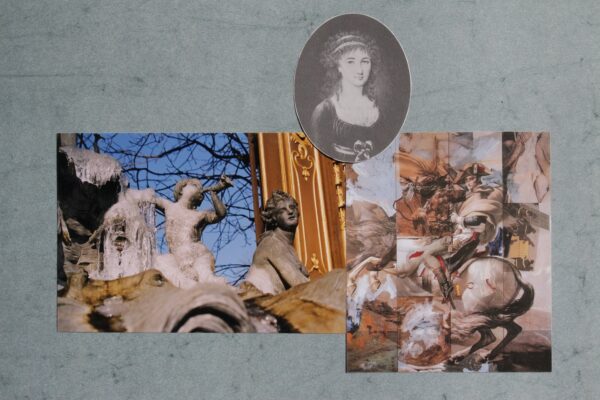
A miniature portrait of Annette Vallon; place Stanislas, Nancy, France, in winter; David’s painting of Napoleon crossing the Alps, as re-interpreted by Robert Rauschenberg
For obvious reasons Wordsworth needed to close his relationship with Annette before marrying Mary, but in general he did all he could to keep the women he was fond of close to him. This was particularly evident in the case of his daughter Dora. Once she reached a marriageable age, suitable suitors were sent packing (by her father); and it was only with extreme reluctance that Wordsworth allowed her to marry at the age of thirty-six. His possessive attitude towards Dora was no doubt linked to her forthright and intelligent character, and to the real interest that she showed in his work: for Wordsworth saw that he could have the same kind of dialogue with his daughter as he enjoyed with Dorothy. And when Dorothy at the age of sixty-three suffered a mental collapse from which she never recovered, Dora was able – up to a point – to take Dorothy’s place in Wordsworth’s life.

A paperweight, and page from The Prelude describing the ascent of Snowdon
Wordsworth’s relations with women were complex. His need for constant female company was evident (and could perhaps stem in part from having lost his mother at the age of eight), but has often been overlooked because he tended to write about himself as if he was alone (‘I wandered lonely as a cloud’ being a good example – the poem was in fact based on a walk that he and Dorothy had taken together). If one were to take the message of Wordsworth’s poems at face value, one would think of him as a resolutely independent man; but the facts of his life suggest a different, and more intriguing, story.
Andrew Wordsworth is a great-great-great-great nephew of the poet. His book, Well-Kept Secrets, the story of William Wordsworth, published by Pallas Athene, came out last month.


