


by Fred Blick
Fingal’s Cave is on the Scottish island of Staffa. It is 72 feet tall and 270 feet deep. It is an extraordinary demonstration of the power of Nature, and was a favourite haunt of Romantic artists of all disciplines in the 19th century. It might be described as an emblem of their search for the ‘sublime’.
The cave first came to cultural prominence thanks to (Sir) Joseph Banks, who included it in his 1772 Journal of Travel, and it also appeared in Thomas Pennant’s A Tour of Scotland and Voyage to The Hebrides, published in 1774. In the late summer of 1772, just a year or so after his return from exploring the Pacific with Captain Cook, Joseph Banks mounted his own expedition to Iceland via the Hebrides.
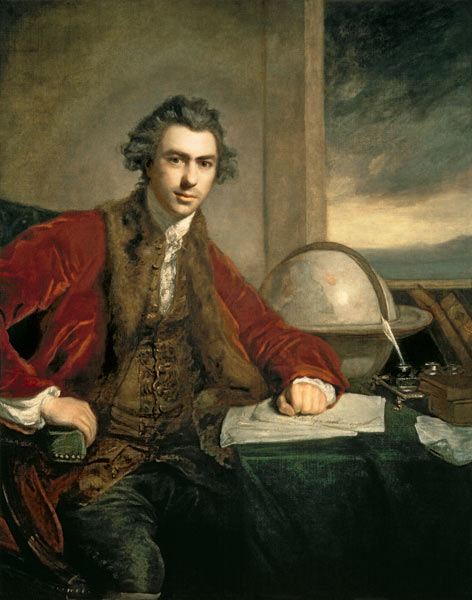
Sir Joseph Banks, by Sir Joshua Reynolds
On 13th August 1772, Banks and his party, including the artist James Miller, explored, measured, and drew Staffa. The Journal of Travel contained a detailed description of Fingal’s Cave and referred to it as “the most magnificent …. that has ever been described by travellers”. A flood of visits ensued from tourists. They had probably seen the below engraving of Millar’s own drawing. It shows three people on a small boat in the entrance with two others looking on, possibly measuring its dimensions.
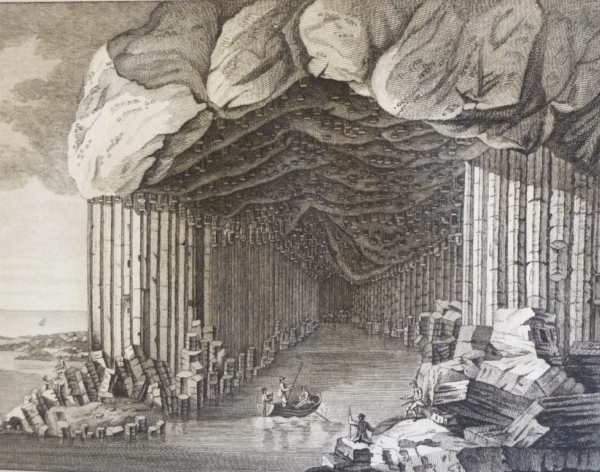
‘Fingal’s Cave in Staffa’: engraving by Thomas Major, based on a drawing by James Miller, 1772
JMW Turner made a painting of the cave to illustrate a book of poems by Sir Walter Scott. Turner shows Fingal’s Cave on the left of his work, with smoke billowing towards it from a tourist steamer.
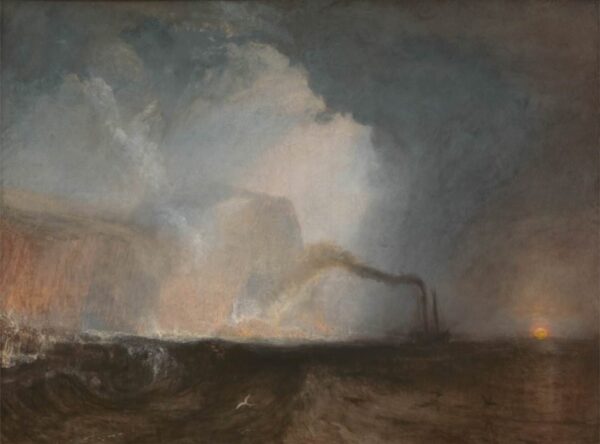
Fingal’s Cave, by JMW Turner
The interior of the cave is penetrated by the sun very rarely, probably only once a year. The atmosphere inside evokes the spirituality and musicality of a church or cathedral due to its shape and to the suggestion of organ pipes brought about by the basalt vertical columns. These look like organ pipes, although square in section instead of round. This church-like, musical and spiritual impression is commented upon by a number of the eminent visitors mentioned below.
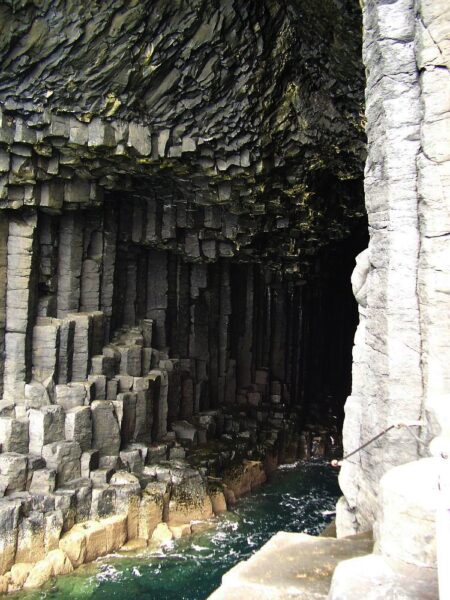
Basalt columns in the cave
Walter Scott described entering the cave in 1814 as “one of the most spectacular places he ever set foot”. He admired its grandiose pillars as “miraculous, marble-like structures that stood firmly embracing the deep, fierce sea”.
He also noted, ”The stupendous columnar side walls—the depth and strength of the ocean with which the cavern is filled—the variety of tints formed by stalactites dropping and petrifying between the pillars, and resembling a sort of chasing of yellow or cream-coloured marble filling the interstices of the roof—the corresponding variety below, where the ocean rolls over a red, and in some places, a violet-coloured rock, the basis of the basaltic pillars—the dreadful noise of those august billows so well corresponding with the grandeur of the scene—are all circumstances elsewhere unparalleled.”
In the summer of 1818, John Keats and his friend, Charles Armitage Brown, headed north to Scotland on a walking tour to visit Burns country and the rugged Romantic landscape beyond. One destination of his tour, Staffa and Fingal’s Cave, already had a well-established reputation by that time. Keats would have seen illustrations following Banks’ publicity.
As to Keats’s state of mind at the time of the tour, he had already begun to fear the possibility of an early death from tuberculosis. In March 1810, when Keats was 14, his mother had died of tuberculosis. His brother Tom was dying from the disease in 1818 and John nursed Tom on his death-bed upon returning from his Scottish tour. With his medical knowledge, he must have known there was a strong possibility he would face the same fate.
With Charles Armitage Brown, Keats undertook the perilous journey to Staffa in a small boat, the only way he could afford. The experience was later recounted by him in the poem ‘Staffa’, in which he describes Fingal’s cave as “This Cathedral of the Sea”:
…. This was architectur’d thus
By the great Oceanus!–
Here his mighty waters play
Hollow organs all the day;
Here by turns his dolphins all,
Finny palmers great and small,
Come to pay devotion due–
Each a mouth of pearls must strew.
Many a mortal of these days,
Dares to pass our sacred ways,
Dares to touch audaciously
This Cathedral of the Sea
Keats senses a music in the “Hollow organs” suggested by the basalt pillars.
In 1819 a 16-year-old girl, Lucy Copland, wrote a diary recording her impressions of a tour which included Staffa and Fingal’s Cave:
Sunday 29th Augt
We …. took a boat at seven o’clock & sailed to Staffa in two hours the wind being quite favourable; on arriving we were much struck with the great beauty of this natural curiosity, the islands near Ulva I must describe are all of a basaltic nature but the pillars of Staffa are much finer: this is this island is about 3 quarters of a mile in length and covered at the top with grass; when we landed we walked on the top of the columns to Fingal’s Cave I was much struck with it the sea goes in a considerable distance through a narrow chasm covered with large basaltic pillars: I think it is out of my power to describe in any way this great curiosity & after passing some time here we ascended on the tops of the columns which from their irregularity form a kind of staircase to the summit of the island we took some refreshment; we then did intend to go to Iona but the wind being directly against us we returned to Aross where we slept.
The most famous Romantic work evoking Fingal’s Cave is the wonderful Hebrides/ Fingal’s Cave overture composed by Felix Mendelssohn (1809 –1847).
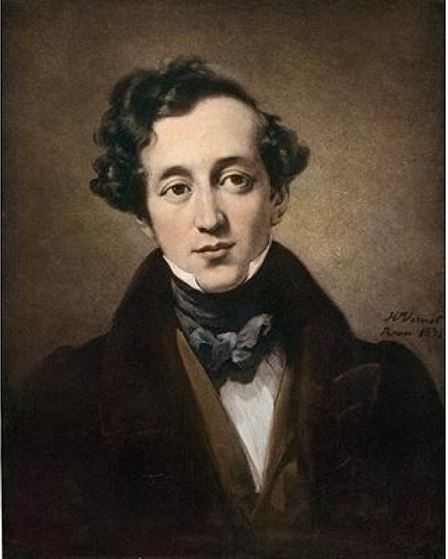
Felix Mendelssohn aged 22, by Horace Vernet, 1831
After seeing the cave in summer 1829, when he was 20 years old, he immediately started writing the overture and completed it the following year. He wrote, then and there, to his sister Fanny, “In order to make you understand how extraordinarily the Hebrides affected me, I send you the following, which came into my head there.” The note included the opening phrase of what would become the full overture.
Mendelssohn’s friend, Karl Klingemann, who accompanied him on the tour, was at that time working as a German diplomat in London, as London legation secretary. He had known the Mendelssohn family for many years. Mendelssohn wrote to him: “ Next August (ie, 1829) I am going to Scotland with a rake for folksongs, an ear for the lovely fragrant countryside, and a heart for the bare legs of the natives. Klingemann, you must join me …. and fly to Scotland”. So, once plans had been put in place, Klingemann accompanied Mendelssohn and the composer’s 82 year old mother on his Scottish tour of 1829 including the visit to Fingal’s Cave. Of the visit Klingemann records:
…. Also there sat (Mendelssohn’s mother) placidly by the steam-engine, warming herself in the cold wind, a woman of two-and-eighty. That woman has six times touched me and seven times irritated me. She wanted to see Staffa; before her end. Staffa, with its strange basalt pillars and caverns, is in all picture-books. We were put out in boats and lifted by the hissing sea up the pillar stumps to the celebrated Fingal’s Cave. A greener roar of waves surely never rushed into a stranger cavern — its many pillars making it look like the inside of an immense organ, black and resounding, and absolutely without purpose, and quite alone, the wide grey sea within and without. There the old woman scrambled about laboriously, close to the water: she wanted to see the cave of Staffa; before her end, and she saw it. …. The two-and-eighty-years-old woman was also in the boat trembling, the boat went up and down, with difficulty she was lifted out — but she had seen Staffa; before her end.

Karl Klingemann, miniature by August Grahl
Wordsworth made his visit to the cave in the summer of 1833, four years after his sister Dorothy had fallen seriously ill. From then on she was an invalid, with periods of recovery but frequent relapses. Coleridge, who was incurably addicted to opium, would prove to be only two years away from his own death, Sir Walter Scott, another of Wordsworth’s friends, had died in 1832, and Wordsworth himself had begun to be much more conscious of his own mortality. Like Mendelssohn’s mother, many of Wordsworth’s contemporaries wanted to see the glories of the Cave before they died, and by the time Wordsworth made his own visit he was 63, and making almost frantic trips across the British Isles as if sensing his own ‘end of days’.
Wordsworth visited Fingal’s Cave accompanied by his friend Henry Crabb Robinson, (who said he was bored by rocks altogether). Wordsworth also came away unimpressed, at least initially, but this was mainly due to the crowds of tourists. Undeterred, however, he turned back while the boat waited for him, saying later “At the risk of incurring the reasonable displeasure of the master of the steamboat, I returned to the cave and explored it under circumstance more favourable to those imaginative impressions which it is so wonderfully fitted to make upon the mind”. With these “imaginative impressions” still in mind he wrote his ‘Cave of Staffa sonnets’, including the following:
We saw, but surely, in the motley crowd,
Not One of us has felt the far-famed sight;
How ‘could’ we feel it? each the other’s blight,
Hurried and hurrying, volatile and loud.
O for those motions only that invite
The Ghost of Fingal to his tuneful Cave
By the breeze entered, and wave after wave
Softly embosoming the timid light!
And by ‘one’ Votary who at will might stand
Gazing and take into his mind and heart,
With undistracted reverence, the effect
Of those proportions where the almighty hand
That made the worlds, the sovereign Architect,
Has deigned to work as if with human Art!
Interestingly, Wordsworth made the same “tuneful” musical connection with the cave as did Keats, Mendelssohn and Klingemann. The latter thought it was “like the inside of an immense organ”. One can understand why. However, as we have seen, Scott heard it more prosaically as a “dreadful noise”.
Fingal’s Cave continues to attract visitors up to the present day for the same reasons that it has always done – the human search for the incomprehensible and sublime, and for the spiritual otherness of spaces that exist beyond ordinary human experience – for a kind of music of the spheres as sensed by Pythagoras.
Fred Blick is an independent scholar from a multi-disciplinary background. He has published a number of essays over the past twenty five years, including “Wordsworth’s Dark Joke in ‘The Barberry-Tree’ in Romanticism journal, October 2014, and essays on the sonnets of William Shakespeare and Edmund Spenser.


Great article! Thank you! No wonder the Romantic poets, composers and artists were entranced by Fingal’s Cave – it truly is awe-inspiring!